If you do
NOT see the Table of Contents frame to the left of this page, then
Click here to open 'USArmyGermany'
frameset |
Giessen
Army Depot
Theater Army Support Command
Looking for more information from military/civilian
personnel assigned to or associated with the U.S. Army
in Germany from 1945 to 1989. If you have any
stories or thoughts on the subject, please contact me . .
|
|
|
|
|
|
| Depot
History |
|
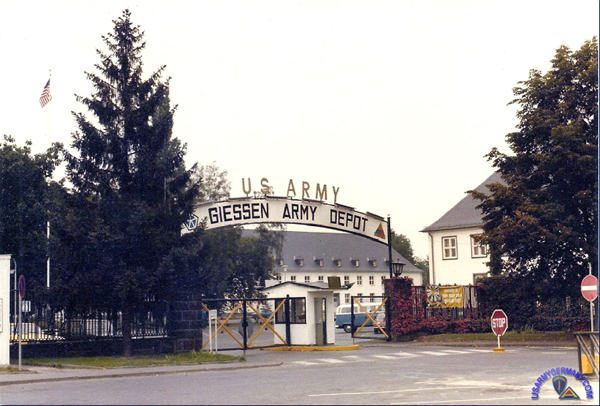
Giessen Army Depot, late 1970s (Wayne Mineard) |
|
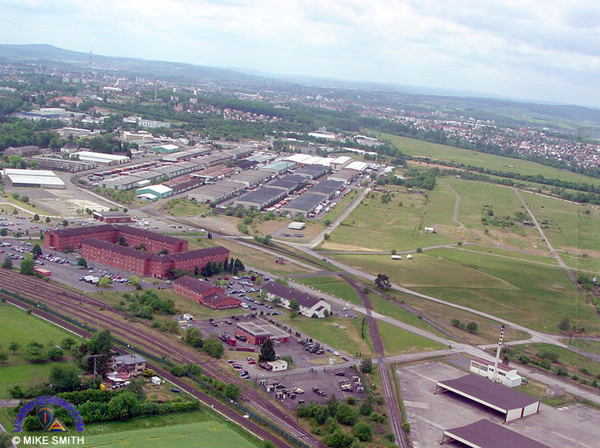
Giessen Army Depot (Mike Smith) |
| |
| Giessen Quartermater Depot |
|
| 1954 |
| (Source: STARS & STRIPES, June 19 1954) |
The Giessen Quartermaster Depot recently celebrated its ninth birthday here.
The sprawling depot, currently commanded by Col Mark A. Smith, covers nearly 500 acres with 119 buildings and 1,500 storage locations.
As the European Theater's "wholesalers," the depot provides the large quantities of supplies needed by "retailers" such as the quartermasters of the various area commands. |
|
|
| 1955 |
| (Source: STARS & STRIPES, Jan 6 1955) |
Maintenance Division, Giessen QM Depot
The depot's Maintenance Division is responsible for the repair and rehabilitation of nine main types of items, ranging from office appliances to huge forklifts and cranes. The division also takes on special projects, such as the complete rehabilitation of a mobile parachute drying chamber and has reconditioned three cemetery rail cars for the USAREUR Mortuary Service.
The value of the QM items reconditioned each month by the maintenance division averages more than $500,000. During the past 18 months, items valued at more than $10 million have been repaired at a cost of $1,694,169.00 or 17 percent of their acquisition cost. (Rebuilding is considered economically feasible if it does not exceed 35 percent of value.)
The maintenance division at Giessen QM Depot is considered to be the only QM depot maintenance division in Europe that meets Stateside standards.
The maintenance division began operations in 1948 and currently has a personnel strength of 500.
All maintenance operations are carried out at the Giessen Depot. Equipment that is worked on includes:
  special purpose vehicles such as mobile laundries and field shower units special purpose vehicles such as mobile laundries and field shower units
special purpose equipment for those vehicles
static laundry equipment
kitchen and refrigeration equipment
canvas and tentage
metal and wood items (such as scales, safes and sewing machines)
In addition, the division excercises technical staff supervision over the Quartermaster Air Item Repair installation at Coleman Barracks (Mannheim-Sandhofen).
Another field the division is involved with is the modification of materials handling equipment. One modification entails the addition of an adjustable spotlight, a tail light and a stop light that allows the equipment to be used after dark or in dimly lit warehouses.
The division's Shop Supply Branch procures and issues about 10,000 line items a month for the Repair Branch.
Another example for the versatility of the division's operations is the semi-annual complete overhaul of an experimental mobile can and drum reclamation plant. At full capacity, this aparatus can refurbish completely, inside and out, 800 five-gallon gasoline containers in an 8-hour shift. (This equipment saves transportation costs that would be incurred in shipping cans to a static plant.)
CO of the Giessen QM Depot is Col Mark A. H. Smith. Under his direction all maintenance operations have been centralized at Giessen. This has resulted in an almost 50 percent reduction in manpower requirements,
Chief of the Maint Div is Maj Peter J. Gumaskas.
Capt Peter E. Burns is the officer-in-charge (OIC) at Mannheim.
Quartermaster Parachute Maintenance & Packing Detachment, Mannheim
The Mannheim detachment repairs or rebuilds personnel and cargo chutes. All members are graduate riggers and they adhere strictly to the "riggers' code" - they periodically test jump the chutes that they have inspected, repaired and repacked.
The unit was activated in July 1953. Since then they have repaired or rebuilt aerial delivery equipment valued at $1.5 million.
Mobile Refrigeration Repair Teams
The division has two mobile refrigeration repair teams that are sent out into the field. Each is equipped with a complete repair shop on wheels, and they can repair or install many types of commecial refrigeration equipment in use by the US Army in Europe. |
|
|
| |
| Giessen Quartermater Supply Center |
|
| 1958 |
| (Source: STARS & STRIPES, Sep 8 1958) |
Streamlined Quartermaster Cornucopia
Army installations from Scandinavia to North Africa are served by big supply center at Giessen, Germany
By THURSTON MACAULEY, Staff Writer
THANKS TO A NEW streamlining of Quartermaster Corps operations in Europe, the Army today is uniforming its men, supplying messhalls, commissaries and gas stations, and furnishing offices and living quarters 3,000 and more miles from home, better, more efficiently and at less cost to Uncle Sam.
The brains of these far-flung operations, which range from Scandinavia to North Africa, are at Giessen, Germany, where last July 1 three major QM agencies in Europe were merged into the newly designated U.S. Army Quartermaster Supply Center.
The agencies were the Giessen QM Depot, Giessen QM Supply and Accounting Center, and Frankfurt QM Market Center.
Just as the Army itself went pentomic for the nuclear era, so QM services underwent drastic revision In keeping with aims for increased efficiency. Under the reorganization, the same QM operations are now being carried out by 821 fewer persons, representing a saving of $1.7 million in annual salaries and wages.
The Giessen center is within the command of Mai Gen Edward J. O'Neill, Com Z CG, with its headquarters reporting to Col Robert C. Kyser, Com Z Quartermaster In France.
Commanding officer at Giessen is 43-year-old Col Joseph S. Kujawski, former Giessen Depot CO.
A West Pointer, class of '38, Kujawski has had a distinguished record in QM Corps dating from 1940. Serving in the Pacific in World War II as G4, Hq Middle Pacific, his assignment entailed QM planning for the Iwo Jima, Mariannas, Leyte and Okinawa operations.
Kujawski's Giessen bailiwick -- "a little bigger than the principality of Monaco," according to him -- covers 474 acres, with 26 warehouses having 1,464,000 square feet of storage space, and 928,000 square feet more in the open. Center personnel number more than 2,000.
Kujawski' s deputy is Col Maxwell B. Fogarty, who is also chief of the Center's supply division. Other key men at Giessen include Lt Col John A. Ford, subsistence; Lt Col Harlan W. Hendricks, in charge of clothing and textiles; Lt Col Henry G. Challen, general supplies; Lt Col William S. Brown, maintenance; Lt Col Robert E. A. Richert, comptroller.
QM cold storage facilities presently provide a total of 1,588,064 cubic feet in Bremerhaven, Paris, Munich, Mannheim and Frankfurt, but a new cold storage plant is now being built at Kaiserslautern. It will have about 1.3 million cubic feet of storage space and will replace facilities at Munich, Frankfurt and Mannheim.
Every one of the thousands of QM items needed by U.S. forces overseas is under direct control of the Giessen center.
The storage division receives, checks and stores incoming supplies, then ships them throughout Europe as needed.
Field representatives insure that troops and dependents have fresh meat, milk, fruits and vegetables that meet strict health and sanitation requirements.
The center's maintenance division repairs or rebuilds QM equipment for return to users or command stocks. Items repaired or rebuilt include all kinds of mechanical equipment and furniture and office appliances.
In a special laboratory, quality of clothing for uniforms is rigorously tested by experts.
"Besides supplying our Army commissaries throughout Europe, we also supply the Air Force commissaries in Germany and France," Kujawski said. "In England, however, the Air Force does the job for its commissaries there.
"By combining our major operations at Giessen, we can operate more efficiently by having everything side by side. Besides manpower savings we are also cutting down on long distance telephone calls.
"Our primary mission is to support the combat-readiness of our 7th Army here."
The Giessen commander said QM surveys are made twice yearly to determine what commissary customers want and compare these preferences with items in stock so additional supplies can be ordered from the U.S.
The Quartermaster Corps does the purchasing for all services to eliminate overstocking in any one branch, he added. Subsistence purchases are made through a central office in Chicago, clothing and textiles in Philadelphia, and general supplies in Richmond, Va.
Shortly after the end of the war, the 56th QM Base Depot came to Giessen. Besides its wartime support of U.S. operations, the 56th helped in the 1948-49 Berlin Airlift, and sent relief for victims of the Po River floods in Italy in 1952 and of the Holland floods the following year.
Today the Giessen QM center is playing an important part in the NATO defense of the free world. |
|
|
|
| 1960 |
| (Source: Email from Cuck Erickson) |
I was stationed at the Giessen Quartermaster Depot for 1 year 9 months (1960 - 1962), assigned to the AG Corps Personnel Division. CWO Carver was our Personnel Officer, Colonel Charles Shaunessey was Commander and I worked in the Payroll section. I paid few hundred personnel located around USAREUR. It was an easy job, and left plenty of time to take leave. I especially liked the fact that I could take a day's leave, and get a day of travel before, and a day of travel after. That meant three for one, and when you got 30 days leave a year, you could have quite a lot of time off.
The barracks we lived in were old two story German officer quarters in good condition. We were a combination of personnel from Finance, Personnel, and Unit Police. There may have been others, but I don't recall. What I remember most about the facility were the beautiful wood floors in the rooms. I was quartered with a spit and polish Staff Sergeant who was a great guy but loved to keep the floor unbelievably polished. We never wore shoes/boots on the floor (except for inspections). We used razor blades to clean any spots of dirt off the floor, polished it profusely and the shine was the most impressive in the building. Our inspections always went flawlessly. Needless to say, that Sergeant instilled in me the desire
to always look and be my best. I was even selected as Soldier of the Month, one month.
I was able to get my wife over to Germany with our new daughter a few months after I arrived. I moved off base and rented an apartment in a local German home. It was very nice living on the economy. I bought an old 1953 Studebaker, and then bought another one. One had a good engine, the other had a good transmission. I combined them into one good car, left a terrible oil spill on the driveway of the German landlord, tried to clean it up,
but my landlord never forgave me for ruining his driveway - I don't blame him. Most Germans were unbelieveably meticulous about their homes.
That old Studebaker worked pretty well and I drove it all around Germany, including a trip to Paris with my wife and child. It was a trip of a lifetime, through the Loire Valley, the Chateaus, Versailles, and Paris. I still remember it well.
Eventually, dependents were sent home due to Cold War concerns, and I moved back onto base.
Going to Mainz for Fasching was an annual event around Easter that I loved. Lots of us would take road trips there and party with everyone. Lots of parades, women, wine, beer, and of course good food. Seems like we did a lot of partying at the depot.
I had several part time jobs after duty hours. The first one was as a driver for a female Warrant Officer. She had a beautiful new Mercury and I had
permission to use it any time. She paid me $1.00 a day to drive her, and her friend, a female Nurse Major, on weekend trips. Of course, she also
paid my expenses when we were on the road. It was quite a pleasant arrangement. Had I not been such a dingbat at the time, the job would have
lasted longer than it did, but one night after stopping at a local lover's lane, the car became stuck in the mud and I had to leave it in there stuck in the
mud. I was going to retrieve it the next day, but the MP's discovered it there and who it belonged to, and shortly thereafter, I lost the job.
Another great part time job I had was across the street from the depot at the Giessen Civillian and Officers Open Mess (GOCOM). A friend told me they were looking for a bartender. I thought that would be a fun job, so I applied and surprisingly got the job -- I had never tended bar before. There
was a Capain in charge of the club, a Sergeant who drank too much and ran the club, and a beautiful German blonde (whose name I don't
remember) that also tended bar and tried her best to keep the Sergeant out of trouble. One of the nights the Sergeant had too much to drink, became a little violent and we had to call the MP's in to calm him down.
It was a fun and exciting place to work. I used to pride myself upon seeing one of the regulars come in the door to the bar, that I would have their drink waiting for them by the time they got to the bar. I heard lots of great stories from officers and civilian depot employees at that bar. I especially liked the promotion parties. Many times when an Officers made rank they would throw a party at the club. We would mix the dirinks, make lots of tips, and have a lot of fun. The dollar was worth much more at the time. The exchange rate was like four marks to a dollar. I remember you could buy a beer for a nickel. My how times have changed.
The cold war was upon us at that time, the Berlin wall had not gone up yet, and I was fortunate to take a trip to Berlin and see the city, both East and West. Going to Berlin from Giessen meant you had to cross through East Germany and of course the East German soldiers checked our papers thoroughly and made us feel quite anxious. Crossing over into East Berlin was easy at that time, we were on a tour bus, and going through the
Brandenburg gate was without event. The city seemed cold and granite. Cars were few, and it seemed that we were transformed to everything in black and white, instead of color as in West Berlin. It wasn't long after that trip when the water cannon matches started in Berlin and then they started construction of the wall around August 1961.
My experience at the depot was one I will always remember, Hopefully others will tell us their stories.
|
|
|
|
| 1970 |
(Source: STARS &STRIPES, July 1, 1970)
|
The 56th Quartermaster Base Depot arrived at the German air base at Giessen in June of 1945.
Of the 51 buildings on the air base, only 8 were still in good condition. Of the remainder, 28 buildings required extensive construction or repair and 15 were completely destroyed.
In 1970, there are over 250 structures of various types located on the Giessen Armt Depot (524-acres in size). Enclosed within the 5-mile long perimeter fence are 16 miles of railway and 24 miles of surfaced road. A marshalling yard within the depot has a capacity of 260 rail cars.
The Depot today serves as a major EES supply depot which has the mission of receiving, storing and issuing brand-name non-perishable food items to 79 commissaries throughout Europe. The supplies are received from the US in sea containers - nearly 17,000 containers were received in 1967.
Col James M. Staigers is CO of Giessen Army Depot and Col Robert F. Higgens is CO of the EES Depot at Giessen. |
|
|
|
| If you have more
information on the history or organization of the Giessen Army Depot,
please contact me. |
|
| |
| 1990 |
| (Source: Giessen
Courier (Giessen MILCOM newspaper), August 15, 1990) |
Planes, trains,
automobiles - 45 years and still moving
By Anthony Reed
Giessen Courier staff |
|
|
|
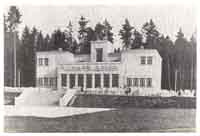
Even
with the finest compass and map, it would be difficult
to locate the pictured airport in Giessen today, yet this
structure, the oldest building on the Giessen Army Depot,
still stands.
In 1935, it was the home of the cafeteria, post office
and reception/departure place for the Lufthansa Airport-Giessen.
The runway reached to the front door of the building.
In 1945 it became the Depot Transportation Office - "the
Spearhead of Logistics." |
|
|
The Transportation Division in the Giessen Military Community, perhaps Giessen's most important historical site, is celebrating its 45th Anniversary with "the U.S. Army Transportation Organization Day" on August 24 within the depot in front of building 119.
"This celebration is supposed to be a surprise for me," revealed the Chief of Transportation Division and Director of Logistics, Hans Koeler. "It was done behind my back."
Assistant Transportation Officer, Rolf D. Schneidmueller and his cohorts are finding it difficult to keep the celebration from the man who, from his own acknowledgement, "opened up the depot in 1945."
"I never did anything else but transportation," Koeler said. "I started as an interpreter, helping the Germans and Americans understand each other. I went from an interpreter to manager," he said.
According to Koeler, transportation was the backbone of the Army during World War II. "You couldn't move food, POL or bullets to the front line without transportation," he said.
In 1945, after the war, the EUCOM Quartermaster Depot began operations. "The transportation office was located at the railroad station in a small building with railcars serving as extra offices;" Koeler revealed.
"We were the main U.S. Quartermaster Depot in all of Europe," he added. Transportation's responsibities included maintaining Class I through IV items such as food, ammunition, etc.
Giessen Depot became the largest transpottation facility in Europe in 1946 when many Italian and French depots were closed. Trainloads of coffee, flour, POL, sugar, tents and other items arrived in Giessen daily. New storage warehouses were built. The entire area between Miller Hall and Pendleton Barracks was used as an open storage area for excess shipments.
"When we had only troops in Europe, soldiers packed their footlocker or dufflebags and carried them," Koeler said. "When dependents began to arrive in 1946, they were provided with all the necessities needed to maintain a household."
The first U.S. dependent in Europe was Mrs. Dunford, wife of theGiessen Depot Commander. She and others aboard the train at the Bremerhaven Port were treated to a parade and other special services, guarded by the Third Army Constabulary from Wetzlar and were moved to quarters at Roedgenetstrasse.
Commercial movement of household goods began in 1950. "Mr. Voelk, of Wetzlar, the father of the present owner, handled the first commercial shipment in our area," Koeler said.
Dependent schools overseas was established in 1951. Transportation motor pools were responsible for school bus transportation. Today these services are provided by commercial bus companies.
In 1966, transportation began containerization, changing from the old method of break bulk cargo by ship and rail. "Sea container shipping became the major mode of inbound transportation," Koeler said. This ended the Giessen Quartermaster Depot.
In 1971, AAFES, in an attempt to save money, moved into the facilities vacated by the Quartermaster Depot. Merchandise began arriving and was reshipped to AAFES facilities throughout Europe.
"The Army has steadily modernized our equipment," Koeler said. "In the past, we used a lot of manpower, mostly prisoners, and little equipment. Now we have less manpower and lots of equipment."
Koeler added, "We want to continue to develop and improve. We want to do better and quicker service at minimal cost."
Koeler also was quick to praise his staff: "We have good workers here and I'm the director. I realize that, as a supervisor, I am nothing without the support of my workers and the backing of my superiors."
Reflecting on his 45 years of experience, Koeler noted positive changes. "The climate here is better. The Germans and Americans have drastically changed from being enemies to becoming a partnership. Both have learned to give and take."
"The Transportation staff is proud in affecting transportation preparedness for the defense of the free world as one of the strongest guarantees of security and peace." |
|
|
| |
| ADDITIONAL INFORMATION: |
(Source: Email from Larry Ross)
That building was also the home to HHB, 42nd Artillery Group in the mid ‘60’s. It housed the office of the commander (a Colonel), command SM, S-1, S-2 offices and the personnel division (which I was in). It sat at the top of a gentle hill and overlooked the vast material center. There was a huge conference room, which in retrospect, must have been the passenger waiting area. That can be seen as the rectangular windows on the ground floor in the photo. |
|
 |
|
|
| 6990th Labor Service Center |
|
| (Source: STARS & STRIPES, Sept 26 1954) |
The 6990th Labor Service QM Battalion celebrated its sixth anniversary here recently.
The 6990th has been assigned to the Giessen QM Depot since 1949. It was established at Rhein-Main Air Base in 1948 and worked there during the Berlin Airlift. With the lifting of the blockade, the unit moved to Giessen.
The battalion is led by Hermann Floerke and its personnel fill many key positions at the depot.
Recent highligts in the unit's history include their involvement in saving property during a warehouse fire near Kassel in July 1953 and during a severe wind and rain storm at the Giessen depot in January of this year. |
|
|
| |
Related Links:
|
| |
| |
| |
| |
| |
|