| If you do
NOT see the Table of Contents frame to the left of this page, then
Click here to open 'USArmyGermany' frameset |
|||||||||||||||||||||||||||||
|
237th
Engineer Battalion |
|||||||||||||||||||||||||||||
|
|
|||||||||||||||||||||||||||||
|
|||||||||||||||||||||||||||||
|
|
|||||||||||||||||||||||||||||
| 485th Engineer Battalion History | |||||||||||||||||||||||||||||
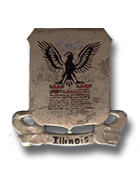 485th Engr Bn
(Cbt) DUI
485th Engr Bn
(Cbt) DUI |
|||||||||||||||||||||||||||||
| 485th ENGINEER C BATTALION ORGANIZATION (Jan 1952) | |||||||||||||||||||||||||||||
|
|||||||||||||||||||||||||||||
| A very interesting article on the Strategic Railway Denial mission that was assigned to the 18th and 485th Engineer Battalions in the 1950s, can be found on the 18th Engr Bn Page. | |||||||||||||||||||||||||||||
Any former members of the 485th who were assigned to the battalion in Germany during that period and would like to provide further details on the role that the 485th played are kindly asked to contact me . We would really like to hear the 485th's side of the story! . We would really like to hear the 485th's side of the story! |
|||||||||||||||||||||||||||||
|
|
|||||||||||||||||||||||||||||
| 1951 | |||||||||||||||||||||||||||||
| (Source: Email from Donovon Carr, Co C, 485th Engr Bn, 1951-53) | |||||||||||||||||||||||||||||
| I was with the 485th Engr C Bn, Company C stationed outside of Munich, Germany from 1951 until 1953. Can you tell me what has happened to the Bn. I understand that it was an Illinios Army Reserve unit that may have been sent back to Illinois. I know that there is supposed to be an 485th Engineer C Bn Association, but i cannot find any info about it. I received my basic traing in Ft Belvoir (both basic and engineer ). Afterwards we were shipped to Germany in 1951. Our first post was in Kaufbeuren. Later we were transferred to Schleissheim, just outside of Munich. After arriving at our new post we were assigned the job of taking up the metal strips used for the landing strip. This was an old army air strip. After completing that job each squad in the company was given two bridges to be destroyed in the event of an attack. i I was in Third Platoon, Third Squad. Our targets were a railroad bridge and a vehicle bridge that were next to each other not far from Schleissheim. When not inspecting the bridges as we did every week we spent the rest of the time in training building timber tressles and baily bridges. We also practiced laying anti tank mine fields. Every so often we were given the job of demolishing old damaged buildings. |
|||||||||||||||||||||||||||||
| (Source: Judy, dependent; father was assigned to Detachment R, Regensburg, 1949-1953) | |||||||||||||||||||||||||||||
| I was so glad to find pictures of one of my favorite places and happiest memories. I lived in Regensburg from 1949 to 1953. My father was stationed there and was with Detachment R at the Raffler Kaserne. Your pictures are as I remember.   Fort Skelly - 3rd. Bn. 6th Armored Cavalry was stationed there. I saw every movie that came through town in the Special Services Building and swam in the pool, on post, in the summer time. Pioneer Kaserne, Motor Pool - my mother did her Commissary and PX there (once there was a large enough commissary). Leopold Kaserne - 485th Engineer Combat Bn. was there and I went roller skating every weekend in the wonderful indoor rink on post. Fort Skelly - 3rd. Bn. 6th Armored Cavalry was stationed there. I saw every movie that came through town in the Special Services Building and swam in the pool, on post, in the summer time. Pioneer Kaserne, Motor Pool - my mother did her Commissary and PX there (once there was a large enough commissary). Leopold Kaserne - 485th Engineer Combat Bn. was there and I went roller skating every weekend in the wonderful indoor rink on post. For some reason I remember Pioneer and Leopold being close to each other but I was young (age 10 to 15 yrs.) and it has been quite a while. I'm sorry that I have never returned, to see and to reflect. Oh, also, I was baptised in the Chapel in Straubing. |
|||||||||||||||||||||||||||||
| 1953 | |||||||||||||||||||||||||||||
| (Source: Email from J.C. George) | |||||||||||||||||||||||||||||
| Company C, 485th Engr C Bn, July 1953 to Oct. 1954. Part of my tour was as Squad leader and part as Platoon Sgt. Our Co. commander was Capt. Goss (later Maj. and transferred out.) One of our duties during the latter part of my tour was laying out transportation routes from the port to the final location for the deployment of the atomic cannon. This was done by two man squads following maps provided by headquarters in Regensburg. We would estimate bridge capacities and check turns and intersections in towns to see if they could be handled by the carriers. At the time of my service I was fortunate to attend the 7th Army NCO Academy in Munich and really fortunate to named top grad. All my records have been lost due to the fire in St. Louis and I have often wondered if any records were kept somewhere else? Were the members of the unit awarded and medals, i.e. Occupation service etc.? |
|||||||||||||||||||||||||||||
| 1954 | |||||||||||||||||||||||||||||
| (Source: Email from Bob Dierks, 485th Engr Bn) | |||||||||||||||||||||||||||||
| Following 8 weeks
infantry basic, 8 weeks engineer basic and 10 weeks leadership, at
Fort Leonard Wood, Mo., I was assigned to a line company, Co. A,
485th Engr. Bn. (C) in Erlangen, Germany around April, 1954. The
485th was later redesignated as the 237th. Bn. HQ was in Regensburg. The orderly picked me up at the Bahnhof. Just as we entered the barracks, an alert was called. I was immediately posted as gate guard, without a weapon, and stood there for several hours until the troops returned. After a few days of some strenuous road repair, I was sent to C-W Radio Operator School in Regensburg. Our main job was demolition so we maintained a 24 hour tactical radio net even during alerts. We had an SCR 399 in a deuce and a half, AN/GRC-9s in 3/4 ton pickups with radio shacks, and a number of VRC 10s in jeeps. In the field we had to work to best orient our antennas to establish communications. I later became chief radio operator and trained company radio operators, etc. In the summer, our field problems involved bridge building, aggressor games and other training. We usually went to Hohenfels for winter infantry training. We had PT tests occasionally. I was also on the rifle team. Initially, our CO was Capt. Mitchell Pietrzyk (not sure of the spelling) from Chicago, my home town. He was a short barrel chested man. He sometimes stood on tiptoes to check our brass during inspection, (but no one laughed). He had an open invitation to anyone who objected to the way he ran things to meet him in the gym. He was a wrestler and pretty gruff but we all liked and respected him. Sometime after I arrived, we got a new first sergeant, a Korean vet named Ernie Mancuso. I helped him try to track down some stupid pranksters and he befriended me. We occasionally went to the gym so he could teach me and another sergeant some martial arts. We had some top notch veteran medics. One pretty much saved my life by noticing I was out of it during a field problem and sent me to the hospital. I was later airlifted to the Army General Hospital in Frankfurt. The head infection I had was resistant to everything they had at the time except, fortunately, a new drug called Cortisone. I posted a few photos on a Classmates Military web site. I haven't visited it lately to learn if it's intact. Bob Dierks |
|||||||||||||||||||||||||||||
| Webmaster Note: a Facebook Page has recently been started for former members of the 485th Engineer Combat Battalion. See Related Links section for a link. | |||||||||||||||||||||||||||||
 |
|||||||||||||||||||||||||||||
|
|
|||||||||||||||||||||||||||||
| 237th Engineer Battalion History | |||||||||||||||||||||||||||||
| 1954 | |||||||||||||||||||||||||||||
| (Source: History of the 237th Engineer Battalion, HQ 237th Engr Bn, Wharton Bks, Heilbronn, early 1980s) | |||||||||||||||||||||||||||||
|
|
|||||||||||||||||||||||||||||
|
|||||||||||||||||||||||||||||
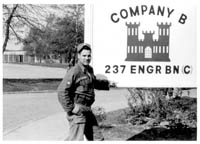
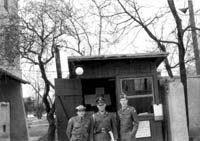
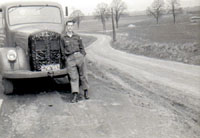
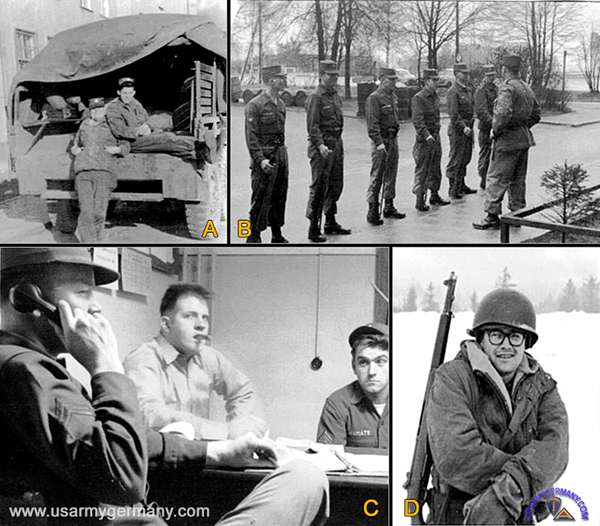 "B" Company personnel, 237th Engineer Battalion, Regensburg (Wallace Smith) (See email below for captions) |
|||||||||||||||||||||||||||||
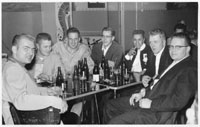
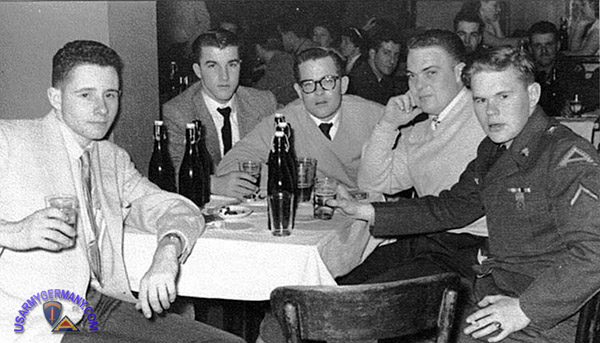 Enjoying a beer at the "Von der Tann" Gasthaus, Regensburg (Wallace Smith) (L to R: Myron Morris, Ogert, myself, Gooch, and Dave Emerson) |
|||||||||||||||||||||||||||||
| (Source: Email from Wallace Smith) | |||||||||||||||||||||||||||||
| Saw your website on the US Army in Germany and the page on the 237th Engineer Battalion. Wanted to send you some of my own recollections. I was assigned as Cadre (Mail Clerk) to a Carrier Company of recently graduated Combat Engineers from Camp Kilmer NJ. After filling up the troop spaces we left New York on 23 December 1954 aboard the USNS General W.C. Langfitt (T-AP-151) bound for Bremerhaven, Germany and spent Christmas and New Years on the North Atlantic. After arriving at Bremerhaven, I recall being hustled aboard a train bound for some place in Bavaria as replacements for rotating troops. A big, burly Major from HQ of the 237th lined us up and read off our names and assigned us to units. I was assigned to Co. B in Regensburg, which also had detachments in Deggendorf and Passau. I was scheduled to replace one of the company clerks, but until one left I was given a few lessons in rudimentary engineering, cleaning equipment, etc. The Commanding Officer of B Company was Captain James O. Brady and the First Sergeant was MSGT Rudolph A. Hoffman - two of the finest soldiers I have ever met. I stayed in Co. B for my entire tour and rotated back to the States in March, 1956. I have many fond memories of Regensburg, even the Alerts which required us to pack up our gear and simulate blowing some railroad bridges across the Danube river to delay any Russian "movements" crossing into the West. I also remember pulling guard duty on our airplane hangar. PHOTO Captions: (A) Bill Beumer and Hollingshead in a deuce-and-a-half, again in front of the "B" Company barracks. (B) Schulze, Adams, Santisteven, Stewart, Cook, Kindley, and Davis on guard mount. (C) Tidquist on Charge-of-Quarters (CQ), with Shumate and Shanks helping. (D) Wally Smith at Hohenfels during the winter of 1955-56. |
|||||||||||||||||||||||||||||
| 1955 | |||||||||||||||||||||||||||||
| (Source: Email from William Beumer, B Co, 237th Engr Bn, 1955-57) | |||||||||||||||||||||||||||||
Just checked out the site and see that Charles Black sent in a few more pictures. Have sent a few more along that you might add. The color ones are off 35mm slides I have in my collection. I am in the process of putting an album together and am trying to copy all the slides to photo paper as the slides are starting to show signs of deterating. I also have about a dozen rolls of black and white 35mm negatives “put away” and I have yet to locate. |
|||||||||||||||||||||||||||||
|
|||||||||||||||||||||||||||||
| ADDITIONAL INFORMATION In July of 1955 I transferred into B Company, (237th Engr Bn) when the USFA command in Austria was closed down. I was previously in the 258th Signal Construction Co. in Camp Truscott, attached to the 63rd Sig. Bn. out of Camp Roeder. At the time of my transfer Capt. James Brady was CO. of B Co. The company was broken down to platoons stationed at three different locations:  Regensburg Straubing Passau Regensburg Straubing PassauStraubing also had a small detachment at Deggendorf. HQ, and if memory serves me right, the 1st platoon was at Raffler. I was dispatcher at Raffler detachment until moving to Passau in 1956 when HQ was moved there. From the summer of 1956 to June of 1957,when I rotated back to the ZI, we went thru five CO’s. When Capt. Brady left in July of 1956 1st Lt. Gary Blahna was CO for a short period until he was replaced with a Capt. whose name I can’t recall. (After a small riot at the Passau detachment). He was relieved of his command (Railroaded was more like it) and was replaced with aanother Capt. until Lt. General Uncles personally flew in and relieved that Capt. of his command. (The Capt. didn’t like the Germans and let everyone know it). Needless to say the word got back to Uncles and he settled it real fast. I talked to 1st Sgt Emery Deal after the General left (he was in the meeting), he said the general told the Capt. “If we went to war right now you would have three casualties before you got out of the front gate, you and your two platoon leaders. Your own men would shoot you”. That Capt. was replaced with Capt. Cameron who was still CO when I shipped out. At the time of my departure I was Motor Sgt. of the Detachment, with the rank of “acting” Staff Sgt. He and I never could see eye to eye to how the motor pool should he run, among other things. The Saturday morning, before I shipped out, we had quite a heated discussion about how he was running the company. Needless to say he didn’t shake my hand when I left Monday morning. Why I am writing, is to try to find out what the CO’s name was in 1956 when the Riot took place in Passau? Every so often I think about it, but when I try to remember the CO’s name I draw a blank. Maybe some ex B CO. Vet or Stick Buddy would have the answer for me. Also, I would like to find out what happened to him after the Fiasco. Maybe Mr. Black would know. But he may have arrived after all of that took place. I looked up my old “SPECIAL ORDERS NUMBER 67” dated 27 April 1956 “Qualification announcement with the Cal .30, M1 rifle” and didn’t find a Black listed on it. So a good possibility he wasn’t there till later. |
|||||||||||||||||||||||||||||
| (Source: Email from Bob Gentile) | |||||||||||||||||||||||||||||
| I was detachment clerk with the Passau Detachment from the middle of 1955 to May 1956. Strangely, I was the highest ranking clerk, possibly in the 237th and more (E-4) with plenty of time in grade. I was motor pool “sgt” for a short period when the Det clerk, Zerkle, took a 30-day furlough and I was the only person who could type. My temporary assignment lasted until I shipped home in may 1956. Zerkle was assigned to a squad. He never spoke to me after that,. I don’t know why!! I remember Lt Blahna and Lt bonito. One of them was ok. I don’t remember our detachment's first sgt.s name, other than he was a gentleman. Nothing exciting happened while I was there, if you discount the blizzard and the frozen danube. If any former buddies are around, tell them I said hello… |
|||||||||||||||||||||||||||||
| 1956 | |||||||||||||||||||||||||||||
| (Source: Email from Charles D. Black) | |||||||||||||||||||||||||||||
| I was stationed in Regensburg Ger., 1956 to 1958. Enjoyed my stay there. We were at the Raffler Karserne. PFC at the time. Company CO was Capt. Cameron and Plt Ldr was Lt Francis. | |||||||||||||||||||||||||||||
|
|||||||||||||||||||||||||||||
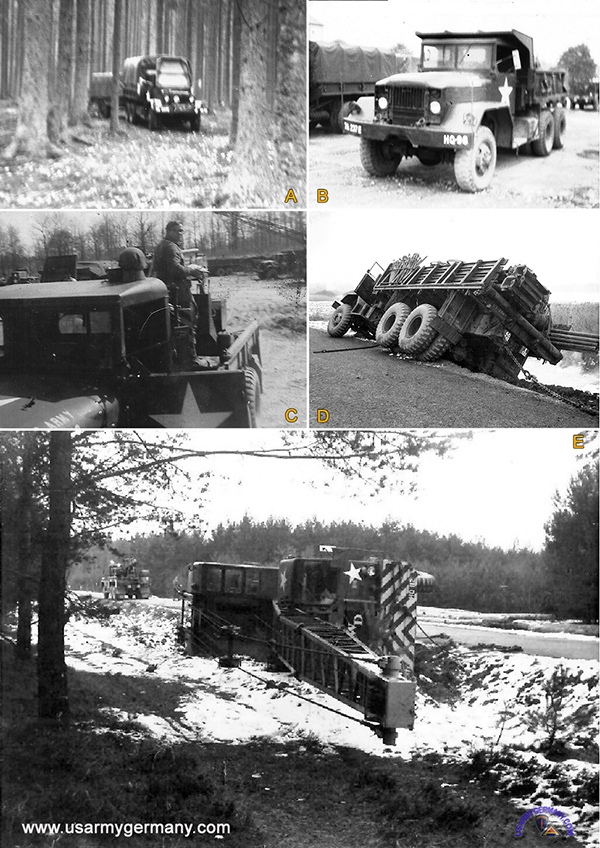 Scenes from HQ Co, 237th Engineer Battalion, Heilbronn (Milt Honeywell) (See email below for captions) |
|||||||||||||||||||||||||||||
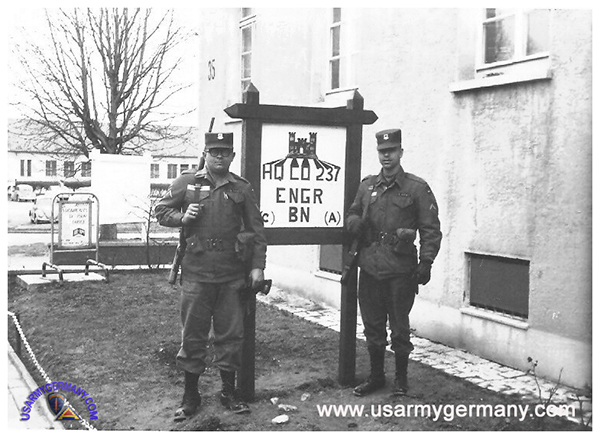 Guard Mount Preparation in front of Bldg #35, 1962 (Milt Honeywell) (Me, on the left, and my buddy, James Bell, a full blooded Cherokee from North Carolina) |
|||||||||||||||||||||||||||||
| 1961 | |||||||||||||||||||||||||||||
| (Source: Email from Milton Honeywell) | |||||||||||||||||||||||||||||
| I enlisted July 13 1961, one month after graduating High School in Pennsylvania, U.S.A. Basic and second 8 were at Fort Jackson, Columbia, S. C. Shipped out from New York for Bremerhaven early Dec of 1961. 13 day boat trip which normally took 10 days, thanks to a wild North Atlantic storm, 3 days all we did was go up and down. I was stationed with HQ Company, 237th Engr Bn from Dec, 1961 to Jun, 1964. My PMOS was 631.10 (wheeled vehicle mechanic). Arrived at Wharton Barracks, no slot open in maintenance for a mechanic so they shipped me down to Garmisch to a Generator Mechanic Repair School, 8 to 10 week course. Back to Heilbronn and became assistant to the Generator Operator. He was also Motor Pool Officer jeep driver and when he rotated I took over that position. I don’t remember the des for the following, but somewhere near mid 1962 our wrecker operator rotated home to Ohio. I was called into orderly room and the Personel officer told me I was the only person with training in Vehicle Recovery, and I ended up with the best job in the Battalion, the wrecker operator. My one and only responsibility was to keep the wrecker ready to go 24/7. As stated in a previous post, we had an ADM Platoon, and where they went the wrecker went also. Then rotated home beginning of June 1964. As an aside, I was a machinist for over 40 years of my working career. My last Employer bought a multi spindle screw machine from a manufacturer named Index Werks in or near Esslingen, Germany, near Stuttgart in 1989. Since I was going to be the operator of said machine, myself, my immediate superior who was the programmer, and the two owners of the company flew over around Easter of 1989. Spent 3 weeks there. I was able to run over there (to Heilbronn) one evening and did I get a surprise. There was an American – German beer fest taking place in the quadrangle. Of course this was 25 after I had left, so I guess I shouldn’t have been too surprised. Visited the orderly room, introduced myself and received the royal treatment, really cool. When I was there there were no women in the Battalion, but when I visited I swear there must have been at least a 10 % female presence if not more. PHOTO Captions: (A) Our Maintenance Tool Truck, bivouacked in the Black Forest near the Bodensee. (B) Our Platoon's 5-ton dump truck. (C) Me with the Wrecker behind HQ in the motor pool. (D) A 24th Engr Bn (4th Armd Div) bridging truck into the berm. (E) The Crane got into berm and rolled right over, what a fun day that was. |
|||||||||||||||||||||||||||||
| 1962 | |||||||||||||||||||||||||||||
| (Source: Email from Joseph T. Chetwynd) | |||||||||||||||||||||||||||||
| I joined the 237th Cbt Engr Bn at Heilbronn in Jan 1962. I was in A Co. I remained there until Jan of 1963 when I received orders to go to join the VII Corps Long Range Reconnaissance Patrol Co ( Airborne ) at Nellingen, some 25 miles south of Stuttgart. It was a volunteer unit and I followed four other former 237th men there. I have some vivid recollections of my time in the 237th as well as some photos and a few items of memorabilia. Mostly I remember being in the field, building a timber trestle bridge over a newly blown chasm up in the hills behind the kaserne. We had to use 60 inch pry bars to break the frozen rocky ground in order to install shape charges. Once the area blew, there were earthen boulders strewn everywhere the size of a VW . Once it was cleared by dozers, we commenced to off-load and erect a timber frame bridge across the hole. We worked all night to complete it. Then, the CO drove a truck and jeep across it and they gave the order to take it down and put it all back onto trucks. Then, of course, there was the bridging of the Rhine River with pontoon swing bridges in torrential downpour and deep, thick muddy ground, in March at Speyer, Ger. There was also a Bailey Bridge exercise where the newly minted First Lt from West Point pushed the bridge beyond its fulcrum point and sunk it in the river. There are two of us former 237th C.Engr Alumni still standing and kicking: myself and Patrick Smith in Oregon. We would also like to remember two others of our brothers both of whom are now deceased, Mark J. Whiteside and Tom McDaniel, and both of whom preceded me to the LRRPs from Heilbronn. |
|||||||||||||||||||||||||||||
| 1972 | |||||||||||||||||||||||||||||
| (Source: Email from Judy Andricak, wife of M/Sgt Paul Andricak) | |||||||||||||||||||||||||||||
| My husband was Msg. Paul Andricak (Andy) and while stationed in Heilbronn, he was in charge of the mess hall at Wharton Barracks. We arrived on Easter Monday, 1972 and stayed in a local hotel downtown. Initially, we looked at renting an apartment close to the Bahnhof, but decided against it and applied for housing at JFK Village. We got a 2 bedroom unit on the first floor of the first unit directly across from the open area and were even provided with a "maid's room" in the basement. That room was used for storage and for hanging wet clothes in the winter. In our stairwell, there was a Junior Cox and his wife, Harriet; Larry and Betty Wayne; a couple named Fox, and a Sgt. Major on the top floor. The colonel's house was behind our unit. Our daughter was born at the 5th General Hospital in Bad Cannstatt, Stuttgart and was baptized in the Wharton Barracks Chapel. Some of the men who worked with my husband were Ray Brown from RI, Sgt. Grey (or Gray), Captain Bible, Bill Beasley, Robert (Pete) Peters and a German named Charlie. The Sgt. Major was named Shaw and his wife was German. I just reconnected with Ray Brown who now lives in W. Warwick, RI. I feel sure Sgt. Grey passed on as he was older when we arrived and I believe Robert (Pete) Peters has also passed on. I lost touch with him and his second wife, Dera, after my husband died in 1982. Pete's first wife, Bobbi, died around January 1974. Pete called us in the States (we were there for the funeral of Andy's father) to tell us of Bobbi's passing. While I don't recall many street names anymore, I do remember dressing Jennie and taking her in her "kinderwagen" on walks through the area. Many times we walked all the way into town and got ice cream or sometimes just looked in the stores. I distinctly remember Fuch's in the winter when I was expecting Jennie - a strong body odor permeated the building. We purchased Marklin HO trains in Fuchs which I still have. My husband liked to run the trains around the tracks when they were displayed each Christmas. I also recall sitting with my mom and Jennie under large umbrellas outside a sweet shop, eating ice cream. We made a number of trips to Heidelberg for the castle illumination, usually standing on the bridge for the best view. We toured the castle once. We also made a few trips to the Garmisch/Partinkirchen area visiting Oberammergau (where we saw Der Passion Spiel theatre and purchased our Nativity set). Our trips took us into Italy as far as Bolzano, Austria, Leichtenstein, Switzerland, France, Belgium, and Holland. I truly loved Holland and would move there in a heartbeat if I could. We visited a place called Madurodam where many Dutch buildings are recreated in 1/20th miniature. We also visited during the tulip season - that was so memorable. Jennie got her feet wet in the North Sea. Andy was on maneuvers when I made my first volksmarch with Jennie in her coach. I did the 20k with two of his co-workers, a guy named Cliff and his buddy whose name I can't recall. I remember the sugar cubes, hot tea and hot broth the Germans provided at the stamping stations. We still have all of our medals from the walks. Somewhere I had the books, but don't know if they are still around. There were various vendors who visited the housing area daily or weekly - bread trucks, salesmen pitching all kinds of wares from dishes to land. I regularly bought rolls from the breadman and pastries from another vendor. We did purchase china from one vendor and we never regretted it. In fact, my mom purchased her china from the same vendor when she was visiting. I do recall a big to-do when the wife of a beer vendor went missing and was found in the basement maid room at another building. I remember watching the grapes grow on the vines on the hill above our building and threatening to take buckets out to get grapes and make wine. Don't remember much snow, but I do remember the summer Olympics at Munich. No one could get onto the base unless they were searched. Our Chevy Impala had the rear seat pulled out so often, it wouldn't fit right. The guards even searched Jennie's diapers! I also recall the bombing at the IG Farben building. It was scary flying out of Frankfurt for a trip home - German soldiers with submachine guns and bazooka type weapons were stationed all over the terminals' roofs. No one boarded planes at the terminal gate, but we were driven by bus to our plane on the tarmac and had to pick out our luggage on the way into the plane! We liked eating out occasionally and as noted, our favorite spot was Gasthaus Balz in Stetten (we just called it Stetten's). Their schnitzel covered the plate! It always came with spaetzle, warm German potato salad and green beans. There was usually a small salad also. We also liked to eat at a place in Heilbronn called the Rathaus (not the town hall). I had a schweinlenchin (spelling?) that was out of this world. In fact, we were never charged for my dinner as I ate all of a meal intended for two people (I was pregnant at the time) and the cook and waiters were impressed. We attended many local wine and beer fests, along with the Christmas market in town. Never got into the Harmonie Hall, but I wished I would have. We swam in local pools and trekked through local farms and vineyards. I rarely shopped in our PX, preferring to buy local groceries when we could including the milk everyone advised us against using. We did some shopping at a huge warehouse type store in Neckarsulm, but I don't remember the name of the place. We used to eat out at local pubs on Sundays with the locals and walked with them. We also raided the dump on Sundays like the locals and brought home some astouding items. My husband had been stationed in France and he loved it. I didn't care for the country or it's people. I liked Belgium, Austria, Switzerland and Lichtenstein, but again, we had an issue in Italy that left a bad impression - Jennie was about 4-5 months old and very sick. We kept asking for a doctor, but the Italians we encountered that day simply laughed at us and ridiculed us. Upon returning to Switzerland, we had some Swiss police lead us to a local hospital with lights flashing. Hope this provides you with some good flashbacks. |
|||||||||||||||||||||||||||||
| (Source: Email from Dewey Burkhalter) | |||||||||||||||||||||||||||||
| Came across your site. I was with the 237th (Engr Bn) ADM in Heilbronn 1972-73. We were located in the Headquarters basement. I do remember that our Lt. volunteered us to help the line companies bridge the Rhine river on Mothers Day 1972. I wished I had some pictures but my camera was broken. We were attached to a German Engineer unit from Ingolstadt where we would go for training and practice. I will check and see if I can find any photos of these times. |
|||||||||||||||||||||||||||||
| If you have more
information on the history or organization of the 237th Engr Bn, please
contact me. |
|||||||||||||||||||||||||||||
|
|
|||||||||||||||||||||||||||||
| 1983 | |||||||||||||||||||||||||||||
 |
|||||||||||||||||||||||||||||
| (Source: Heilbronn Community Circle, May 2, 1983) | |||||||||||||||||||||||||||||
| 237th GIs
bridge gap on the Rhine with "marriage" By C.J. Costello, 7th Eng Bde PAO Recently, soldiers of the 237th Engineer Battalion, 7th Engineer Brigade participated in BRIDGEX, an annual training exercise held in the 7th Eng. Bde. The exercise, which took place on an inlet of the Rhine River near Speyer and Schwetzingen, provided an opportunity for the combat engineers to develop proficiency in constructing bridge equipment. According to Capt. Joe Miller, a training officer from the 565th Eng. Bn., 7th Eng. Bde., who was in charge of BRIDGEX, "The main purpose of this exercise is to train the VII Corps combat engineers how to utilize the different bridges available in case of war." |
|||||||||||||||||||||||||||||
|
|||||||||||||||||||||||||||||
|
|
|||||||||||||||||||||||||||||
| 1985 | |||||||||||||||||||||||||||||
| (Source: Heilbronn Eagle, Dec 9, 1985) | |||||||||||||||||||||||||||||
| Local
construction and repairs teaches soldiers saves money by Mike Novogradac Everyone, including the Army, wants to save money. CARES (Construction and Repairs by Engineer Soldiers) is one way the Army saves big bucks. "CARES provides lower cost projects for the community by using soldiers as laborers and any Army assets we can, to keep costs down," explained 1st Lt. Dennis A. Faker, assistant S-3 of the 237th Engineer Battalion, 7th Engineer Brigade. "All the Army has to do is buy materials for a CARES project and give soldiers TDY (Temporary Duty) pay if we go outside the community," continued Faker. "The Army doesn't have to pay soldiers overtime, so about 60 percent of a project's cost is saved by not contracting to a civilian construction company." One recent CARES project performed by soldiers of the 237th was the parking lot located across from the Wharton Barracks dispensary. The project consisted of getting vehicles owned by the 22nd Maintenance Company moved, tearing a fence down and upgrading the area to parking lot standards by dumping and compacting 140 tons of stone. According to Sgt. 1st Class Richard K. Zeger, the 237th's construction NCOIC (Non-Commissioned Officer in Charge), CARES projects allow good training for engineer soldiers in planning, construction and equipment utilization. "We can't use our dozers unless we go to a major training area, which are few and far away," Zeger said. "CARES allows soldiers to use their heavy equipment during projects right here in Heilbronn." Zeger explained that from submission to completion, a CARES project can take from two to three years. "If a company, battalion or organization wants a project completed, they justify it on a request to DEH (Directorate of Engineering and Housing)," said Zeger. "DEH figures the cost, gives the project a priority and then decides when it will be completed. "Next, VII Corps makes a decision as to which USAREUR engineer brigade will work the project and when it will be completed." Another CARES project is near completion in the Kleingartach community. "Delta Company has torn down three bunkers, 14 or 15 buildings, moved 700 cubic yards of dirt and 3,000 square meters of concrete to turn a NATO (North Atlantic Treaty Organization) Hawk Missile site back to nature," said Zeger. "This is a good project," he continued. "We've trained in `open demolitions,' instead of being confined to an explosives range. We're working with our heavy equipment and the project has placed us into our German/American partnership with the 210th Pioneer Battalion from Munich. "The soldiers are also receiving training with German munitions and the Germans are training with our explosive. "That project will make the Kleingartach community happy," Zeger added. "The site has been abandoned for five or six years and it was really an eyesore. No one liked it and it was always in the German newspapers." Since renovation and re-opening of the Wharton Barracks Child Care Center in October, engineers from A Company have been building a new parking lot for the center. "The parking lot is the first time we've had the opportunity to lay down German 'Dog Bone' bricks," said Zeger "We couldn't use asphalt or concrete for the lot because the post's main ETS (European Telephone System) cables are buried in that area." "With the bricks," he continued, "no major cost will be involved if repairs are ever needed. We'll just remove the brick and lay them back down." The engineer, have layed 27,000 brick to make the 38-space parking lot. Two German mason from DEH provided help when the project began. Not only do CARES projects save the Army money, but they also lend something that's important to the engineer soldiers. "The soldiers enjoy keeping busy," explained Faker. "They come in the Army to do the kind of work that CARES allows them to do, but we're a combat engineer unit. I think they'd rather do a CARES project than go to the field any day." |
|||||||||||||||||||||||||||||
|
|||||||||||||||||||||||||||||
|
|
|||||||||||||||||||||||||||||
|
Related Links: |
|||||||||||||||||||||||||||||
| 485th Engineer Combat Battalion - Facebook Page moderated by Kevin Doughty. The page is dedicated to the memory and honor of the 485th Engineer Combat Battalion, specifically to his father, SFC Hays H. Doughty | |||||||||||||||||||||||||||||
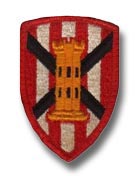
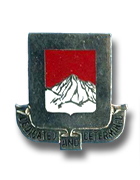 237th Engineer Bn (C) (Army) DUI