| If you do
NOT see the Table of Contents frame to the left of this page, then
Click here to open 'USArmyGermany' frameset |
|||
|
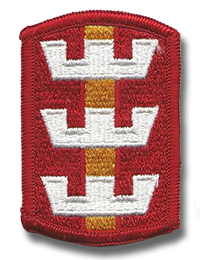
549th
Engineer Battalion |
|||
|
|
|||
|
|||
|
|
|||
| Battalion History | |||
 549th Engr Bn DI 549th Engr Bn DI |
|||
| 1945 - 1985 | |||
| (Source: Heidelberg Herald-Post, October 24, 1985) | |||
| The 549th Engineer
Battalion can trace its origin back to the 549th Engineer Light Pontoon
Company, constituted on Feb. 25. 1945. It was redesignated the 549th
Engineer Panel Bridge Transport Company on Dec.15, 1945. The company participated in the Rhineland and Central Europe campaigns of World War II. The unit was first designated a battalion on Nov. 21, 1946, as the 549th Engineer Service Battalion, and operated in Germany until June 20, 1947, when the battalion was deactivated. The colors of the 549th did not unfurl for some 22 years until June 9, 1969, when they again proudly flew at Tompkins Barracks, Schwetzingen. The 549th Engineer Battalion was then activated with four American engineer companies -- the 541st (Float Bridge), the 522nd (Float Bridge), the 530th (Panel Bridge), and the 535th (Light Equipment). The Battalion also had two labor service companies -- the 8591st (Float Bridge), and the 8592nd (Bridge Maintenance). In October 1969, the order was received to deactivate the 530th and the 522nd companies. In July 1975, the 535th Engineer Company was permanently transferred to the 563rd Battalion in VII Corps, with duty station in Grafenwoehr, leaving the 549th Battalion with three companies. In December 1975, the 541st was reorganized and became a mobile assault bridge (MAB) company. In April 1978, the 8592nd Civilian Support Group was permanently transferred to the 21st Support Command. The 549th Engineer Battalion, presently located at Tompkins Barracks, consists of headquarters and headquarters company, the 541st Engineer Company, and the 8591st Labor Service Engineer Company (Float Bridge and Ribbon Bridge). Apart from its military training the 549th Engineer Battalion participated in several civic projects helping local German communities. Called "schnitzel" projects because the Germans provided hot meals to the engineers, they included rebuilding the east curve at Hockenheim race track and draining the swamp between Ketsch and the Rhine, turning it into a recreation area. |
|||
If you have more
information on the history or organization of the 549th Engr Bn, please
contact me . . |
|||
|
|
|||
| 1974 | |||
| (Source: Email from Larry Jinkins) | |||
| I saw your note email not on wanting input on USAREUR history. I was with the 656th Engineer Battalion (Topo) in 1970; 535th Engineer Company (Light Equipment) in 1974-75; and the 565th Engineer Battalion (Bridge) in 1976-77. Some notes to augment history. I first went to Thompkins Barracks in 1970 while I was enlisted (SP5 E5). I was assigned to the Topographic Survey Team of the 656th Engineer Battalion (Topo) (later redisignated 649th for reasons I don't know). 1. One very small historic piece of information is that the Survey Team was heavily involved in bringing 2nd order survey control and in "plane tabling" Nike Missile Sites all over Germany. There were a huge number of those sites. I was personally involved in Nike survey projects at Bitburg, Baumholder, Butzbach, Giessen, and Friedburg. Trying to locate those sites now is difficult. Morale of the soldiers at those sites was horrible. Soldiers essentially had nothing to do but pull guard duty in the towers - bored out of their minds. I hated the time we spent in garrison at Thompkins, but the survey field work was one of the best jobs I've ever had. In the field we worked 12 hour days Monday through Thursday, and then took 3 day weekends to travel to German sites near where we were working. We had some 10-speed bicycles and an old VW to travel to those sites. 2. Drugs were beginning to appear in Germany at this time. Our Survey Team was often avoided by soldiers at our survey sites due to local soldiers believing we were a CID team. This sometimes worked to our advantage with unit commanders and first sergeants who did not know who we were except we came from somewhere out of Heidelberg which, coincidently, was where USAREUR Headquarters was located at. I returned to Thompkins Barracks in late 1974 as a Second Lieutenant assigned to the 535th Engineer Company (Light Equipment) which was in turn assigned to the 549th Engineer Battalion (Composite). I could not believe how bad the Army in Germany had gotten in the years between 1970 and 1974. The race and drug problems that had started to occur by 1970 were out of control. I spent much of my first months at Thompkins working with CID setting up cases against drug pushers in our company. We had one soldier thrown out a 4th story window by a drug pusher. Each officer had 2 platoons; we pulled staff duty every 5th night with no sleep during the night and went back to work the next day without sleeping; we had difficulty with NCO and officer tires being slashed, and our 1SG's car was fire bombed. 50 % of our equipment was deadlined; repair parts were hard to get; and we were woefully short on mechanics. But, being the new VOLAR Army we had to have the mechanics spend every Friday afternoon playing sports. Fuel for vehicles was rationed. We spent New Years Eve 1974/75 with most of the battalion officers and MPs parked outside the Thompkins gate waiting to come in when a reputed planned fight was going to break out between the 535th and the 541st because of a stabbing earlier in the week. Meanwhile, sacrificial Lieutenants were stationed on each floor of the barracks. Nothing happened. The best thing that happened to the 535th was being reassigned permanently to Grafenwoehr in May 1975. Our Company Commander claims he did not realize who he was talking to at a party in Heidelberg when he told an older gentleman his troubles of managing a huge earthmoving company in the Heidelberg area with no earthmoving work to be done and how great it would be to have such a company in Grafenwoehr, but a month later we had orders to relocate to Grafenwoehr. Funny how fast things happen when the Commander USAREUR hears a good idea. COL (later General) Fiala, Commander of the 13th Engineer Brigade, was not amused by losing the 535th. COL (later General) Kim of the 7th Engineer Bridgade was delighted to obtain the 535th. Not much to say about Grafenwoehr except that it was good duty - exactly what the 535th needed. We did have a constant problem with getting repair parts. On occasion we would go to Nuremberg and purchase parts from Caterpillar out of our pockets. Once a month, as Company Maintenance Officer, I would send an E5 (who at one time had been an E6) who had been stationed in Germany forever around Germany with a 2 1/2 ton truck, a wrecker, a maintenance contact truck and a shopping list. He would return a week later with a truck full of badly needed parts. I never asked where he went or what he did. From Grafenwoehr, while I was still a 2LT, I was assigned as S4 to the 565th Engineer Battalion (Bridge) at Karlsruhe. The 565th had just failed an IG and the Bn Commander had every Captain in the Battalion replaced except one. So we had all Lieutenant staff officers except the XO and S3, and all Lieutenant company commanders. Twelve months later we not only passed the IG, but did so well they exempted us from the following scheduled IG. In thinking back on this (I teach leadership and management), I believe the secret to our success was that all of us were single. Every night was a drinking staff party; and many of us rented houses together. When we did things well we did them together; and when we screwed up we did it together - but we were always coordinated. One company we had was the 93rd Mobile Assault Bridge Company. MABS were a real pain. Hard to convoy on German back roads; lots of hydraulics to maintain. We received a mission to rail the 93d across Germany. The German rail master inspected our loaded rail cars the day before departure. That night I was walking through the rail yard with the setting sun lighting up the sides of the MABs. I started having a feeling that I should be seeing something. Looking closer, I all of a sudden realized that some of the bridge curbs were bent outwards - apparently from tanks sliding into them. This made those MABS, as currently loaded, too wide for the German tunnels. That night we pulled in crews and reworked the tie down system on the curbs. One afternoon one of the terrorist groups killed one of the German Justices a short distance from Neuret Kaserne. Terrorist groups were a common problem in Germany during the 1970s. Getting the ribbon bridge was an incredible improvement over the MABs and M4T6s. It revolutionized river crossings and our ability to maintain equipment. During Reforger 1976 we flew in ribbon bridge sections via helicopters across the Danube. We moved so fast and so unexpectedly that the controllers had to slow down the Blue Force we were on to regain the Reforger scenario schedule. Perhaps the Labor Service units have not mentioned enough in history. We had the Polish Labor Service (a bridge company) in Thompkins with the 549th; and the German Labor Service (a bridge company) at Neureut with the 565th. Lots of sad stories here. The Polish were displaced from their country and families. The Germans included many former high ranking members of the WW II German military. That is about all I can think of to say. In general, I believe that we felt that the Soviets could have overwhelmed us during the 1970s due to our myriad issues (i.e. drugs, race, staff shortages, repair parts shortages). US ARMY Europe essentially became non-functional during the late 1960s / early 1970s. As Battalion S4 of a critical bridge battalion, I could never get a clear concept of what the war plans were for our battalion. When we started to get an idea of one of the 4 or more plans that were out there, the plans would be changed. About all I knew was that we had to get out the gate fast to our dispersion sites, and there were some stockpiled bridge assets in our area of Germany. Beyond that, we really did not know what was going on. Perhaps the last thing I can think of is is that Rhine river crossings with the French were great. They always had great multi-course with multi-drink meals afterwards. ADDITIONAL INFORMATION I don't have much to add other than to note there was a Polish Labor Service unit (possibly a bridge LS unit) attached to the 549th Engineer Battalion at Thompkins Barracks in the 1970s, and a German Labor Service bridge unit attached to the 565th Engineer Battalion at Neuret (spelling?) Barracks in Karlsruhe during the 1970s. I was enlisted at Tompkins Barracks in 1970 and use to drink with the Polish unit. One had to take care when drinking with them because the could really put it down. There was a considerable amount of sadness in the group since they were separated from their homeland. I was later commissioned and became the S4 for the 565th from 1976 to 1978. Our German LS bridge unit (I can't recall the number designation) was really good at bridging, and many a US Captain and Lieutenant relied on their advice in bridging operations. The IG inspections were never a problem with the LS because they were always prepared. The one difficulty we had with them was during field exercises in that they had restrictions on their hours of participation. This became a problem during REFORGER 1976 (I think it was 1976) on the Danube when the 565th became a target of a US Army Ranger attack and the LS were sleeping during their mandated down time. Fortunately for us the Ranger unit parachuted into a frozen beet field and most of the Rangers ended up in the hospital with injured legs. |
|||
| 1985 | |||
(Source: Heidelberg Herald-Post) |
|||
| 8591st Civilian
Support Group, By
Walter C. Kunz, July
4, 1985 PFC Walter Kunz is a public affairs specialist with the 549th Engineer Battalion. |
|||
|
"Proud
and Proficient" is the motto of the 8591st Civilian
Support Group of Tompkins Barracks in Schwetzingen --
and the unit's members are extra proud this year because their proficiency
has been recognized by a USAREUR Sword of Freedom unit maintenance
award.
The 8591st was nominated in the table of distribution and allowances organizations supporting active forces, high density category (a non-standard unit composed partially of civilians and authorized 1001 or more total items of equipment). The road to receiving the Sword of Freedom was a difficult one, says Maj. Gordon B. Jobe, executive officer of the 549th Engineer Battalion. "In order to receive a nomination, the unit had to be graded in an across-the-board maintenance program which was inspected by the 549th Engineer Battalion, 130th Engineer Brigade, V Corps and finally by USAREUR-level judging teams. Every aspect of unit maintenance was judged and graded including weapons, NBC (nuclear, biological and chemical) equipment and procedures and the dining facilities." The 8591st was founded in 1949 as an engineer maintenance company. At that time, according to unit supervisor Wolfgang Klee, it was composed of displaced Lithuanians. Some of those men, now in their fifties, are still in the unit as supervisors. It is this continuity of experience, that has given the 8591st an edge in the training of new workers, Klee says. This allowed them to maintain the high standards that prompted USAREUR Commander, Gen. Glenn K. Otis, to describe the 8591 st as epitomizing the Department of the Army theme of "Improved Maintenance Through Demonstrated Leadership." Lt. Col. Daniel W. Waldo, commander of the 549th Engineer Battalion, says, "The 8591st is always ready to perform its mission, whether it be bridging, rafting or any number of assorted and sometime off-the-wall taskings. The unit is successful because of the equipment always being ready. This is accomplished by highly trained operators and mechanics." The unit is now made of Germans, Poles, Lithuanians, Bulgarians and other nationalities, who work with U.S. equipment and manuals printed in English. Klee said, "Certain supervisory positions require proficient English understanding, however, these positions are relatively few and well staffed." The 8591st will try to surpass its USAREUR level award by competing for the Chief of Staff of the Army Award for Unit Maintenance later this year. |
|||
|
|
|||
|
(Source: Heidelberg Herald-Post)
|
|||
| Farewell, 549th - bridgebuilding engineers deactivate Oct. 24, By Walter Kunz, October 24, 1985 | |||
| The end is here for the 549th Engineer Battalion; the unit deactivates today, Oct. 24. The last bridge has been crossed, and the last field training exercise, code named "Swan Song," has been completed. But why the deactivation? "The whole Army Corps of Engineers is undergoing reconstruction. The reason is a reallocation of engineer resources in order to compensate for the strengthening of the engineer role in light infantry divisions," says 1st Lt LeRoy Maurer, commander of the 541st Engineer Company that is being deactivated along with its parent battalion. Bridging is the business of the 549th and has been since the unit's activation in 1969, using ribbon and mobile assault bridges throughout central and southern Germany. According to battalion commander, Lt. Col Daniel Waldo, bridging was what the Sept. 10 - 16 field training exercise Swan Song was all about. "Our major objective for this exercise was to do as much river crossing in a tactical environment with as much realism as possible. At the same time we had to exercise the command and control required by the battalion's V Corps mission to effectively cross that traffic." The exercise involved close to 20 units, including armor, infantry, cavalry and engineers, as well as support elements. "Swan Song went pretty well,' said Waldo. 'The exercise was successful from the standpoint of pointing out problems we had, and what needed to be corrected to solve them... It's better to make a few minor mistakes now and correct them than to discover and have to deal with the same problems in an actual combat situation." Diversity was the key to the operation. According to Waldo, everthing from M-1s and Bradleys to transportation and chemical companies crossed at some time during the week-long field exercise. "In numbers of vehicles crossing, this was the largest bridging exercise this battalion has ever done," said assistant operations noncommissioned officer SSgt Donald R. Currey. "In a single week we crossed 1,283 vehicles, using nine locations on the Rhine and Main rivers." "Command and control was the most difficult portion of the exercise," said Waldo. "Getting crossing traffic to the right place at the right time. When you cross 1,200 vehicles it takes a lot of coordination. Without it you'd have a big traffic jam. "The hardest part was sending letters to all combat and support units in the exercise area requesting crossing traffic and then to work with those units to find out when they were available, the type of traffic to be involved, and which area they could cross in," said Capt. Donald A. Palmer, battalion executive officer. The Mobile Assault Bridge, or MAB, is the backbone of the 541st Engineer Company, and 541st commander Maurer says that the MAB's versatility puts it in a class by itself. "Unlike ribbon bridges, the MAB doesn't require a hard site and you don't need boats in the water to move the bridge bays -- they're amphibious and self-propelled. This allows the MAB unit to hit the water and be completely assembled within 12 minutes. At that time I can have a six-bay float raft capable of crossing two class 60 tanks at a time during wartime conditions." Although the MAB has such an impressive performance record, some questions were raised among enlisted soldiers about the validity of an exercise which in part, based its activities on equipment that will be outmoded. Waldo answers them simply. "In river crossing operations, there are basics which don't change, whether they're using MABs or ribbon bridges. Many of the procedures are the same, so the troops are able to exercise that ability. It's also wrong to think that the MABs are "outmoded." The 93rd Engineer Battalion still has MABs, and there are many MAB units in the States, and many of our men will be going to these units. Just because this unit is deactivating is no reason for these individuals to think they'll never use the equipment again." PFC Walter Kunz is a journalist assigned to the 549th Engineer Battalion. |
|||
 |
|||
| Related Links: |
|||