If you do
NOT see the Table of Contents frame to the left of this page, then
Click here to open 'USArmyGermany'
frameset |
US Army Railway Maintenance Activity, Rheinau
Kaiserslautern Army Depot
Looking for more information from military/civilian
personnel assigned to or associated with the U.S. Army
in Germany from 1945 to 1989. If you have any
stories or thoughts on the subject, please contact me . .
|
|
|
|
|
|
| USAREUR Transportation Center |
|
| Webmaster note: If anyone has additional maps, photos or information on the USAREUR Transportation Center / Rheinau Rail Maintenance Activity from the 1950s-1970s, I would like to hear from you! Falls Sie ein deutscher Angestellter waren, können Sie auch gerne auf deutsch schreiben. |
|
|
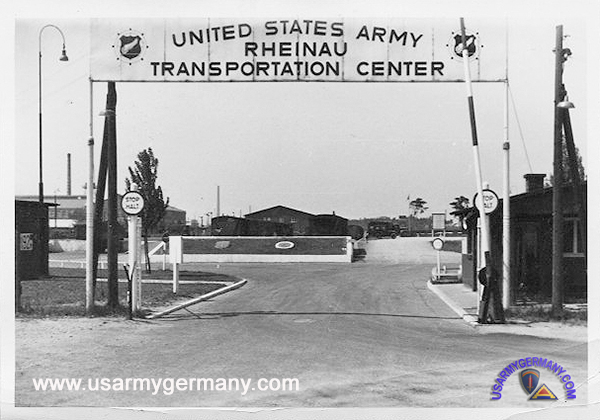
Entrance to the Trasportation Center at Rhenau, 1950s |
|
| 1950 - 1958 |
| (Source: STARS & STRIPES, Nov 25, 1956) |
The USAREUR Transportation Center in Rheinau, near Mannheim, is responsible for planning, directing, supervising, controlling and adminstering assigned traffic management activities for the USAREUR Transportation Command. In addition, the center provides technical advice and assistance to area commanders on traffic management matters.
CO of the Transportation Center is Col C.A. Houltry.
As far as railway activities, the center provides train commanders and dining car rations for military trains and controls, inspects, maintains and accounts for US Army owned, leased and controlled rail equipment. The center is also responsible for the procurement and distribution of supplies.
The USAREUR Trans Cen (possibly designated as something else at the time -- Rheinau Trans Cen?) was formed in Frankfurt a.M. in August 1950.
In 1951, the unit moved to Rheinau, part of the Heidelberg Military Post.
In Dec 1953, the unit was redesignated as 7705th Army Unit and divided into two detachments:
 Rheinau Service Detachment, Rheinau Rheinau Service Detachment, Rheinau
Frankfurt Air Traffic Detachment, (Rhein-Main Air Base)
In Sept 1955, the unit was redesignated USAREUR Trans Cen.
The center is composed of 222 military and civilian personnel:
33 officers
2 WO's
107 enlisted men
8 DAC's
72 German employees
Two of the officers are air traffic coordinating officers who control Army and Navy cargo at Rhine-Main AB and in France.
The unit operates detachments in the following locations:
Frankfurt
Munich
Augsburg
Regensburg
Trier
Mainz
Karlsruhe
Stuttgart
Nuernberg
Helmstedt
The detachments maintain liaison and coordinate rail transport matters with the German Federal Railways (Bundesbahn).
Movement of Personnel
The movement control mission consists of the supervision, planning, execution and control of all passengers and freight movements in Europe. An average of 25,000-35,000 persons are transported monthly on military trains (about 225 trains). When three or more persons require transportation, the local transportation officers in the area report the "packet" to the area movement control office. There the requests are consolidated and forwarded to the USAREUR Trans Center's Passenger Movement Section. If a small group is traveling, a special railcar may be set up and attached to a regularly scheduled German train. If a larger group is traveling, Army-owned or leased equipment may be utilized and a (military) train of six or eight cars formed. If a military train is used, the center will usually use the train -- after it has arrived at its destination -- for a return trip or send it to a staging area in Bremerhaven, Frankfurt or Munich for further assignment.
If persons are traveling to or from the Com Z (France), they are usually transported on commercial trains. However, if the group is large, a military train might be used.
Freight Movement
All shipments of freight under 150 tons or 50,000 gallons are handled by the area commands concerned. Anything above those numbers is handled directly by the Trans Cen. The center handles primarily "nonprogrammed" movements - about 1,600 each month.
Recently, the center assumed responsibility for the control and supervision of CONEX containers. The use of these containers was introduced into the command just a short time ago. CONEX containers are reusable metal freight shipping devices that weigh 1,430 pounds and have a maximum capacity of 8,000 pounds and 295 cubic feet. There are now 3,000 containers in use in the command.
Rail Equipment
Another responsibility of the USAREUR Trans Center is the maintenance of all Army rail equipment. Maintenance teams from the center travel to military facilities utilizing rail equipment. (The teams are equipped with shop trucks.) Teams are broken down into three types -- diesel, freight and passenger maintenance. |
|
|
|
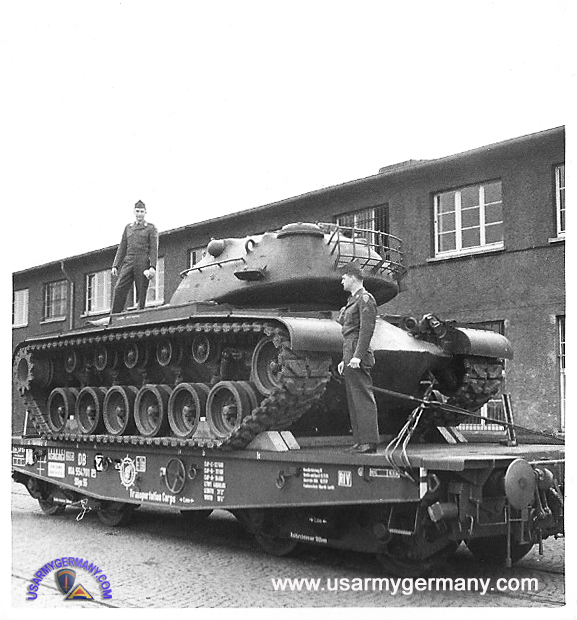
Frank Rolin and Bill Pitkin inspect an M-48 tank loaded on top of
an SSys 55 flat car at the RTC (Daniel Richetts) |
|
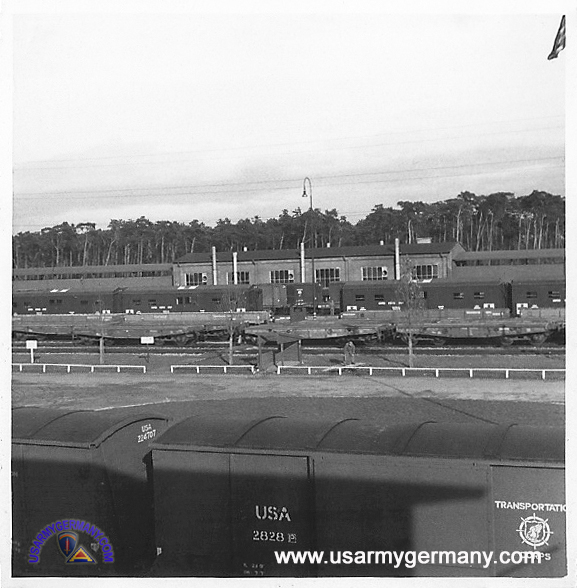
A view of some of the rolling stock at RTC including a hospital train.
In the background is the maintenance and paint shop. (Daniel Richetts) |
|
| 1954 |
| (Source: Email from Daniel Richetts, son of Don Richetts who served with the 8th TTRG in Schwetzingen) |
| Click here to view additional photos submitted by Daniel Richetts of Tompkins Barracks and Mannheim. |
|
|
|
|
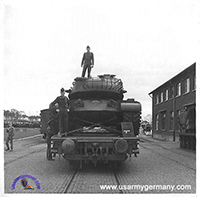
1. M-48 Tank on flat car
|
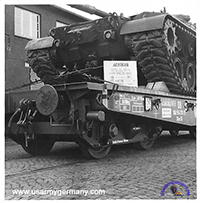
2. M-48 Tank on flat car
|
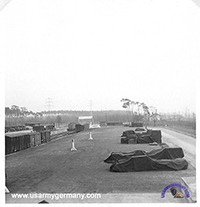
3. Looking towards the entrance to RTC |
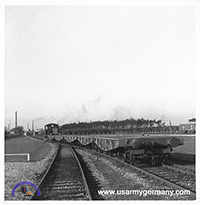
4. Looking towards Mannheim |
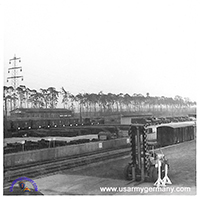
5. RTC |
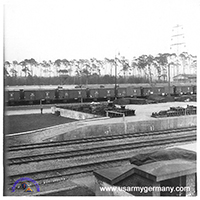
6. RTC |

7. Box car |
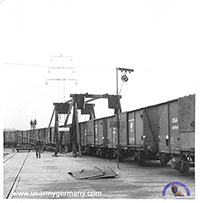
8. Hoist frame |
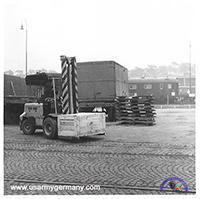
9. Damaged truck mounted crane |
|
|
|
|
 |
|
|
| Rheinau
Railway Maintenance Activity |
|
| 1958 - 1977 |
| (Source: STARS & STRIPES, Aug 21, 1968) |
The US Army Railway Maintenance Activity at Rheinau was originally established as the Rheinau Transportation Center on August 18, 1950.
The center was inactivated in July 1955 when the USAREUR Transportation Center was formed in Frankfurt. At this time railway maintenance was done by private (German) firms under contract through the Army.
In 1958, the Rheinau Railway Maintenance Yard was reactivated.
On Jan 1, 1966 the Yard was reorganized as a separate US Army Activity.
The Activity comprises 14 enlisted men and 10 Germans who handle about 1,700 pieces of railway equipment. CO of the Railway Maint Acty is Maj Edward M. Bahniuk; NCOIC is Sgt.1.C. Warren Guiden, Jr.
The mission of the Activity is to provide maintenance for all US-owned and operated railway equipment in Europe and to provide supply support for all installations that have US railway equipment on hand or in operation. Another aspect of the mission is to provide liaison between European railways and the various USAREUR headquarters for the procurement of railroad maintenance.
Major pieces of railroad equipment in Germany: |
|
|
Sixteen 45-ton locomotives (3 in operation at Rheinau; 13 in storage as uneconomical to repair) |
|
|
|
Fifteen 60-ton diesel-electric engines |
|
|
|
Two 2-car "mobile command posts" in operation (1) |
|
|
| | Three 1-car "mobile command posts" in operation (1) |
|
|
|
Four ambulance trains on location (each with a 3-man crew) |
|
|
|
Eight ambulance trains in reserve at Rheinau (with utility, personnel, kitchen and ward cars) |
|
|
|
Freight equipment at Rheinau - 715 tank cars; 708 flatbed units; 3 guard cars; and 3 mail carriers. |
|
|
|
Passenger equipment (2) - 103 sleepers; 10 troop cars; 2 kitchen units (seating eight per meal); 1 prison car; 1 Quartermaster clothing sales unit (3). |
|
|
|
(1) The mobile command posts are self-propelled trains that provide USAREUR's senior commanders with rapid transportation over European rail lines; they are equipped to serve the commanders as command posts on location.
(2) This equipment is used primarily on duty trains to and from Berlin.
(3) This car is used on scheduled runs to outposts like Fulda, Kassel and Giessen. |
|
|
The Rheinau Acdtivity also provides services to SETAF at Camp Darby and the Port of Embarkation, Leghorn, in Italy.
Major pieces of railroad equipment used by the Army's train system in Italy (4): |
|
Three 60-ton diesel-electric engines (used at the General Depot at Camp Darby and to and from the POE Leghorn) |
|
|
|
Passenger equipment: 2 sleeper cars |
|
|
|
Freight equipment: 18 flatcars; 3 tank cars |
|
|
|
| (4) This equipment belongs to Rheinau Acty |
|
Every piece of railroad equipment that arrives at Rheinau for maintenance is checked to see if it is beyond repair. The Activity serves as the only railway cannibalization point in Europe. They are authorized to remove serviceable parts and scrap what is left.
Many of the repair parts are purchased locally because most of the locomotives and railroad equipment was manufactured in Germany.
Rheinau maintains a 90-day supply of parts and keeps approximately 680 items in stock. They provide parts for all US railroad units in Europe, no matter where the equipment may be used.
The 60-ton diesel-electric engines are overhauled every six years at the yard. |
|
|
| If you have more
information on the history or organization of the Rheinau Railway Maint Acty, please contact me. |
|
|
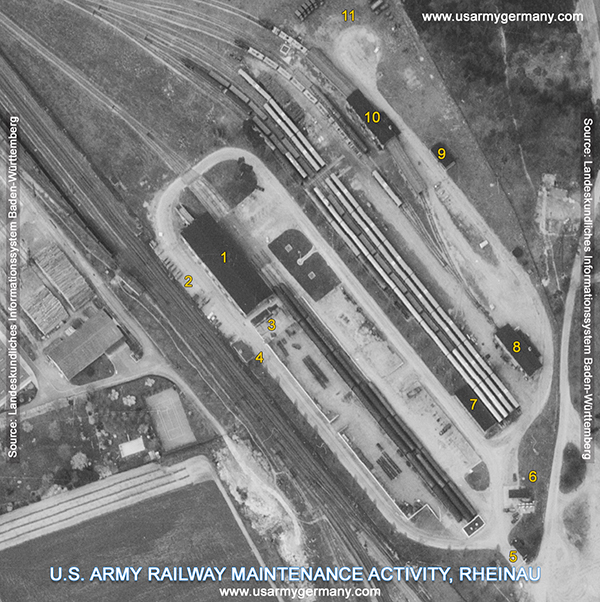
Aerial view of the Railway Maintenance Activity installation in 1968 (LEO-BW archive) |
|
| 1966 |
| (Source: Email from Ken Newberry) |
I've been reading the story on internet. It says contact you.
I was there (Rheinau) late 1966 untill April 1968.
I have lots of good memories, some not so good, from there.
My MOS was 65C20, diesel electric locomotive mechanic.
I remember Major Kahler, Major Bahniuk, Capt. Gutsfield, and Lt. Hyak. Sgts, Guiden, Jackson, Slaughter, Auman, Winters, and Patterson. (My name spelling may be incorrect, it's only been 58 years, ha.)
Looking at the picture you sent to me (see above), I can identify the buildings:
| |
#1 is the headquarters building, with offices in the upstairs in right hand end. Left end had offices for what, I don’t Know. There was a warehouse in the bottom floor, managed by a German named Gus. |
| |
#5 was entrance, possibly a guard shack |
| |
#6 was a “gas station” called motor pool. |
| |
#7 Not sure about, I don’t recall it. |
| |
#8 was called building 1187. It was used for repairs and some storage. We worked in there most all time. |
| |
#9 was Not used and was vacant as far as I remember. |
| |
#10 was the main locomotive shop with sheds built onto each end. |
Area between shop #10 and first set of tracks was known as “rip track” area where railcars were repaired. Repairs consisted mostly of replacing wooden planks on floors of flatcars.
I’m glad to find someone with interest in the place. Maybe we can learn more about it.
Looking at current aerial or satellite photos, it looks to be almost destroyed. Sad to look at. |
|
|
| 1967 |
| (Source: STARS & STRIPES, July 15, 1970) |
Regarding the Rheinau Railway Maintenance Activity information, when it was reorganized in 1966, it was known as the US Army Railway Maintenance Activity Rheinau (USARMAR), and was assigned as an activity of the General Depot in Kaiserslautern (USAGDK)
Besides Major Bahniuk, staff included one CPT and two 1LTs (I was one of them from 1967-1968). In addition to the permanent enlisted and German civilian staff, there were a number of German and expatriate Turkish contract workers.
Responsibilities included the licensing of all operators for US Army trains in Europe, including the Berlin trains and command trains.
Equipment maintained also included a number of missile railcars assigned to the 32nd Army Air Defense Command in K-town.
(Webmaster note: who can provide additional details on the "missile railcars?") |
|
|
|
| 1970 |
 |
|
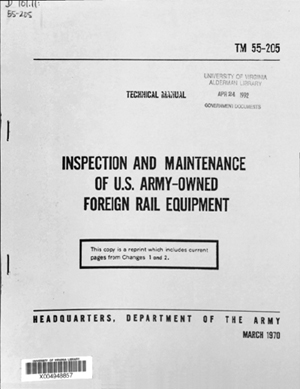
INSPECTION & MAINTENANCE OF US ARMY-OWNED FOREIGN RAIL EQUIPMENT
This technical manual serves as a guide for Army personnel responsible for inspection and maintenance of Army-owned foreign railway locomotives and cars, with special focus on equipment operated and maintained in Germany, Italy, Korea and Thailand. (The segments that are exclusive to Korea, Thailand and Vietnam have not been posted as they exceed the scope of this website.)
Click on image on the left to access the manual.
|
|
|
|
| (Source: STARS & STRIPES, July 15, 1970) |
The US Army Railway Maintenance Activity, Rheinau (USARMAR) ( ) is located between Schwetzingen and the small town of Rheinau near Mannheim. CO of the Acty is Maj Malchiga C. Whitworth who heads up a staff of 39 military and a similar number of civilian personnel. ) is located between Schwetzingen and the small town of Rheinau near Mannheim. CO of the Acty is Maj Malchiga C. Whitworth who heads up a staff of 39 military and a similar number of civilian personnel.
Their mission is maintenance and supply for US military rail equipment in Europe. The Activity maintains about 1,600 pieces of railway equipment (with a value of approx. $22 million) that belongs to USAREUR and provides supply support for all US military installations having rail equipment.
USARMAR is believed to be the largest railway maintenance activity in the US Army. The Acty falls under the control of the Kaiserslautern Army Depot.
USARMAR's railyard sits adjacent to the main north-south line of Germany's rail network.
About 35 percent of the maintenance work on US Army-owned-and-operated rolling stock is done at the Rheinau Activity (primarily organizational Direct Support and General Support work). The remainder is contracted out to about 15 (commercial) shops in Europe at locations that stretch from Bremen to Constance on the Bodensee. Rheinau is also responsible for the overhaul of all US military rail equipment in the theater.
The majority of maintenance work done at Rheinau is on flat cars, locomotives, passenger equipment and medical evacuation cars. Some of the type of work done at Rheinau includes testing the braking system on cars; repairing utility cars that supply electricity and heat to other cars on a train; reflooring and reworking flat cars (typically used to haul tanks and other tracked vehicles and equipment to the major traioning areas or to drop off or pick up vehicles at ports). Also, crews from USARMAR often travel to sites where rail equipment is being used to perform tests and repairs on the spot.
US rail stock can roll on tracks in all European countries with the exception of Spain and Russia (they have different track gauges).
Big users of US Army rail equipment in Europe: |
|
3rd Movements Region in Frankfurt - 3rd Mov Reg is responsible for the duty trains that run between Berlin - Bremerhaven, Berlin - Frankfurt and Frankfurt - Bremerhaven (primarily passenger equipment). |
|
|
|
Medical Command Europe in Heidelberg - The Command operates hospital trains that run twice weekly between Münchweiler, Nürnberg, Landstuhl, Heidelberg, Frankfurt and Rhein-Main. (The Rhein-Main run is to shuttle patients to the air base for medical evacuation to the U.S.) |
|
|
|
Petroleum Distribution Command in Zweibrücken - This command uses several hundred tank cars to ship POL products to US military units and activities throughout Europe. |
|
|
Some of the more unusual pieces of rail equipment include a QM Clothing Sales Store car that serves isolated activities and traing areas (the car is pulled to the location by German trains and then left on a siding as long as needed) and the Mobile Command Posts that provide senior USAREUR commanders with rapid transportation over European rails as well as serving as command posts during field exercises.
As part of the supply support mission, USARMAR maintains a 15-day supply of parts for all railroad units in Europe.
(Webmaster note: USARMA, Rheinau, APO 09333) |
|
|
|
| (Source: Email from Rudolf Heinisch, Germany) |
|
|
I have gone through my papers and records and have arranged some additional informations to the "Trains" US Army used in Germany. If you have questions, just ask. I am still looking to information for all kinds of railway equipment used by the US Army here in Germany and the rest of Europe.
I can confirm the data from Ralf Dittmer. Here is some additional information.
The trains were called “Two-Car Unit Command Trains” (801/2) and “Two-Car Unit Hospital Trains” (803 – 6). The Command Trains were located in Heidelberg and Stuttgart. The Stuttgart train (CG 7th Army?) was taken out of service in 1973 and scrapped. The Heidelberg train (CINCUSAREUR) still exists. It was modernized between 1988 – 1989, and was ready for service just a few months before the “Berlin Wall” fell.
The Heidelberg train was kept on standby 24 hours a day. A driver, a co-driver and an electrician where permanently (located with the train) to prepare the train to run in any direction within 2 hours. The use of the train depended on the CINC of USAREUR. Some of them used them very often; others just used sedans and planes. |
|
After the two Germanies were reunited, there was no further need for such a train and it was sold to a private railway, the GVG (Georg Verkehrssbetriebe, Frankfurt). It can be hired by anyone for private, exclusive trips throughout Germany and/or Europe. For example, the train was used by a group of American veterans on the 50th anniversary of D-Day for a historical tour of northern France.
The four Hospital Trains (VT 08 803 to VT 08 806) were stationed at Muenchweiler and Neubruecke (for some pictures of the VT 08 in Muenchweiler look at this website http://www.muenchweiler.de/Unterhaltung/BilddesMonats/General.html). All Hospital trains went out of service in 1973 (804-806) and 1974 (803). To my knowledge, 803 & 806 were scrapped in the Netherlands. I have no information what happened to 804 & 805.
In addition to the “Two-Car Units” there also were three “One-Car Units”, also used as Command cars. They were built in 1957 by DWM, Berlin and where numbered as VT 33 801 – VT 33 803. After renumbering in 1969 they were called 633 801 – 633 803. They were stationed in Heidelberg (801), Stuttgart (802) and Frankfurt (803). The 801 and the 802 went taken out of service in the 1980s and were sold to scrap yards. 633 803 was in Heidelberg together with 608 801. 633 803 was sold to a rail maintenance agency and was scrapped. I read on the Internet, that 633 801 still exists (see http://s134260722.online.de/drehscheibe-online/forum/read.php?f=17&i=2554&t=2554)
Additional remarks to the Hospital Trains
As described in the Story of “Stars & Stripes” there had been also “Hospital Trains” consisting of different coaches. US Army Medical Corps received in 1952/3 65 Hospital Ward cars (HWL). Each HWL as able to transport 42 wounded soldiers. In 1955/6 the German industry delivered some more coaches for the hospital trains. There were 8 personnel cars for medical persons and nurses, 8 kitchen dining cars and 8 utility cars. With these cars there were built up 8 Hospital Trains. Each one consists of
8 Hospital Ward cars (HWL)
1 Personnel Car (HCL)
1 Kitchen-Dining Car (HWR)
1 Utility Car (HM)
One HWL was surplus and was used when shop maintenance was to be done. The utility cars supplied the train with electricity and steam (for heating and warm water). The trains were stationed in Neubruecke (2), Muenchweiler (2) and in Mannheim (4). The trains in Mannheim were stationed at the Rail Maintenance Activity Yard in Mannheim-Rheinau. After Medical Corps received the diesel trains the hospital cars were very seldom on tour. By 1974 most of them were sold. One of the customers was RCT/BOAR, the Rhine Transportation Corps/British Army of the Rhine. They bought in total 38 cars from the Hospital train. It might be that American solders used one of these cars during the “Desert Storm”. Today most of the cars are scrapped, some still have survived in museum, for example a HWL in Cologne at the RIM (http://www.rimkoeln.de/), some other are in very poor condition in private collections, just like this one (http://s134260722.online.de/drehscheibe-online/forum/read.php?f=17&i=97289&t=97289#reply_97289) |
|
|
|
| 1977 |
| (Source: STARS & STRIPES, Nov 29, 1977) |
The Rail Maintenance Activity at Rheinau (Mannheim) officially ceased operations in October 1977. (In a statement made by the Deputy Chief of Staff for Engineering (HQ USAREUR), the installation was not scheduled -- this is 1977 -- for closure. USAREUR was still studying options for continued use of the facility which was equipped with storage and maintenance facilities.) The reason for closing the operation was the transfer of rail maintenance responsibilities to German repair companies which have more modern, up-to-date equipment.
Walter Kirylo was the last chief of the Rheinau Rail Maint Activity and was still on site at the installation at the time that the article was written. He planned to remain until the last of the rolling stock and locomotives was disposed of.
The facility, a part of the Mannheim Military Community, encompassed 18.5 acres of land, had 2.7 miles of track in the yards and operated two major repair facilities -- one for diesel and electric locomotives and the other for rail car repairs. At one time, the Army had 1,600 pieces of rolling stock and numerous locomotives (in Europe). They ran regular trains and did a variety of things with them. The bulk of the rolling stock was made up of freight equipment -- flat cars and tankers, but the Army also had about 83 passenger cars that made up its troop trains.
The major need for troop trains ended in 1966 as troopship service to and from Bremerhaven ceased. But other needs kept some of the passenger cars occupied -- such as the 37 cars that were retained to operate the Bremerhaven and Berlin duty trains. These duty trains were really just one or two cars hooked onto a regular German train.
The Activity began operations in August 1950 after the consolidation of several rail maintenance depots in Germany was completed (see the section on the USAREUR Transportation Center for more details). It was established as the most moden and complete Army train maintenance center in Europe.
Until mid-1955, all maintenance and repairs except required Deutsche Bundesbahn inspections were performed by the 35 local national employees and 45 soldiers who worked at the facility.
After 1955, only routine maintenance and minor repairs were done at Rheinau. All other work was considered to be depot-level and was contracted out to German repair firms.
Several reorganizations followed and by 1973, the last of the military rail workers and train engineers had been moved out.
By December 1976, when the decision was made to cease operations at Rheinau, only 19 Germans were still employed at the Activity -- each having more than 25 years of service with the facility. |
|
| |
%20at%20Ingrandes%20600.jpg)
US Army RS-4-TC engine at Ingrandes Depot, 1960s (Webmaster's collection) |
| |
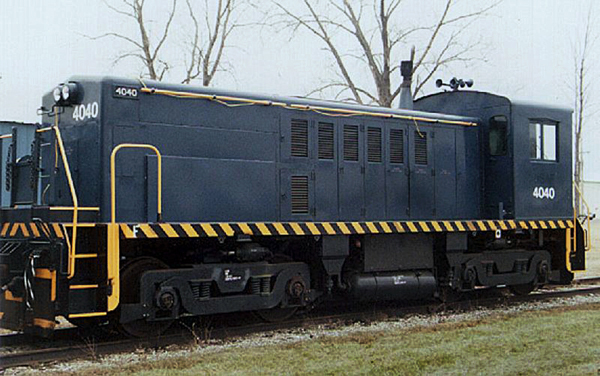
One of the RS-4-TC engines returned to the US in 1978 (Larry Pursell - website)
|
| |
At the time of the article, there were still 15 Baldwin-Hamilton diesel-electric, 60-ton locomotives in Europe. 13 were held in storage at Rheinau and two were in Italy where they were in limited use by SETAF (probably at Leghorn). Plans called for these engines (built in the 1950s) to be returned to the US where they would replace older, less efficient locomotives and be used by the Army and Air Force (see photo above).
The freight equipment at the facility was assigned to the German equivalent of the US Property Disposal Office and the majority was resold to various German companies.
Most of the passenger cars had been built for the US Army in Germany and some were unique. One of the major roles that they were used for was to serve as rolling billets for troops on exercises. One unusual type of car that the Germans built was designed for use in the field. It had its own boilers and generator and could provide power for a 12-car train up to two weeks. These trains were usually used as billets, hospitals and messes and remained stationary during the field exercises. |
|
|
|
| |
Related Links:
|
| |
| |
| |
| |
| |
| |
| |
| |
| |
| |
|