If you do
NOT see the Table of Contents frame to the left of this page, then
Click here to open 'USArmyGermany'
frameset |
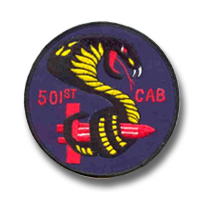
501st
Aviation Battalion
1st Armored Division
Looking for more information from military/civilian
personnel assigned to or associated with the U.S. Army
in Germany from 1945 to 1989. If you have any
stories or thoughts on the subject, please contact me . .
|
|
|
|
|
| |
| 501st
Aviation Battalion (Cbt) History |
|
| 1972
- 1986 |
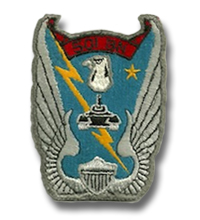
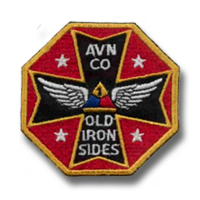
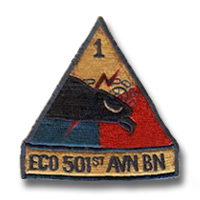
Early 501st Avn Bn Patch |
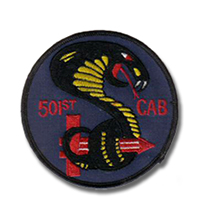
Later 501st Avn Bn Patch |
|
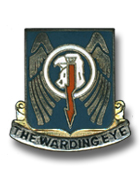 501st Aviation Bn (Cbt) DI 501st Aviation Bn (Cbt) DI
The 501st Aviation Battalion was reactivated on 21 August 1972 in Germany.
After serving in Germany for fifteen years the Battalion was deactivated on 16 November 1987, relieved from assignment to the 1st Armored Division and became a part of the United States Army Regimental System on 16 October 1988. |
|
|
|
| 1971 |
| (Source: Email from Monte E. Caylor) |
| In Mar 1971 I was assigned to Aviation Company, HHC 1st Armored Division at Göppingen, Germany.
The unit had UH-1 and two Beavers. CW2 David Gollem was the maintenance warrant at the time. I was assigned as the Beaver mechanic.
One Beaver was posted at Monteith Barracks and was used to transport mail and personnel over the 1st Armored Div Area of Operations.
We moved from Göppingen to Ansbach (Katterbach) in the Fall of 1971. Since there was no barracks available we moved into the building behind the fire station which later became the dental clinic. The roof was caved in and we lived in field conditions. Later we moved into the barracks across from the snack bar.
We stayed there for several months while they were renovating the warehouses along the side of highway. We were so far from the gate that we ended up cutting a hole in the fence to get to our favorite guesthouse (Stinkys) or (Pops).
I began crewing a UH-1 when they turned in the Beavers. The unit got two rebuilt UH-1H’s from ARADMAC. My aircraft was 66-16687 and it was the ADC’s helicopter. Later the Commanding General's pilot, CW4 Bill Abbot, decided that the CG wanted the 66 aircraft over the 68 because they had recurring problems with that aircraft. Spec Steve Fensky was the CGs crewchief. Since he was so short, I ended crewing for the CG.
I stayed at Katterbach until 1974 when I rotated back to the States. One of the other crew chiefs was Mike Williams.
The pocket patch for Avn Company, 1st AD was designed by one of the pilots.
Major William Howard was the commander at Katterbach.
I have come up with some more names of people that I knew while I was there:
 Sp5 Jimmy Bruce Sp5 Jimmy Bruce
Sp5 Mike Williams
CW4 Bill Abbott
Cpt Mike Halby
SSG Peter Satariano
SSG William Radabaugh
|
|
|
| 1973 |
| (Source: Email from Mark Gott) |
I worked in airfield ops from 1973 to 1976 at Katterbach. I remember Marty Caylor and W4 Abbott.
I arrived in Frankfurt and spent about a week there. I was supposed to be a company clerk. Several of my friends from Basic had gone over with me and they went to infantry units. They didn't seem to have a spot for me so they changed my MOS to airfield operations.
After about a week they sent me on a long day's trip South. I had no idea where I was going. We went to many Kasernes and dropped some guys off. After dark we arrived at a darkened out airfield. They did not leave me there. Some guys did get off but not me. They took us to another town to an old Kaserne on top of a hill in Ansbach. I spent another week there after arriving in the dead of night.
After one week I was picked up in a Volkswagen bus by the head company clerk and the mail clerk. I guess they had to get the mail, so I was part of the mail pickup. lol. Nice fellows both. Head clerk rotated out not long after. Mail clerk was my friend until he rotated out.
Mail guy stayed in Army and retired and served during Desert Storm.
That was my first day at Aviation Company 1st AD. Commander at first was Major Joles - he rotated about a year later. Super officer and very nice man. I drove for him when we went to the field and had some good times on field exercises with him and other company officers. He was always very generous and included me if they went to get food or a drink. It also got me out of the cold so I was grateful for that. I guess he liked the way I drove his jeep because I was always the one they asked for. I remember one time the Division General, I believe it was Heiser, landed in his chopper and needed a ride so we met him and he took the jeep with me as the driver. My Major was left standing in the field beside the chopper, a UH1.
The General, his aid and Sgt. Maj.went for a ride up a lot of roads. We had a severe traffic jam in this REFORGER 1974 exercise. Traffic was backed up for miles and these roads were very narrow. I had to drive in ditches, gullies and mud and every where. The General had me stopping everywhere and he was chewing butt and taking names. A lot of officers got reamed that day. If we had been under air attack we would have looked like the Iraqis did at the start of their retreat in Desert Storm.
The General tried to get me to drive for him but that's another story.
Some people I remember very well are:
Sgt. E7 Maples - ATC platoon Sgt.
Sgt. E6 Benson - ATC chief head of GCA at airfield.
Major. Joles - my company commander; he was also the airfield commander.
Capt. Simon - platoon leader for ATC platoon until riffed.
Capt. Rapp - Executive officer; later platoon leader for ATC platoon.
Lt. Tom Johnson - Leader ATC Plt.; my last platoon leader. He is from Vt.
He is a semi retired dentist now.
Tom was there after I left for some time.
It seems you forget names as time goes on. Some of these people and others were some of the best I have ever known in my life.
|
|
| |
| 1982 |
| (Source: IRONSIDES, Aug 18 1982) |
In 1979, the 116th Attack Helicopter Company (a subordinate element of the 10th Avn Bn) at Fort Lewis, Wash. was redesignated as Echo Company , 501st Avn Bn. The unit began to prepare for deployment to Europe.
By late June 1980, virtually every piece of equipment was enroute to Europe by sea -- the troops of E Co regrouped at McGuire AFB and departed for Katterbach near Ansbach, Germany.
Within 30 days of arrival, the unit had been fully trained, in-processed, equipped and was flying missions in support of the 1st Armored Division. |
|
|
|
| If you have more
information on the history or organization of the 501st Aviation Battalion
or 2nd Bn, 1st Avn Regiment, please contact me. |
|
| |
| MISCELLANEOUS
UNIT INFORMATION |
|
UNIT
DESIGNATION
|
DUTY
STATION |
COMMENTS |
| HSC,
501st Avn Bn (Cbt) |
Ansbach
AHP, Katterbach |
|
| A
Company |
|
form. Avn Co, 1st Armd Div |
| B
Company |
Ansbach
AHP, Katterbach |
form. D Trp, 1/1 Cavalry |
| C
Company |
Illesheim |
form. 175th Attk Hel Co |
| D
Company |
|
form. F Co, 123rd Maint Bn |
| E
Company |
|
form. 116th Attk Hel Co |
|
| |
| VARIOUS POCKET
PATCHES |
|
|
|
| |
| (Source: Email from Robert Quillen) |
| I was stationed in Katterbach (1964-1966), Coleman Bks (1967-1969), Illesheim (1970-1973, 1974-1977), and Katterbach (1977) until my retirement 1993. Some of the data provided below needs to be checked i.e. D Trp 1/1 Cav. The data in reference to A Co 504th Avn Co 4th Armored Division is correct up until about 1971. F Co 123rd Maint Bn is correct up till 1993; I was in that unit until Aug 1992 but still in the same hangar until 1993 with the 45th Med Co. |
|
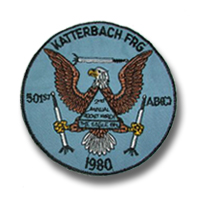 2nd Annual Rocket Hunt, 1980
 |
|
As for stories about the 501st Cbt Avn Bn,: It is the year 1979, B Co 501st Cbt Avn Bn is scheduled for gunnery at Grafenwöhr and to simulate the real thing or in time of threat, loaded the ammunition at the storage location in Urlas by Ansbach. It was on one of the AH-1Gs that some one forgot to flip the firing pins back into the proper position. On the flight to Graf the aircraft lost 3 rockets. The battalion was called out in mass to go search for the lost rockets, each unit was given an area to cover by foot through heavily forested areas, through streams, over fields and up and down steep hills. The battalion found not three rockets but five, it seemed that another unit had lost two but had never reported the lost. This rocket hunt became the annual Battalion get together of the units up until about 1985 -- the 7th annual Rocket hunt.
|
|
In 1977 the following units: 175th Attack Helicopter, Company F 123rd Maintenance Battalion, Aviation Company names were changed and the personal assigned at that time was reassigned to the new unit 501st Combat Aviation Battalion (Aug)(Carrier) (WADL90 A) -- the units became D Co 501st , C Co 501st and A Co 501st. At the present time I do not remember what the former unit ID was for B Co 501st. These units were located at Ansbach Army Airfield (Heliport) in Katterbach: A Co 501st, B Co 501st and D Co 501st; C Co 501st was located at Storks Barracks in Illesheim.
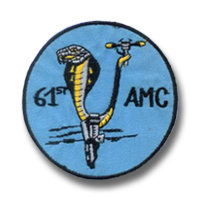
I have a copy of the orders reassigning the Officers of F Co 123rd Maint Battalion dated 21 Oct 1977, orders number 263-2 in my file. My records show that the D Co 501st became the 61st AMC around July of 1985 (*). I was stationed in Germany from Oct. 1974 (175th Attack Company) Illesheim APO 09140 to Aug 1977 at which time I transferred to Katterbach APO 09326, later APO 09250 and remained at that location until I retired in 1993.
CW4 Robert T. Quillen
(*) In reference to the 61st AMC in the 1st Armored Division, the day that we changed names from D Co 501st ABC to the 61st AMC we became part of DISCOM. My OER’s were signed by the DISCOM Commander as my Senior Rater. |
|
|
INFORMATION ON ANSBACH AND ILLESHEIM UNITS:
1964 - 1966
In Feb 1964 Ansbach Army Airfield, Katterbach, Germany, was the home for:
 EES* (AAFES*) as a Warehouse Depot EES* (AAFES*) as a Warehouse Depot
a nine hole golf course
A Company, 504th Aviation Bn, APO 09177
the aviation section for the 210th Artillery Group, and
a Detachment from B Co, 126th Maint Bn (Support Maintenance)
* EES = European Exchange System (*Army Air Force Exchange System, today)
A Co, 504th Aviation Battalion used hangar Number 1, Building 5801, for its maintenance, operation, and support of the aircraft. In front of the hangar across the ramp were located four Q-huts that we used to store our military vehicles. The unit was assigned 18 CH-34s.
On top of the hill at the end of the runway was a small hangar used by the 210th Artillery Group, the unit had OH-13’s, O1-Birddog and U6 Beaver.
B Co, 126th Maint Bn (Det) used half of hangar number 2, Building 5802 as their support maintenance hangar. The other half belonged to EES (AAFES).
EES used a 2½-ton World War 2 military truck painted blue to move the box cars around on the railroad tracks for loading or unloading. The truck was equipped with normal tires but had small train wheels that mounted on the chassis to allow movement on the rails without slipping off the tracks.
From the hangars looking south toward the back fence was where the 9 hole golf course was located.
The rest of the installation was used by EES (AAFES) as their Warehouse Depot up until about the middle /end 1965.
In 1965 A Co, 504th with the B Co Det. 126th took part in Operation Cold Winter 65, a NATO training exercise in Norway.
In Feb. 1966 A Co, 504th Aviation Company received the USAREUR Army Aviation Unit Award for 1965.
Due to the war in South Viet Nam A Co, 504th started losing its pilots and had to go into caretaker status. It was around this same timeframe that hangar #1 and #2 were declared unsafe and we moved from hangar No. 1 to hangar No. 7, Building 5807. All the aircraft except for three were placed in long-term storage under the supervision of B Co, 126th Maint Bn (Det) in hangar No.6, Building 5806, and were in storage in Sep. 1966. One of the aircraft that did not go into storage was CH-34C, serial number 55-4485 (58-463).
** Today the hangar numbers are backwards in reference to the Building numbers: hangar 1 is now Building 5807, hangar Number 2 is Building 5806,etc. Another item is that the old wooden hangars Number 3 and 4, Building numbers 5803 and 5804, are no longer standing -- they were torn down sometime in the 1980’s.
The personal from A Co, 504th Avn Bn and (Det) B Co, 126 th Maint Bn were housed at Hindenburg Kaserne, Ansbach, Germany, in Building 5351, third floor. The mess hall was Building 5392, the Enlisted Club Building 5363, NCO Club Building 5370 and the bowling alley was Building 5398. Hindenburg Kaserne is no longer part of Ansbach, in its place is now a College and a Shopping Mall. The college took over some of the old buildings to include Building 5351 as it was one of the Historical buildings that could not be torn down and replaced.
Headquarters Company, 504th Avn Bn, B Co 504th Avn Bn., and the Headquarters for B Co 126th Maintenance Battalion were located at Monteith Barracks, Fürth, APO 09696.
In 1966 I departed Germany and returned to the USA for further schooling.
Upon my return in late 1967 to Coleman Barracks, Mannheim, I learned that A Co 504th Avn Battalion had been renamed as the 349th Avn Co, APO 09177, located at Katterbach (Ansbach Army Airfield).
|
|
| |
1970 - 1973
In 1970 I was assigned to Illesheim, Stork Bks., to the 591st Transportation Company, APO 09140 as a Helicopter Technical Inspector. The Headquarters was the 71st Maintenance Battalion located at Pinder Bks, Zirndorf, APO 09070.
The 591st Trans Co. was the only aviation unit on Illesheim until late 1972 or early 1973 when the 175th Attack Helicopter Company arrived. In Jun 1972 the 591st Trans. Co. was disbanded and the personnel were transferred to the 29th Trans Co, APO 09061 but for duty with AK4024 Det.*, Illesheim APO 09140.
* AK4024 was the direct support supply for the aircraft within the area of Ansbach, Illesheim and Nürnberg. |
|
| |
1974 - 1993
In Oct 1974 I was assigned to the 175th Attack Helicopter Company, Illesheim, Germany APO 09140 as a Technical Inspector 67W20.
In March 1975 the unit took part in an Army test for the future Combat Aviation Battalion. The 175th Attack Co. became Company B 3rd Combat Aviation Battalion (Provisional), 3rd Inf. Division, APO 09140 with our Headquarters located at APO 09031. This test ended about Aug 1975 and the 175th Attack Helicopter Company was again under its own name.
In 1977, I was reassigned from the 175th Attack Helicopter Company to F Company 123rd Maintenance Battalion, APO 09326, Ansbach Army Heliport, Katterbach, Germany. Headquarters for the 123rd was located at Montieth Bks, Fürth, APO 09696.
On 21 Oct 1977, Company F 123rd Maintenance Battalion, APO 09326 was redesignated as 501st Combat Aviation Battalion (Augmentation) (Carrier), APO 09326 with instruction that effective 21 Jun 1978 the unit would become Company D, 501st Combat Aviation Battalion, 1st Armored Division, APO 09326 located at Katterbach, Germany, Ansbach Army Heliport.
It was during this time that most of the units were renamed/redesignated between Oct. 77 and Jun 1978 (Official date per order number 263-2 was 21 June 1978).
---There was no unit with the name 501st Aviation Company prior to the activation of the 501st Aviation Battalion on Katterbach in 1977. |
|
| |
Redesignated Units (Formation of 501st CAB)
Aviation Company, 1st Armored Division = A Co, 501st CAB, Ansbach Army Heliport, Katterbach, APO 09326
D Trp. 1/1 Cavalry (Aviation Only) = B Co, 501st CAB, Ansbach Army Heliport, Katterbach, APO 09326
175th Attack Helicopter Company = C Co, 501st CAB, Stock Bks., Illesheim, APO 09140.
F Co 123rd Maintenance Company = D Co, 501st CAB, Ansbach Army Heliport, Katterbach, APO 09326 |
|
| |
Units at Ansbach Army Airfield (Heliport), Katterbach, 1964- 1993
|
|
- Hq. Company, 501st Aviation Battalion
- A Co, 504th Aviation Battalion = 349th Aviation Company
- 349th Aviation Company = Aviation Company, 1st Armored Division
- Aviation Company, 1st AD = A Company, 501st Combat Aviation Battalion
- A Company, 501st Combat Aviation Battalion = A Company and E Company.
- A Company and E Company = Task Force Phoenix, 1st Avn Regiment
- B Co (Det), 126th Maintenance Battalion = F Co, 123rd Maintenance Battalion
- F Co, 123rd Maintenance Battalion = D Co, 501st Combat Aviation Battalion
- D Co, 501st Combat Aviation Battalion = 61st Aviation Maintenance Company
- 61st AMC = I Company, 1st Aviation Regiment
- I Company, 1st Aviation Regiment = Company C, 9th Battalion, 1st Aviation Regiment
- Company C, 9th Battalion, 1st Aviation Regiment = 601st Aviation Support Battalion
- D Trp, 1/1 Cavalry = B Company, 501st Combat Aviation Battalion
- B Company, 501st Combat Aviation Battalion = 2nd Battalion, 1st Aviation Regiment
- 3rd Battalion, 1st Aviation Regiment (had been 10th Battalion, 1st Regiment or C Company, 501st CAB) moved from Illesheim to Katterbach when unit exchanged aircraft AH-1S to AH-64A.
- 501st Military Intelligence had a small aviation section with EH-1H Helicopters.
- 45th Medical (Air Ambulance) Company, moved to Katterbach in 1992 from Nellingen.
- 1/1 Cavalry reactivated after 2/1 and 10th Attack received the AH-64 Helicopters
- Aviation Section, 210th Artillery Group moved to Herzogenaurach. |
|
| |
ADDITIONAL INFORMATION
From the data that I have the 501st Avn Bn (Cbt) was activated 21 Jun 1978 at Katterbach, Germany as that is the date that we were all transferred from the 501st Combat Aviation Battalion (Aug) (Carrier) to Company D, 501st CAB. Order Number 263-2. (I was with the unit D Co 501st Avn Bn Cbt from day one until it changed it’s name to 61st Avn Maint Company in 1986.)
I was stationed in Katterbach (Ansbach Army Heliport) from 1977 until I retired in 1993.
The units as I remember them were :
Units at Katterbach
HHC 501st ABC
A Co 501st ABC UH-1H and OH-58A
B Co 501st ABC (Attack) AH-1’s, OH-58’s, and UH-1
D Co 501st ABC (Support Maint) unit acft UH-1H
E C0 501st ABC UH-1H
Unit at Illesheim
C Co 501st ABC (Attack) AH-1’s, Oh-58’s and UH-1
Hangar buildings on Ansbach AHP
Hangar 1 (Bldg #5801): on Katterbach was B Company’s hangar
Hangar 2 (Bldg #5802): (Commissary Warehouse)
Hangar 3 (Bldg #5803) & 4 (Bldg #5804): old wooden hangars
Hangar 5 (Bldg #5805): (Commissary and Gym)
Hangar 6 (Bldg #5806): E Co and A Co
Hangar 7 (Bldg #5807): D Co with it’s DSSA and the acft from 501st MIB used our hangar.
This was not my first tour in Katterbach, I was first stationed there from 1964 until 1966 with A Co 504th Aviation Battalion 4th Armored Division ( CH-34A/C Helicopters)
CORRECTIONS
(Source: Email from Tom Hischler, D TRP, 2/4 Cav, 1968-69)
Re your 501st Avn Bn Page: During the late 1960s there were two aviation units at Katterbach not mentioned -
D Trp 2/4 Cav, likely the predecessor of D Trp 1/1. The rest of the 2/4 Cav was at Schwabach and was part of the 4th Armor Division which was replaced in name in the early 70s by the 1st Armor Division.
The other was the 349th Aviation Company which flew a number of CH-34s.
(Source: Email from Robert Quillen)
Reference VII Corps - 4th Armored Division - Trp D (Air Cav), 2nd Squadron, 4th Cavalry was not stationed at Ansbach Army Airfield (Katterbach Kaserne), Ansbach Germany in 1965.
The 4th Armored Division’s A Company 504th Aviation Battalion (later redesignated as 349th Avn Co) was stationed at that location in 1965 with 18 CH-34s.
(Source: Email from Robert Quillen)
The question, did the 61st TAMC fall under the TFP as a subordinate. No, this would never have worked out as the TFP had an aircraft mission and would have made their unit a priority unit for aircraft support maintenance. For this reason the aircraft support maintenance unit (AVIM) was always assigned to the HHC Aviation Battalion, 1st AD DISCOM (61st TAMC) and the HHC 1st Aviation Regiment to better support all units in the Battalion, Regiment or Division.
In my records, US Army Officer Evaluation Reports, the 61st TAMC was assigned to the 1st Armored Division between 1985 until around 1987. At no time was it assigned to Task Force Phoenix. Task Force Phoenix was just one of the units that the 61st TAMC supported in the 1st AD. If the unit had been under any other higher command it would have been HHC 4th Bde, not TFP.
|
|
|
| |
| 1982 |
| (Source: Ironsides, August 13, 1982) |
501st AB(C) is largest battalion in division
by Walter Crockett
The largest Battalion in the 1st Armored Division, the 501st Aviation Battalion (Combat), has only been around since 1957 but has a rich history and tradition of excellence and pride.
The battalion's history can be traced from Fort Polk, Louisiana, where it began as the 501st Aviation Company in 1957. The unit went through four campaigns in Vietnam where the aviation company earned the Presidential Unit citation with Streamer. Since 1978 the 501st AB(C) has been located at the Ansbach Army Heliport in Katterbach.
Providing total aviation support for the 1st Armored Division is the primary mission of the 'Eagle Battalion'. This support includes command and control for division and major subordinate commanders, attack helicopter support to the brigades, combat support to the division in the form of aerial resupply and air assault operations and general support, upon request, to divisional elements. |
|
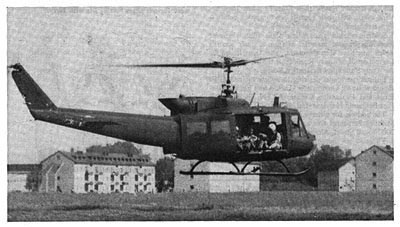 UH-1H of the 501st Avn Bn (Cbt) leaves Katterbach AAF on another mission supporting the 1st AD
|
|
The 501st AB(C) is comprised of 240 officers, 960 enlisted personnel, 146 helicopters, including the AH-1S modernized Cobra, the Army's newest attack helicopter, and 235 wheeled vehicles.
According to Battalion S-3 CPT. William A. Ryan, the 501st AB(C) began picking up the new Cobras in February of this year with Charlie Company receiving the last of the 42 choppers in June. "B Company was the first to receive the AH-1S's," Ryan explained, "and we began our New Equipment Training Team (NETT) training even before we received one Cobra. A NETT team from Fort Rucker and the Army Systems Command in St. Louis trained our troops in every aspect of the Cobra." |
|
During the last year the battalion's B-C-D companies have been extremely busy learning everything about the new chopper and the rest of the battalion has kept busy supporting the division.
In the last quarter year there has not been a day of rest for the aviation battalion with each company doing their part. In mid-April E Company flew missions in support of the 1st Battalion, 46th Infantry at the Hohenfels Training Area. At the same time A Company, B Company and HHC, respectively, conducted ranges at Oberdachstetten. The ranges were held so individuals could establish their zeros and qualify with their primary weapon.
In May E Company flew in support of interoperability exercises between the II German Korps and the U.S. VII Corps. The manuever was designed to test not only ground unit interoperability but also aviation interaction. The areas tested were air mobility, logistics and U.S. attack helicopter operations.
Bravo Company and Charlie Company provided three OH-58's each for Forward Observer and Aerial Observer training with the 1st Battalion, 22nd Field Artillery from 3-20 May. During the Gunnery density, the 1-22 FA provided FO's that needed observation experience from an aerial platform at the same time B and C Companies had the opportunity to train their aerial observers using live fire. C Company had a very valuable experience during its tenure in support of the 1-22. The German sister unit, the 1-25th Panzer Artillery arrived to work with the 1-22. The battery firing density was six per day which gave C Company not only the opportunity to train its AO's but to also work directly with a German artillery battalion learning their techniques and procedures.
Later in the year the 501st's E Company supported the 1st Battalion, 46th Infantry in Exercise Flintlock. According to CPT. Ryan, Echo Company did an excellent job. "We provided an aggressor scenario for both British and American forces."
The battalion kept busy in June flying in support of the activities of the 1-1 Luxembourg Light Infantry and accomplished many objectives pertaining to interoperability. During this exercise a Pathfinder Team from A Company assisted in airmobile operations. Charlie Company, also, got the opportunity to participate with the Luxembourg soldiers.
B Attack flew in support of the 2nd Brigade at the Hohenfels Training Center during SPRING-EX. The company flew scout missions and attack missions to support the 2nd Brigade with its tactical scenario. At this time the television program 20/20 sent representatives to film the attack helicopters as they performed their mission in a simulated combat environment.
Recently the Non-Bundeswehr Partnership Award was presented to Bravo Company. MAJ. Paul Murtha, B Company Commander accepted the award. According to Ryan the award was given for the distinquished relationship that B Company has with the 444th Squadron of the 4th CMBG.
In the upcoming REFORGER the battalion will have a reserve unit from the states training with them. "The 282nd Aviation Company from Fort Rucker will accompany us during Carbine Fortress," explained Ryan.
After REFORGER the battalion will have Gunnery at Hohenfels with the new Cobras and work on platoon section and crew level qualification. But according to Ryan some of the most important training in the near future will involve the pilots of Echo Company. "Echo Company pilots will be filtering to Fort Rucker right after REFORGER to train for the Black Hawk helicopter," Ryan said, "The pilots will get the training in the states and we'll be getting the choppers around February 83."
In conclusion Ryan added, "In the future as in the past and present we will continue to provide excellent support for the 1st Armored Division at anytime, any place." |
|
|
|
| (Source: IRONSIDES, May 6, 1983) |
501st AB(C) receives improved birds
Scout choppers are known as the "eyes and ears" of the attack helicopter teams, said Chief Warrant Officer Richard Raysik of Hqs. Co., 501st Aviation Battalion (Combat).
The battalion recently started receiving an improved version of the old OH-58A Scouts, the OH-58C. The first three C models arrived in March and Raysik is the first in the battalion to fly the new version.
"There are a lot of improvements over the A model," said Raysik, who is the senior instructor pilot for the new model. "The most visible difference is that the C's have a rounded windshield instead of the flat-plate type. The flat and round plate windshields are as different as night and day. The new ones are much easier to see out of, so the scouts can see the targets much better."
Another big improvement, said Raysik, is the addition of NVG (night vision goggle) capability. "If we go to war," he said, "we'd have 18-hour fighting days. This gives us the affordability to fly at night, which we couldn't do before."
"Another big change is the addition of a radar alitimeter," said Raysik. "It tells you precisely how high above ground you are. Before, the pilot had to calculate it himself. There is a low and high light which cells you whether you are too low and may hit wires or too high in an enemy area.'
Other improvements to the Scout include a bigger engine, a whole new instrument panel, increased weight limit and an added fourth planetary gear to the transmission.
"The fourth gear enables the aircraft to run another 30 minutes with no oil in the transmission," said Raysik.
Also, the addition of a landing and search light enables the pilot to maneuver the bird at any angle during night flight and when hovering in the woods. "The old model had only a landing light," said Raysik, "and the search light is a nice improvement."
On the maintenance side of the house, the engine area is now much easier to work on because of rearranged components, according to Sgt. Ernest Hill, the first crew chief to go through the OH-58C refresher course.
"We learned how to crew both the A's and C's in AIT," said the A Co. soldier, "but after working on the A model for two years you need a refresher."
Both the pilots and crew chiefs are currently going through training on the OH58C at their battalion in Katterbach. The 501st AB(C) currently has seven of the new Scouts and will have a total of 37.
Raysik said the battalion's A Company will retain some of the OH-58A's for general support missions. |
|
|
|
| 1985 |
| (Source: Email from Mike Lege) |
I was trying to find information about CSM Robert M. Kannardy and I came across your site. You and your contributers certainly have brought back many memories for me. In fact, so many I can't rember what I have forgotton!
I arrived at the 21st Replacement Detachment in June of 1985 and was assigned to A Co 501st ABC as a UH-1H helicopter mechanic. In Headstart, Sgt Major Kannardy sat directly behind me (we were both new to country), and every time Frau Goppelt had us counting, it made no difference who the # six fell on; she always called on me to turn to the big scary Sgt Major with a stogie in his mouth and a smile on his face and tell him, "sex"!
I arrived as an E1 and left Katterbach as an E4. I stayed @ A Co through our restructure with E Co when we became Task Force Phoenix. I was, as were many of us, a subject of Lt. (name withheld) mini dictatorship. I was there when he hit the bacshops NCOIC with a trashcan lid. He sealed his fate with that one!
Later, I moved to 501st AHB. It was my understanding that at the time we were inspected in the field by the Soviets, it was a first. We stayed in the tents and played poker; the Soviets were not allowed to look inside.
Some of the names I remember, (I was there from 1985 to 1987):
Anna Thompson
Thomas Faupel
Albert P. Brocious
Craig Nitzche
"Sprad" (Spradling)
Cox
Hanley
Ronald Osborne
Gardner Mckay
Michael Hebner
Robert M Kannardy
Louis and Sheri Deldo, (flight surgeon and gp, respectively)
I also remember Lt. Faupel having Sean and I clean the fuel spill in the hangar (A Co), after one of the avionics techs hooked up the battery and turned on the fuel boost pump without letting us know. The main fuel line was disconnected. It's a good thing I had the presence of mind to suggest we water the hangar floor down and squegee it before we started using the straw brooms we had or you would be reminiscing about the big fire that killed 2 people from A Co.
I also remember when one of E Co's Blackhawks went down due to the pin in the transmission cooler shearing and breaking the tail rotor driveshaft. That was in the winter of 1986 if I recall. We were impressed with the pilot's ability to get the nose up during the resulting spin.
I remember the controller in the Nuremburg control zone that sounded like Elmer Fudd, (two five zewo - turn whight to a heading of....)
The memories are coming back. |
|
|
| |
| 1986 |
4th Brigade (Aviation), 1st Armored Division, was activated on 17 April 1986 using elements of the 501st Aviation Battalion as its core. Colonel James W. Lloyd, the first Brigade Commander accepted the unit colors from Major General Dave R. Palmer, Commanding General, 1st Armored Division.
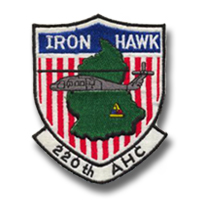
The Brigade consisted of the 10th and 501st Helicopter Battalions, the 220th Assault Helicopter Company, the 244th Command Aviation Company and the 61st Aviation Maintenance Company. Brigade aircraft included 22 AH-1 Cobras, 38 OH-58s and 30 UH-1s.
On 16 November 1987 the 501st and 10th Attack Helicopter Battalions were redesignated as the 2nd and 3rd Battalions, 1st Aviation Regiment. A Company, 501st became G and H Companies, 1st Aviation Regt. under the 1st Armored Division. The 61st Aviation Maintenance Company was designated I Company, 1st Aviation Regt.
In May 1988, the 1st Squadron, 1st Cavalry completed the conversion from a pure ground squadron to an air/ground squadron, and moved from Schwabach to Katterbach (to join 4th Bde). |
|
 |
|
| |
| A Company, 501st Aviation Battalion |
|
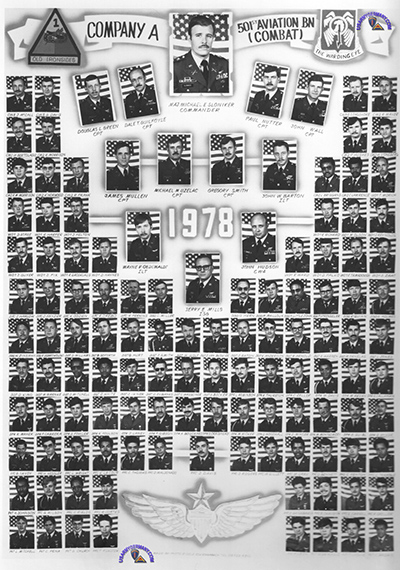
A Company, 501st Avn Bn (Cbt), 1978 (Doug Green) |
|
| 1979 |
| (Source: Email from Thomas Lewandowski) |
I was assigned to the 501st CAB from Feb/79-Sept/81. I was in A Detachment, A Company, 501st CAB.
We were stationed in Monteith Barracks, Furth, Germany (just outside Nuremburg). We flew all the Brigade Commanders for 1st AD. I was the crew chief on a OH-58A Helicopter that supported 2nd Brigade out of Illesheim. We also flew the division commander.
It is great to see this info on the web. |
|
|
|
| 1980 |
| (Source: Email from Jerry Miller) |
I found your web site for the 501st Avn.
I was with A Company from mid 1980 till mid 84.
Went to Katterbach as a member of E Co when they came over from Ft. Lewis.
I
had my "in-country" orientation, currency ride on a Saturday right after arriving only to find out on Monday I was being transfered to A Company as an OH-58 pilot since that's what the majority of my time was in.
Worked as a Line pilot till 1983 when Col. BJ Wright sent me back to Ft. Eustis for AMOC.
Returned to A Company and finished my tour as an OH-58 test pilot.
I returned to Germany in 1989 as a Blackhawk test pilot assigned to 203rd Avn in Schwabisch Hall. |
|
|
| 1983 |
| (Source: Bamberg Times, August 12, 1983) |
Det. B Army Aviators - 501st AB(C) provide air support in Bamberg
by Chris Gross
The Bamberg Army Airfield, located just north of Berliner Ring, between Memmelsdorfer Strasse and B 26, is staffed by Army aviation personnel from Katterbach. The Airfield commander, 1st Lieutenant Gregory N. Brooks, is also the commander of B Detachment, A Company, 501st Aviation Battalion (Combat). In trying to explain his position here in Bamberg, Brooks said, "To the 501st, I am the detachment commander; to the Bamberg community, I am the Airfield commander."
The main mission of the Airfield personnel is to provide support for movement to the assistant division commander (B) (Bamberg Community Commander), and to the Commander, 3rd Brigade, 1st Armored Division.
Support for the ADC(B) is provided with a Utility Helicopter (UH-1) and two aviators, Chief Warrant Officer 3 Dennis Krewson and Warrant Officer James Bindschatel. The support for the 3rd Brigade Commander is provided with an Observation Helicopter (OH-58) and one aviator, Warrant Officer Richard Welsh. Brooks is occasionally called in (as) a substitute pilot when needed.
The Airfield also supports 2/2 ACR by providing facilities for their squadron commander's OH-58 and aviator, Chief Warrant Officer 2 Ted Zoeller.
In addition to the helicopter pilots, the Airfield is home to three Crew Chiefs, two Petroleum, Oil and Lubricants (POL) specialists, and the Airfield NCOIC, Staff Sergeant Don Jacobs.
Jacobs, Brooks' right hand as Airfield NCOIC, is in charge of the troops as the Detachment NCOIC, and also serves as the Airfield TI (Technical Inspector). "Any time anything is done to, or with, an aircraft, the TI has to inspect it to make certain everything is right," said Brooks.
When it comes to flying a mission, there is a lot involved. The pilot needs to know who he is transporting, what the destination is, and the required arrival time. From this, he will determine his departure time, and will know at what time he will need to begin his pre-flight inspection. He must also obtain weather reports from both the starting point and the destination. The biggest problem peculiar to flying in Germany is the weather. According to Brooks, "you could have perfectly clear air over the Airfield, and at the same time, downtown Bamberg could be covered with dense fog."
After each mission, it is the responsibility of the Crew Chief to inspect the entire aircraft. This inspection is called a "daily" and will usually take from 1½ hours to 2 hours. For every hour of flight time, 2 hours of maintenance are required.
Each aircraft must be refueled after every mission. This is part of the job done by the POL specialists. It is also their responsibility to order all POL, and make certain the 5,000 gallon tanker, located at the Airfield, is fueled at all times.
Although the Airfield personnel are from Katterbach, they are attached to Headquarters Detachment, USMCA Bamberg, and receive much of their support from the Bamberg Community. In turn, the community gains support for many activities. One example of this support was the recent German-American Volksfest, for which Brooks and Krewson flew over the Volksfest site and dropped two parachutists for the opening ceremony. Another German-American Activity supported by the Bamberg Airfield was the Air Show on July 24th, on the German side of the Airfield.
Working with Herr Rudolf Suss, Brooks, Krewson, and other airfield personnel helped to coordinate the static display of American Aircraft for the Air Show, which included a Cargo Helicopter (CH-47), provided by the 180th Aviation Company from Schwäbisch Hall.
A section of the Bamberg Army Airfield has frequently been utilized by the Bamberg Area Scouts, as a location for overnight camping.
The Bamberg Army Airfield is patrolled by a Civilian Security Guard Force, consisting of multiple-man teams working 24-hour shifts. In addition to guarding the gate at the entrance to the Airfield, the guards insure the security of all aircraft, POL and buildings on the Airfield, at all limes.
Although the number of personnel at the Bamberg Army Airfield is small, the support provided is most definitely no small thing. Said Brooks, "Our goal is to provide support to the Bamberg Community, both military and civilian, in every way we can." |
|
|
|
| |
| B Company, 501st Aviation Battalion / Trp D, 1st Sq, 1st Cav |
|
| 1979 |
| (Source: Email from Steve Vaske) |
| Thank you for all your work on the 501st CAB website.
I served with B Attack from 1979 to 1981 and loaded the port side rocket launcher of the Cobra that lost 3 rockets! Luckily (for me anyway) those rockets all came out on the starboard side.
One thing I would like you to include on the website is how B Attack (and later C) got its name.
Our CO, when I arrived, was Maj. Ace A. Cozzalio and he was the man who changed it from B Company to B Attack!. We took a lot of pride in that name and a lot of ribbing from the other units in the Btn. and on the post but they soon recognized the excellence that Ace demanded of us and the reason for our pride. I knew that Major Ace as we all called him was a decorated Viet Nam era pilot but I had no idea how much he was respected and admired by the US Army as a whole until I google'd his name a few months ago.
Major Ace left B Attack in the summer of 1980 to go th the CGSC at Fort Leavenworth.
He later achieved the rank of LTC. and commanded an aviation training battalion at Fort Rucker. Unfortunately he had to take a medical retirement from the Army and passed away in the early 1990's.
Major Ace had sent a letter to the Pentagon volunteering B Attack to go and rescue the American hostages in Iran when that was all happening back in 1980. I have no doubt that if he were alive on 9/11/2001 Ace would have captured or killed Osama bin Laden long ago! |
|
|
|
| 1980 |
| (Source: Email from James M. Speicher, B ATTK, 501st ABC, April 1980 - August 1983) |
| I was a proud member of B ATTACK! I think our CO was Major Key, followed by Major Murtha. I lived for some time at the BOQ across the road, just a short crawl from the O'club. Cheers. BTW, great website - nice memories. |
|
|
|
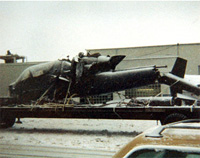
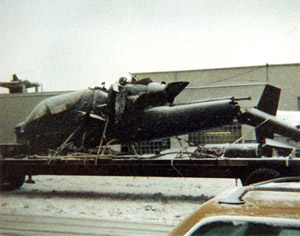
The Cobra (shown in Kevin Matthews' contribution above) being hauled out on the flatbed belonged to C Company.
The Standardazation Instructor Pilot, Sandy Breckens, was front seater. Can't recall the rear seater, I believe he was Dee Falks but can't be sure. Anyway, they were in line at a FARP (refuel point) when they whited out. From later discussions we figured they must have hung a skid on the up-slope side and fell victim to dynamic rollover. |
|
|
| They also had a good time getting out. It landed on the port side which trapped the front seater inside. They hit the canopy jettison but being pretty old, it failed to work. The front seater had to climb rearward, over the pilot console, to exit through the pilot door. |
|
|
|
| (Source: Email from Glen Meldahl) |
I am a CW2 retired Cobra pilot. I flew with Jim Speicher under Major Paul Murtha in B Attack.
I was part of the flight that delivered the first AH-1S Cobra to Katterbach from England. Problem with the aircraft was the air conditioning. We had to turn it off because it was blowing
chunks of ice at us when we got to altitude.
Jim Speicher was in 2nd Platoon when I got there and gave me my orientation flight through the little Swiss valley.
Trim Glen, "step on the ball" I remember him saying repeatedly.
I retired from the Army at Katterbach in 1986. My last 6 years of service were with B Attack. |
|
|
|
| 1983 |
| (Source: IRONSIDES, July 1, 1983) |
501st practices teamwork
Pilots from B Attack, 501st AB(C) held a Joint Air Attack Team (JAAT) exercise recently with a squadron of A-10s from Leipheim. (Webmaster Note: The Air Force maintained four forward operating locations (FOLs) in Germany for the A-10s that were stationed in the UK. Leipheim was one of them.)
Working with the 3rd Detachment, the Cobra/OH-58 teams and the A-10's played havoc with the 3rd Infantry Division units on the ranges of Hohenfels.
"What we have today are two teams of three OH-58s each, five Cobras and four A-10s," explained 1st Lt. J. Craig Tallman, assistant operations officer, with the 501st. "What we'll be doing is scouting targets for the A-10 and the Cobras to kill.
"A JAAT exercise is basically what it means," explained Tallman, "a joint operation between the Army Cobra/OH-58 killer teams and the Air Force.
"What happens is, if there's an enemy position/concentration, the scouts will already be on station observing," he said. "We spot the target and call in artillery or, in the case of tanks, we call in the Cobras.
"If there are too many tanks for the Cobras to handle or the enemy armor is beyond their ammunition capacity, the Division Air Liaison Officer coordinates with the Air Force for an A-10 strike.
"How JAAT takes place," he explained while drawing on a chart board, "is the battle captain of the scouts will take over once it has been confirmed that the A-10s are coming and everyone will change to a pre-arranged frequency.
"The A-10 flight leader informs the battle captain when they're about one minute from the pop-up point," said Tallman. "The Cobras are already in the area and the artillery is falling, so the battle captain has to make all the coordination to stop the artillery, get the Cobras out of the way and bring the A-10s in on target.
"He only has a little time in which to acccomplish this," he added. "The reason to stop artillery isn't because the A-10s might get hit by incoming artillery; it's because of all the shrapnel coming up from the explosions.
"When the A-10s reach the pop-up point and begin their final run on the target, the Cobras must stop and mask (duck into protective cover and change positions).
"When the A-10s have released their ammunition from about three thousand meters out, they begin an erratic maneuver to evade enemy air defenses,"he said. "By this time, the Cobras have changed their positions, and they unmask to provide covering fire for the A-10s on their way out.
"If the pilots decide that another strike is needed, the whole process begins again," Tallman concluded. "If they do come back in, it's usually from a different direction so as to keep the enemy in confusion and to give the Cobra a chance to relocate and reengage the enemy. |
|
|
|
| |
| C Company, 501st Aviation Battalion / 175th Attack Helicopter Company |
|
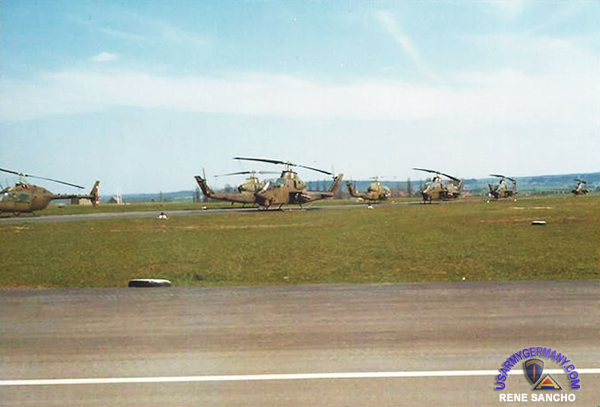
175th Avn Co flight line at Illesheim, mid-1970s (Rene Sancho) |
|
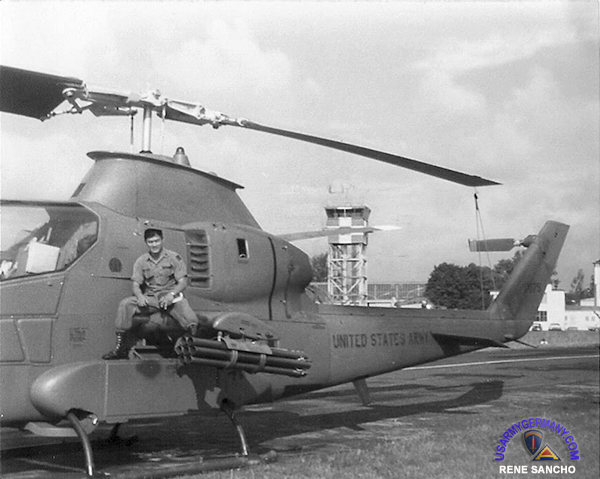
175th Avn Co COBRA at Illesheim, mid-1970s (Rene Sancho)
|
|
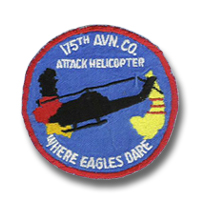
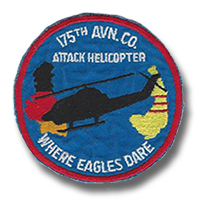 175th Aviation Company (Attack Helicopter) patch, early 1970s 175th Aviation Company (Attack Helicopter) patch, early 1970s |
|
| 1973 |
| (Source Email from Dennis Green) |
I was talking today with some fellow vets here at work. It got me thinking about my years in Germany, so I looked up your website. I was assigned to the 175th Avn Co AH in Dec. 1972 at Fort Knox, KY after graduating from Aberdeen Proving Grounds Ordnance School. My MOS was 45M20, Aircraft Armament Subsystems Repairman.
The unit was reassigned from Fort Knox to Illesheim, Germany in Jan., 1973. We deployed to Europe as a unit flying out of Fort Dix, NJ to Frankfurt and arriving on Jan. 26, 1973.
The new barracks were not ready when we arrived, therefore for the first six months in Illesheim we lived in the top floor of the main hangar.
The 175th Avn Co (AH) patch came out shortly after the unit arrived in Germany. It was to signify the unit leaving Viet Nam and flying to Germany. I still have a field jacket at home with the patch on it.
My section was Armament, and the section chief was SFC Glenn Dickerson.
The CO of the unit upon arrival was Capt. (later Major) Rosenberg.
Here are some names of my buddies I remember from those years:
Jeff Rosenblatt
David Florczak
Jay Leonard
Thelbert Hamm
Wade Hedges
Lloyd Phelps
Steve Westerman
Steve Fowler
“Bug” Gibson
Michael Query
Richard DeLosier
Willie Hill
I remember that the Rod and Gun club was just down the main road at that time and it was ran by a ex-serviceman named Ernest T. Gambil.
The installation was called Storck Barracks, and the closest city other than Illesheim was Bad Windsheim.
The funny thing is that nearly every married couple in the unit at Storck Barracks had at least one child while there. The closest hospital was in Nuremberg, and sometimes the expectant mother gave birth in the ambulance on the way to the hospital.
I spent two and a half years in Germany, leaving on June 1, 1975.
During that time our Cobras fired several times at Grafenwhoer, spent six weeks in Madrid, Spain in the Spring of 1974, and Sardinia in the Fall of 1974. The trip to Madrid was due to the Spanish government wanting to purchase some AH-1G Cobras from the US, but they wanted a live fire demonstration before they made a decision. The 175th was selected as the unit to provide the demo. We spent about a month at Torrejon AFB outside Madrid, and then drove every day to a Spanish chopper base the other side of Madrid. Several dignitaries were there including Francisco Franco’s brother, and Prince Juan Carlos who later replaced Franco when he died.
When I left in June, 1975 the 175th was just starting to receive the new TOW Cobras.
My most memorable time was during the October 1973 war in the Middle East. The 175th was on one hour alert status as we were an anti-tank helicopter unit. We slept in our combat gear for about three days as we were on a moment’s notice to assemble on the airfield for deployment.
Sadly, when I left the Army in June, 1975 I didn’t contact any of my buddies from my unit and have never heard from any of them. There were some good memories from those days of firing the Cobras, and being in the field at Graf and for REFORGER. |
|
|
| (Source Email from Robert Quillen) |
The 175th arrived in the early part of 1973, at that time I was assigned to the 29th Trans Co (DS) APO 09061, but for duty with AK4024 Det, Illesheim Germany APO 09140, order number 180, dated 28 Jun 1972.
In 1974, I was assigned to the 175th Aviation Company (AH) APO 09140 Illesheim Germany, order number 297-24 dated 24 Oct. 1974.
Futher orders show that the 175th Aviation Company (AH) was in Illesheim in 1975 and 1977. The statement in the Email from Danny Rutledge that the 175th was in Kitzingen in 1975 is not true, reference the enclosed orders. (AH) stands for Attack Helicopter.
Robert Breden's email that the unit had 21 AH-1G’s, 2 TH-1G’s is 100% correct and he is correct that B and C Companies received the AH-1S (Mod), neither unit had any F of Q models.
I left the 175th Aviation Company and moved to Katterbach with an assignment to F Company 123rd Maintenance Battalion order number 202-14 dated 11 Aug 1977.
Order number 263-2 relieved us from the 123rd Maintenance Battalion and assigned us to the 501st Combat Aviation Battalion (Aug) (Carrier) APO 09326 reporting date 21 Oct. 1977. These orders further assigned us to D Company 501st Combat Aviation Battalion which would take place on 21 June 1978. All the units that became part of the 501st Battalion happen during the time periods.
I hope these orders help with your research of units in Europe.
In June 1972, we were a total of 35 personnel as part of AK4024 in Illesheim. AK 4024 was the supply point for Army Aviation within the VII Corps area, non Division aviation units, in Bavaria.
AK4024 used a hangar, building number 6501. This is the same building that the 175th moved into in 1973 and remained in that building, even after the name change to C Company 501st Combat Aviation Battalion. AK4024 and the 175th used the same building until the late 70’s.
The 175th Billets was building number 6505.
IMAGES:
1. Special Orders #180 (Hqs VII COSCOM), dated 28 June 1972
2. Special Orders #297 (Hqs USAREUR and Seventh Army), dated 24 October 1974
3. Unit Orders #10 (175th Avn Co (AH)), dated 25 August 1975
4. Letter from AEUPE-PR, subj: Appointment as a Reserve Warrant Officer of the Army under Title 10, dated 2 May 1977
5. Orders 202-14 (US Army Regional Personnel Center Ansbach), dated 11 August 1977
6. Orders 263-2 (US Army Regional Personnel Center Ansbach), dated 21 October 1977
|
|
|
|
| 1975 |
| (Source Email from Danny L. Rutledge, 175th Attack Helicopter Company, 1975-78) |
I was in the U.S. Army from Aug. 11, 1975 - Aug. 10, 1978. I was first stationed at Kitzingen near Wurzburg. At that time the unit was the 175th Attack Helicopter Company. I am afraid I don't remember any of the guy's I was with except Dwane Zurl's. We were there just a short while. That was when there were still a West and East Germany.
We were reassigned to Stork Barracks (Illesheim) and everything was reorginized into the 501st CAB of the 1st Armored Division. I believe the commander at that time was Maj. Collins but I am not sure.
Could you help me find some of my old friends? I am 51 yrs. old now and I guess I am wondering what has happened to them all.
CORRECTION
(Source: Robert T. Quillen,
CW4, US Army Retired)
Danny L. Ruthledge states that the 175th Attack Helicopter Company was stationed in Kitzingen when he was in the unit.
This is not true, during the time frame that he has given, the 175th Attack Helicopter Company was in Illesheim, Storck Barrarks, APO 09140.
I arrived in that unit in Oct. 1974 as a SP6 Tech Inspector 67W20, later took over the back shops as a SFC 67Z50 and in 1977 left the unit to transfer to Katterbach as a WO1, Aviation Maintenance Technician. This data can be check if any OUTLAW pilot checks your site. |
|
|
|
| 1976 |
| (Source Email from Robert E. (Gene) Breden, 175th Attack Helicopter Company & C Company, 1976-80) |
I was assigned to the 175th Aviation Company in June 1976 as a SP6 Technical Inspector. The 175th had no AH-1Q aircraft. We had 21 AH-1G Cobras and two TH-1G Cobras. We turned these aircraft in to receive AH-1S(Mod) aircraft.
I was assigned to the 175th and was present at the activation ceremony for C Co. 501st. I left the 501st in June of 1980.
I was assigned to the D Co. 3rd ABC in June 1982 and served until September of 1987. When the 63rd TAMC was activated, it was assigned to DISCOM. It was still part of DISCOM when I departed. |
|
|
|
| |
| D Company, 501st Aviation Battalion / F Co, 123rd Maint Bn |
|
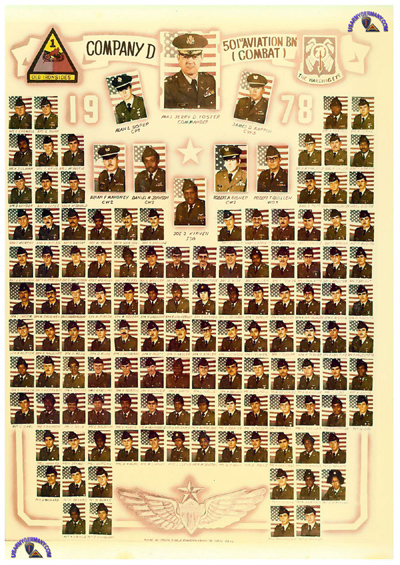
D Company, 501st Avn Bn (Cbt), 1978 (Wilberto Gonzales) |
|
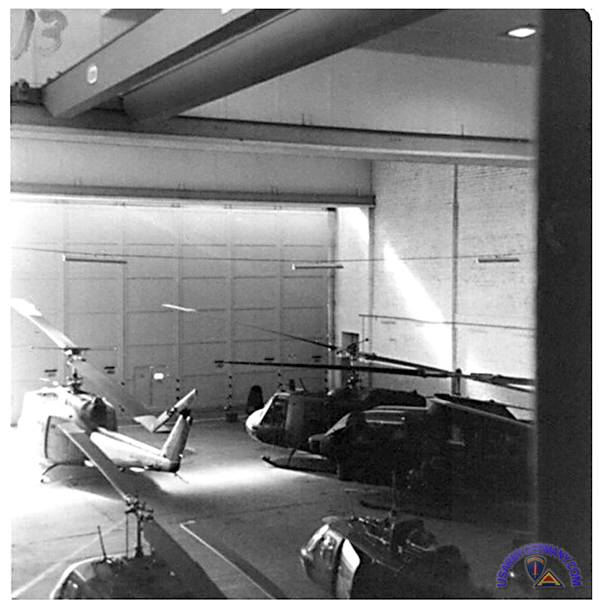
Inside D Company hangar, Katterbach, c. 1977 (Doug Green)
The UH-1 in the center was 66129 company bird. It was either a 1972 or 74 model.
New for the average age of a Huey in the battalion.
|
|
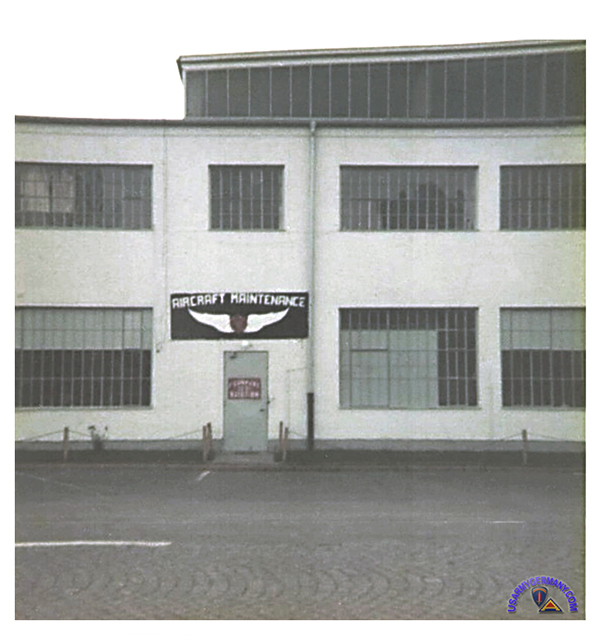
Street entrance to D Company hangar, Katterbach, c. 1977 (Doug Green) |
|
 501st Avn Bn Cbt decal, 1981 501st Avn Bn Cbt decal, 1981 |
|
| 1976 |
| (Source: Email from Doug Green, F Co, 123th Maint Bn; A & D Co, 501st CAB, Katterbach AAF 1976-1979) |
I served in Germany from approximately June 1976 thru May 1979. I served in F Company 123rd Maint Bn, then D Company 501st, then C Company 501st, then back in D Company again, and lastly A Company 501st.
If possible I would like to post on the web site some of the individuals I served with and some of the events that transpired during my time in the unit. For example I believe I know how and why that OH-58a crashed and ended up in the trailer. Also a story behind the first SOTAS UH-1 having a 42 degree gearbox failure while on station up at the border, at 30knots, at altitude (somewhere north of 6,000ft.) on a Friday night and how the pilot only bent the skids, no other damage. |
|
|
Doug Green's recollections of the 501st CAB (PDF format) |
|
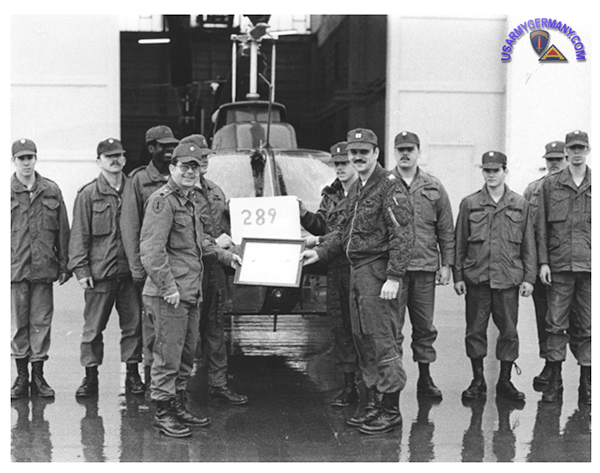
OH-58 SERIAL # 289
When I joined the unit in July 76 the aircraft needed a transmission, main rotor system, engine, tail rotor/gearbox assembly, etc. It was a division float aircraft that had been used as a parts “source” and had turned in to pretty much just an airframe. This picture was taken the day we finally got it all back together. Sometime around December 1976. Ltc. Barnaby Commander of the 123rd Maintenance Battalion presented us with a letter of accomplishment. Holding the plaque on the left is Ltc. Barnaby, on the right is Cpt. Hudspeth. Holding the serial number 289 on the left is CW2 Bourland and I am on the right. Unfortunately the names of the aircraft mechanics escape me. My most sincere apologies. |
|
|
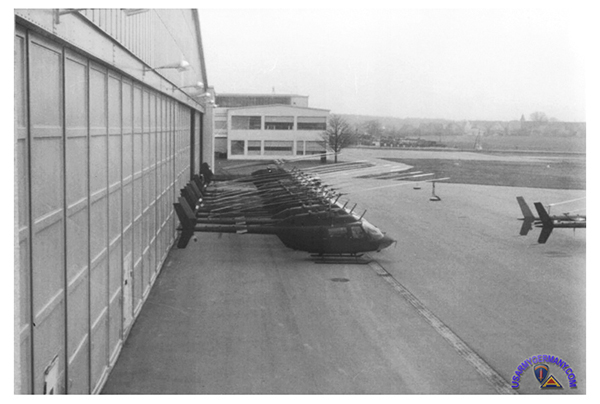
16 of the 25 OH-58’s assigned to A Company. D Co hangar in background (Doug Green) |
|
ADDITIONAL INFORMATION
The 501st Avn Bn patch was worn on the breast pocket of the uniform or the breast pocket of the flight jacket.
The Production NCO reported to the Aircraft Maintenance Officer (me). He was the NCOIC over the hangar. The QC NCO, Backshops NCO, and forward support platoon (i.e. the hangar floor platoon) NCO reported to him for coordination and accomplishment of the daily work load in the hangar. If something didn't get done on time he was the individual whom I asked first the question "why".
The various back shops were: armament, avionics, sheetmetal/airframe, engine, prop(rotor), and transmission. 70% of the work happened on the actual hangar floor, the majority of the backshops mechanics came out and performed their work on the floor.
The forward support platoon/floor platoon consisted mostly of a/c mechanics who tasks similar were to crew chiefs in the line units and line unit maint. platoon. Our support platoon mechanics from time to time got transferred to line units.
When we organized the 501st, the maintenance levels reorganized at the same time. So in my terminology the old way was: the actual aircraft crew chief in the line unit where the a/c was assigned was 1st level, the maint platoon in the line unit was 2nd level. The maintenance company was 3rd level.
When the battalion was formed the line unit maint. platoon got enhanced skills, and then the "maint. company" picked up some what were formerly known as GS level jobs. What those exactly were for the maint company, I do not remember. But I seem to remember that when I was in F Co. we changed all the engines, trans, rotors, stuff of that nature. Then when I got assigned to C Co. which was also about the time the Bn was formed, I started changing all my engines, and rotors. I don't remember doing many if any trans, cause they were pretty durable. Tailboom changes went to D Co., except since I had come from D Co., I sorta just did what I needed to do get the job done.
|
|
|
|
|
1. "A" Co hangar
|
2. "F" Co ramp
|
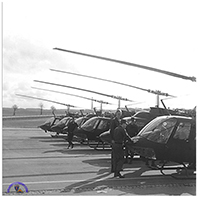
3. OH-58s needing repair
|
|
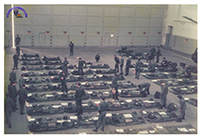
4. AGI Inspection
|
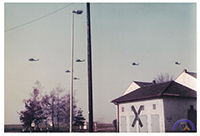
5. "C" Co fly-by
|
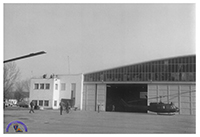
6. "A" Co moons the fly-by
|
|
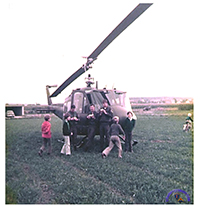
7. In the field
|
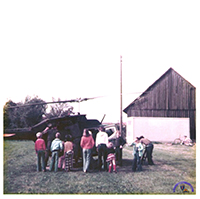
8. REFORGER 77
|
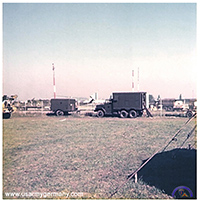
9. Operations van in the field
|
|
|
|
|
| 1977 |
| (Source: Email from Wilberto Gonzales, D Co, 501st CAB, Katterbach AAF 1977-1979) |
I was stationed at Katterbach from 1977 thru 1981 at D Company 501st CAB (AVIM LEVEL maintenance). I arrived at the 21st Replacement and was then sent to Katterbach Army Airfield mid to end of Octocber 1977.
I have a D Company photo, the year is 1978. Maj. Jerry D. Foster was the commander, Cpt. Alan L. Soper the X.O, CW3 James D. Barton the Maintenance Officer and, I believe, CWO 1 Robert Quillen was of P.C and Q.C. shops (Production Control and Quality Control).
There is a picture where I am standing with LTC P. BORN in front of B Company 501st CAB. That picture is in the batch where there is (2) two picture of a recovered crashed OH-58 in 1978. Pictures Recovery of crash OH-58A, I believe Feb. or March 0f 1978.
I thank you very much for this website and I am very proud of your work and efforts. Many great memories came pouring in. I hope that I can contact some the people that were there during that time. Like, Mr. Robert Quillen, who I remember vividly, SFC Reeves, Company Commander Jerry D. Foster or some of the NCO's like SSG. Lopez, DAVID.
In early 1981 I got an ITT (Inter theater transfer) approved and moved to Feucht Airfield with D Troop 2nd ACR stationed there until Oct. or Nov. of 1982.
ADDITIONAL INFORMATION
The hangar for D Co 501st was BLDG. 5807. The barracks was BLDG. 5818
(that's where the 1SG KIRVEN and Commander Maj. Jerry D. Foster office were
located) and I lived on the second floor of bldg. 5818.
The shoppette was
bldg.5825. I know cause I had to buy donuts for the platoon courtesy of SFC
REEVES, back in 78.
The NCO Academy was bldg. 5817 and c part of the bldg is
an arch that is or was over the street.
The Rod and Gun Club was on the
lower left corner of bldg 5805 as you look at the map. A co. 501st hangar
was bldg 5806 and their barracks was 5815(C).
B co. 501st hangar was I
believe either 5801 or 5802 ( don't quote me on this, I'm not too sure, but
I know for a fact the their Commander Maj. Colliazo office was in either
5803 or 5804.
I know B co. 501st was at the end of the air field where
bldgs. 5803, 5804 are located according to this map.
The Mess hall was
locate in bldg 5814 and the Commisary was bldg. 5886.
The Airstrip (Flight Line) is not depicted on this map, but is stretched from behind bldg. 5807
to 5802 , in that open area.
The Dispensary was bldg 5810.
The road on the
map that says TO NURNBERG is B14, the opposite direction was to "STINKY'S on
the way to ANSBACH on B14. I met my wife in 1977 and married in 1979 in
NURNBERG, lived in STEIN, just outside of FURTH and NURNBERG. I drove to
Katterbach for over a year from 1979 - 1980, before getting an ITT approved
and transfer to 2nd ACR at FUERTH ARMY AIRFIELD, NURNBERG (MERRELL BARRACKS).
|
|
501st ABC
Ansbach AHP, Katterbach |
|
|
|
|
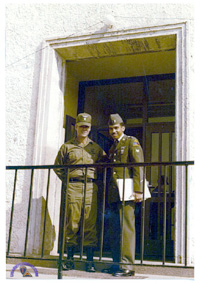
1. Wilberto with LTC Born |
2. Recovered OH-58A |
|
|
|
|
|
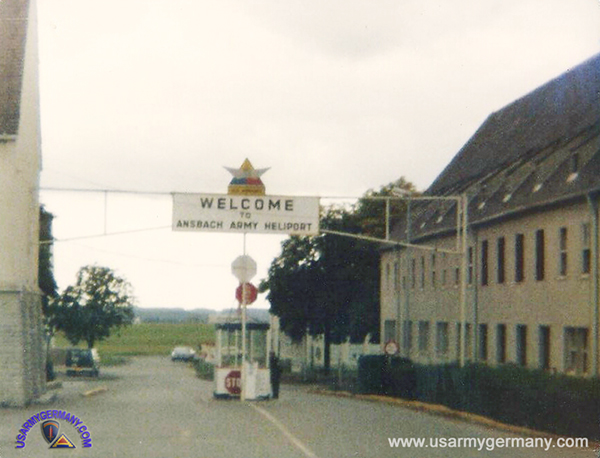
Ansbach Army Heliport gate (John Krueger)
|
|
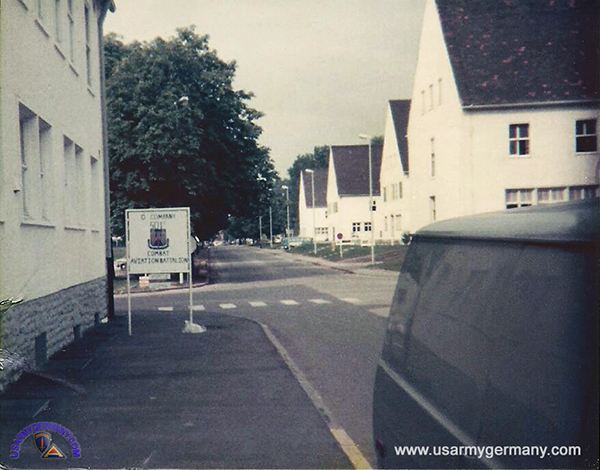
Looking west toward the 5815 buildings.... D Co, 501st CAB barracks on left (John Krueger) |
|
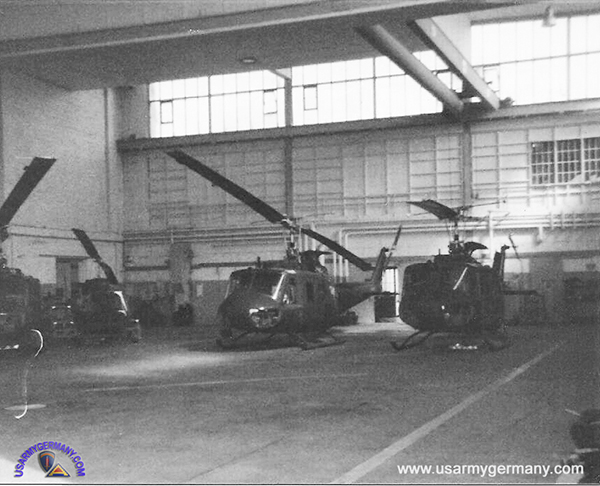
Inside D Company's Direct Support maintenance hangar, building 5807 (John Krueger)
You can see the yellow electric maintenance crane hanging overhead |
|
| (Source: Email from John Krueger, F Co, 123rd Maint Bn/D Co, 501st Avn Bn, 1977-1979) |
I arrived in F Co, 123rd Maintenance in late Aug or early Sep 1977, as a 67N UH-1 mechanic.
I worked for SFC Reeves but got OJT on the OH-58, since that was what the hangar was full of. We had one company Huey, but I later became its crewchief when the crewchief rotated out. Can't remember his name but he ran the movie projector on the tank side's theatre at night!
I remember doing maint. test flights in 58's with Mr. Abbott and Mr. Risner. Mr. Abbott carved a desktop name plaque for me that I still have. CW2 Dan Johnson often flew our Huey on parts runs and he gave me lots of stick time as we snuck away as a crew of two! Lt. Al Soper flew it too. Dan Johnson died in a car wreck I believe.
I recall the 58 with a pilot, crewchief and chaplain that came apart in mid air, killing them (have photos of it in our hangar).
I recall the arrival of the SOTAS Hueys with their under fuselage radar bar. I recall the first tow missile hunt....I was probably the only guy that escaped it because by then I had become the General's crewchief, reassigned to A Co. and was able to go to a Boston concert in Nuremburg that weekend! I flew for Gen Glen K Otis, and then Gen John C Faith.
Some names I recall are SSG Lopez, SGT Dave Hendricks, mechanics David Chunn, Robert Golden, Scott Porter, Ron Moore, Mike Nesbit, Bill Wilfong and David Sigler.
I re-enlisted in the fall of 79 and left for Davison AAF, Ft. Belvoir, VA in Feb. 1980. I hope some of this spurs your memories too! |
|
|
D Co, 501st ABC
Ansbach AHP, Katterbach |
|
|
|
|
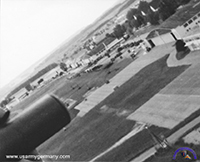
1. Taking off from Katterbach |
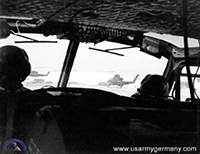
2. Inside a Huey cockpit |
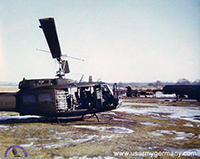
3. D Co Huey |
|
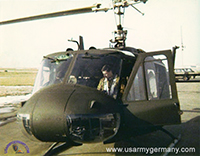
4. 1st Lt Al Soper |
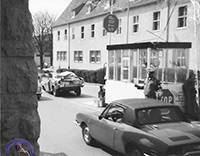
5. Ansbach Heliport gate |
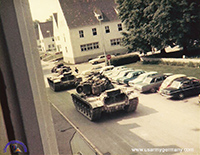
6. Tankers from Bismarck Kaserne
|
|
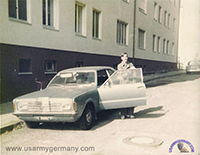
7. Sgt. David Hendricks |
|
|
|
|
|
| |
| 1979 |
| (Source: Email from Kevin Matthews, Katterbach AAF 1979-1982) |
Just came across this 501st Aviation Battalion web page. I was stationed in Katterbach, Germany from 1979 to 1982. I was assigned to D Company as a helicopter mechanic, carrying a small Kodak 110 camera most of the time. I have many good memories of my time there and a number of photographs.
I was on the original 1979 Cobra rocket hunt that Robert Quillen mentioned on this site. As a matter of fact, Mr. Quillen was one of the first individuals I was introduced to when I reported to the unit. I have photos of the first Blackhawk to ever visit Ansbach/Katterbach Army Airfield. I also have numerous photos of their first two AH-1S Cobras, the day they arrived there at Katterbach in early 1982.
I have photos of the two Huey SOTAS aircraft that were assigned there with the 501 MIB. I was a member of the recovery crew at the location of a fatal crash (E Company Huey) near Hohenfels, on Feb 25, 1981.
I was temporarily assigned to B Company in the summer of 1980, when they went to Greenham Common RAF Base, England to train with the British/Canadians.
Kevin Matthews
Security Change 1979 - 1982
In the fall of 1979, when I arrived at Ansbach AHP (Katterbach), security was very loose to say the least. The front and back gate were guarded by unarmed UP's (Unit Police) who were detailed from the various units on base for 30 days. Normally two soldiers were assigned to each gate, but due to breaks you might find only one. If you really had a serious problem, the only help available would have to come from the MP's in Ansbach, five to ten minutes away. In 1979 and 1980 it was common for German civilians to drive through or even cruise the heliport. The Cold War was very cold at that point. The lack of security was really brought to light one day, when a civilian sailplane (glider) landed at the Heliport. The MP's didn't show up for several minutes.
The Cold War began to heat up after Ronald Reagan was elected in late 1980. I remember one night being on runner duty, when we learned that a bomb had been found on a US Army helicopter, somewhere in West Germany. I was quickly sent out by our CQ with a flashlight to check all the assigned D Company aircraft. While doing my inspection I was challenged by the Battalion Duty Officer/NCO who was out doing his own inspection. Everyone was on edge by that point. Within a few minutes the orders came down to get all the D Company aircraft into our hangar.
By late 1981, the 501st ABC instituted a guard detail for all the helicopters on the heliport. Every weekday afternoon, and weekend morning, a rotating security detail was sent out to keep an eye on the aircraft. Problem was, we were only given three bullets each, but were told never to load them in our weapons, unless we were attacked. I never believed a saboteur would have given us a chance to load!
Alerts
I experienced my first "Alert" in Katterbach, within a week of being assigned to the 501st ABC. At that time D Company (AVIM) would quickly load up their trucks with TA-50 bags, C-rations, tents, ammo, etc. We then waited patiently for the order to move out, which never happen while I was stationed there. The rumor floating around, was that Katterbach was on the short list of targeted airfields to be taken out, early in a conflict with the Soviets. I even remember one speech given in 1979 by our CO, in which he said, "the odds were, we would be killed, wounded, or captured, within the first ten days of a full out war."
Within a few months our alert practices changed. D Company would suit up in alert gear, but go to work in the hangar while the rest of the battalion moved out. By late 1980 or 1981, our company received connexes in which to store all the loose helicopter parts. This went along with other changes that were being implemented. Until the time I left in early 1982, we would be ordered to get all our flyable aircraft out of the hangar and on the flight line. All non-flyable aircraft were to be loaded up on trucks, along with the connexes. We never got that far, so I assume the priority was on those few aircraft that would fly.
The sights and sounds of an alert in Katterbach (cir. 1981) were something you had to experience in person. Imagine a complete armor battalion (1st of the 37th) armed and loaded, rolling out of Bismarck Kaserne. Next, imagine three complete company's (A,B, & E) of Huey's, Cobra's and OH-58's, all running at the same time, then taking off to points unknown. There's no soundtrack of such an event that would do it justice. Now of course, this was all taking place in the early morning darkness, or just as the sun was coming up. For the few of us left back in Katterbach, the sudden silence (after all this organized chaos) was almost spooky.
Cold Weather Issues
During the winter months it could be a problem for maintenance personnel to move any of the skid equipped helicopters, especially those left on the ground or grass overnight. During the day if the temperature got above freezing, a parked helicopter would sink down into the soil. This was especially true with the new AH-1S Cobra's. When the ground froze overnight the ice would get a firm hold on the skids. In the early morning this same frozen ground allowed you to drive a heavy tug out to the aircraft without sinking up to you axles. The downside was that during the initial pull on the tow bar, you sometimes broke a shoe on the skids.
Huey Crash at Hohenfels, Feb 1981
The three-man crew of a UH-1 was killed in a crash at the US Army training area in Hohenfels. The helicopter from E Company, 501st Aviation Battalion, 1st Armd Div, crashed in a farmer's field shortly after takeoff from the Hohenfels Army Airfield.
A second Huey from E Company also nearly crashed near the original crash site that same morning. A detail was sent out within a couple of days from D Company to fix the other Huey. They installed a new landing gear assembly to replace the damaged one, due to a hard landing. I believe that helicopter flew back to Katterbach.
A few days later I was on the detail that went out to recover the crashed Huey. The weather was terrible that day. The 5-ton tractor and trailer I was riding that morning, nearly jack knifed off a ridge on the way to Hohenfels. The staff at the Hohenfels training area tried to throw us out of their mess hall that morning when we ate breakfast. They didn't want our large vehicles parked in their parking lot. When they learned that we were there to recover the crashed helicopter, they immediately left us alone. At the crash scene (which the MP's were guarding) we began to dig the pieces from the frozen ground and snow. This was a slow process, since it had been snowing off and on for several days since the crash. We eventually got everything we could find (in those conditions) loaded onto several trucks.
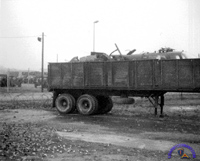
The next day back in Katterbach, we placed all the crash parts in an unused wing of the D Company hangar. Overnight one of the fuel cells in the largest part of the wreckage began leaking fuel into the TA-50 issue room, below the hangar. That piece was eventually placed at the end of our ramp, near the back gate. We covered it with some sort of canvas, but it was still very visible for everyone on the airfield to see. I'm not sure that the investigators ever found a cause for the accident. One result I saw though, was that several crew chiefs within the battalion gave up their crew chief jobs.
Hof Border Tour, 1979 |
|
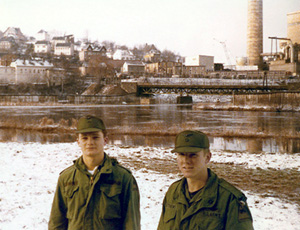 Hof border area
 |
|
This photo, taken in the fall of 1979, shows Frank Older (left) and Kevin Matthews (right) on the Hof Border Tour. In the background across the river, can be seen the heavily fortified East German border.
This tour was mandatory for all new soldiers of the 501st ABC. It gave you a very visual idea, of how far the Communists were willing to go in order to keep their own people imprisoned.
I took this same tour again in the fall of 1981. We were told at that time that East Germany had recently replaced all the fabric fencing along their border with West Germany.
|
|
| |
| Crashed Cobra, Winter of 1980-81 |
 Crashed Cobra
 |
|
This photo shows a crashed Cobra on a flatbed truck at Katterbach AHP, during the winter of 1980/81. I was told that the pilot of this aircraft had experienced a whiteout (swirling snow) during the landing attempt, and had rolled it due to disorientation. I don't remember if this helicopter was assigned to B or C Company. Anyone else know?
COMMENTS:
See James Speicher's email.
|
|
| D Company Hangar |
 D Company Hangar
 |
|
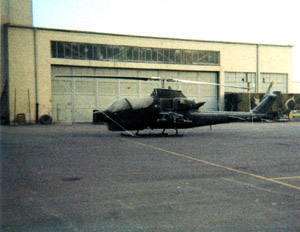
This early 1981 photo, made on the D Company, 501st ABC ramp, shows a Cobra covered by an early morning frost. Behind this aircraft can be seen the east wing of the D Company hangar.
This hangar area was where the recovered pieces (destroyed E Company Huey) were laid out for crash investigators in late February of 1981. A few months after the investigation was over, and the wreckage hauled off, it became home for several OH-58's. Evidently it had been a number of years since this area had been used for aircraft maintenance, because a contractor was brought in to rebuild the overhead crane.
|
|
| |
 Parachutist on roof
 |
|
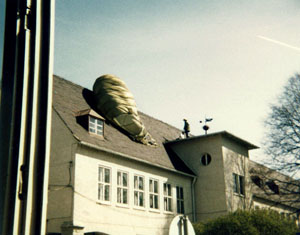
This view shows a fireman and a medic on the roof of the building beside the front gate at Ansbach AHP. The bellowing parachute is from a parachutist who was stuck on the roof. I was told that he went up to his waist before his fall was stopped. He was one of several rookie parachutist that day who ended up in unusual places. This was an R&R weekend activity, not a military jump, even though they were taken up in a Huey from our heliport.
|
|
| One of my roommates in the barracks participated in this jump. He said they tested the wind with a weighted steamer, and their jumpmaster sent them out when he thought they were in position. I was told that one parachutist went into a plate glass window on Bismarck Kaserne. One went into the roof beside the front gate (photo) at Katterbach AHP. One was caught by a telephone pole on the main road going through the heliport, and had to be rescued. My roommate said that he hit the top of the fence near the back gate and twisted his ankle. This all took place on a beautiful Saturday, possibly in the spring of 1981. |
|
| |
501st ABC
Ansbach AHP, Katterbach |
|
|
|
|

1. First AH-1S to arrive at Katterbach |
2. Cobras at RAF Greenham Common in 1980 |
3. SOTAS Huey |
|
4. Door gunner training at Hohenfels |
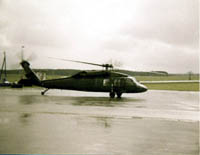
5. First UH-60A Blackhawk in Europe |
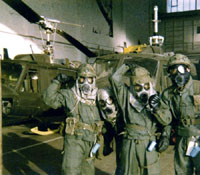
6. NBC Suite Training, 1979 |
|
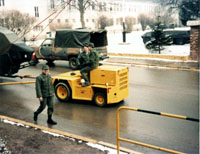
7. View from D Co barracks |
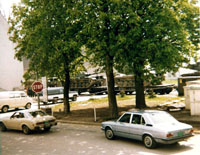
8. Armored unit returns from the field |
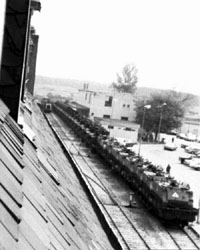
9. View from D Co dayroom |
|
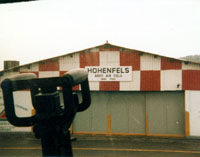
10. Hohenfels AAF |
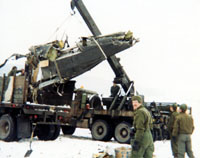
11. Wrecker assists in recovery operations |
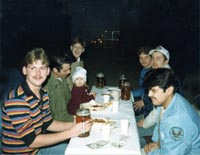
12. D Co Christmas Party |
|
13.
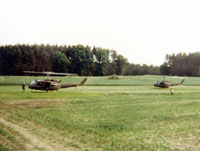
Two Huey's from E Company, 501st ABC |
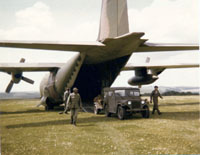
14. Jeep and trailer of B Company, 501st ABC, being off loaded in England |
15. Gasthaus beer |
|
|
|
|
| |
| E Company, 501st Aviation Battalion / 116th Assault Helicopter Company |
| |
| 1980 |
| (Source: STARS & STRIPES, July 17, 1980) |
An advanced team of the 116th Assault Helicopter Company out of Ft. Lewis, Wash will arrive in Germany today. The remainder of the unit will arrive later in the week.
The 157-member aviation unit will be assigned to the 501st Avn Bn (Cbt) and be home based at Katterbach. The company is scheduled to be redesignated as Company E, 501st later this month and should be fully operational by the end of August. The unit is equipped with 23 UH-1H helicopters and is responsible for a variety of combat support missions.
CO of the company is Maj James M. Abell. |
|
|
| |
| (Source: Email from Cliff Bowyer, E Co, 501st AB(C), 1980-1983) |
I was an original member of E Co. 501st as we arrived at Katterbach in 1980 and I remained in that company till I left for Fort Sam Houston in 1983.
Originally E Company was the 116th Assault Helicopter Company, 10th Aviation Battalion at Fort Lewis Washington and we did a unit move to Katterbach after being deactivated and reactivated as E Company.
Some of your contributors have mentioned the helicopter crash at Hohenfels that took the lives of three of our members. Those members were CW3 Schroeder, WO1 Holly and Sgt Garcia. They were a very great loss to our company and the loss of Mr. Schroeder was a particularly harsh loss to me as upon my assignment to the 116th AHC at Fort Lewis Mr. Schroeder had been the first pilot to take me flying and had also served as the unit Motor Officer of which I was a power generation and wheeled vehicle mechanic assigned to the motor pool.
Other than the loss of these individuals I have very great and fond memories of my time in Germany and especially around Ansbach. I look forward to sharing more information in the future if you will have my input. Thank you for a great web site that I have forwarded to many of my friends who were assigned there with me during the same time frame. |
|
|
| |
| (Source: IRONSIDES, Jan 14, 1983) |
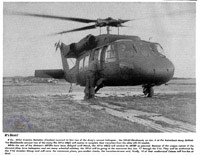 First UH-60's at 501st AB(C)
 |
|
| E Company, 501st AB(C) received its first two of the Army's newest helicopter, the UH-60 Blackhawk, on Jan. 6 at Katterbach AAF. The 501st is transitioning from the older UH-1H models to the UH-60. |
|
|
|
| |
| (Source: IRONSIDES, April 8, 1983) |
|
|
Black Hawks move in
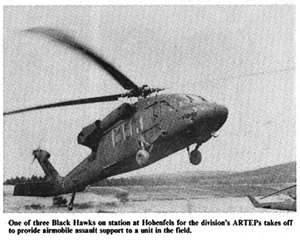
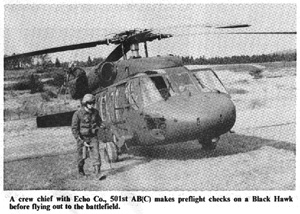
Since the Black Hawk helicopters only recently arrived at Echo Company, 501st AB(C) in Katterbach, the pilots and crews are in the midst of "mission training" with the new birds.
Chief Warrant Officer Daniel Clark III, a Black Hawk pilot, said the division's ARTEPs at Hohenfels Training Area are supporting that training.
"While we provide airmobile assault and resupply support to each brigade, we're getting valuable training time with the Black Hawks," he said.
About 20 personnel and three Black Hawks from Echo Company have supported the ARTEPs since they began March 11.
"We're available for whoever needs us," added Clark, "either the Orange or Blue Forces on the attack or defense."
|
|
|
"This is the first time we've been able to get 'down and dirty' in the Black Hawk," enthused Ist Lt. George "HAP" Core, a 2nd Flight Platoon section leader. "We take the soldiers in battle from a secure area to behind the lines.
"We got a mission to haul 36 infantrymen in three Black Hawks, but the unit's strategy worked so well we didn't need to."
Core added, "The Black Hawks add quickness and surprise during the battles assets the units don't normally have."
For resupply support, the Black Hawks are being used to haul ammo, fuel, food and personnel replacements to the field. If needed, the helicopters can slingload ammo, fuel, jeeps or gamma goats, said Capt. Dan Piper, a 1st Flight Platoon section leader.
"Since a lot of the guys in the field have never worked with Black Hawks before, the units are learning quite a lot about what the Black Hawks can do and what they can be used for," concluded Piper. "We can lift a lot more, carry more people, and we have increased speed and survivability." |
|
|
|
| |
Related Links:
|
| |
| |
|