If you do NOT see the Table of Contents frame to the left of this page, then
Click here to open 'USArmyGermany' frameset

59th Ordnance Brigade
US Army, Europe

Looking for more information from military/civilian personnel assigned to or associated with the U.S. Army in Germany from 1945 to 1989. If you have any stories or thoughts on the subject, please email me (webmaster).


Brigade History (1962 - 1992)

Page 2
(NATO Nuc Arty)

Page 3
(GE Nuc Arty)

59th's role in NATO

Headquarters Support Bn

3rd Ord Bn
(until Nov 1982)

72nd Ord Bn

197th Ord Bn

165th Sig Co

22nd Avn Det

PAL Det

List of Dets
(1960s)

List of Dets
(early 1980s)


Special Weapons Depots

Redstone Arsenal Historical Monographs
CORPORAL
HONEST JOHN
LACROSSE
LANCE

SERGEANT


Advanced Weapons Support
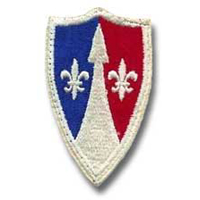
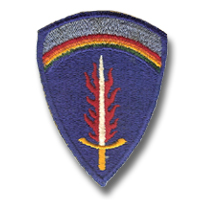
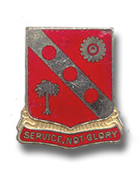
Command Patch


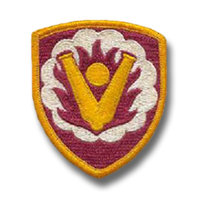
59th Ord Bde Patch (1982-1992)
Related Links
Personal recollections submitted by former members of the US Army warhead custodial detachments can be found in the corresponding group sections - below!

Personal recollections submitted by former members of NATO nuclear-capable outfits can be found in the corresponding unit sections on Page 2 (UK, Canadian, Belgian, French, Dutch) and Page 3 (German)!

5th USAAG

294th USAAG

512th USAAG

514th USAAG

528th USAAG
(not part of 59th Ord Bde)

548th USAAG

552nd USAAG

557th USAAG

558th USAAG
(not part of 59th Ord Bde)

559th USAAG
(not part of 59th Ord Bde)

570th USAAG

576th USAAG

 
Brigade History
1962 - 1992
59th Ordnance Brigade DI


(Source: A Look Back ... at the 59th Ordnance Brigade. Final issue of the 59th COURIER, the command newspaper, published in 1992.)
59th Ordnance Brigade: One for history books.

At one time, the 59th Ordnance Brigade was the largest brigade in the U.S. Army. The 59th covered 95,000 square miles from the border of Denmark, south to Switzerland, west into the Netherlands and spread throughout western Germany with over 7,000 soldiers.

The soldiers within the 59th came from a wide variety of different occupations. The vast majority of soldiers were artillery, ordnance and military police, however, several support occupations were included to fill out this well-rounded brigade.

One word stands out when describing the 59th Ordnance Brigade. Unique.

Unique in that this command successfully meshed three Army branches, the ordnance, artillery and military police corps, and performed a mission that came to be known as the backbone of the North Atlantic Treaty Organization.

Unique in that nearly one half of the personnel assigned to the command lived and worked on installations throughout Germany, which were maintained by Great Britain, the Netherlands, Germany and Belgium.

History
The history of the 59th Ordnance Brigade and its forerunners, the Advanced Weapons Support Command (AWSCOM) and the Special Ammunition Support Command (SASCOM), reaches back into the 1950s, several years before the command's headquarters was organized.

In April 1955, Headquarters and Headquarters Company, 71st Ordnance Group was organized and assigned to the Seventh U.S. Army and stationed in Pirmasens, Germany.

In June 1959, the 71st Ordnance Group was officially redesignated as AWSCOM as part of Theater Army Support Group.

AWSCOM was redesignated as the 59th Ordnance Group (Ammunition) in March 1962. The Group assumed a record of service that went back to 1943 with the Headquarters and Headquarters Company. By May 1962, 21 units were assigned to the 59th Ordnance Group. In June 1965, AWSCOM was authorized as the official abbreviation for the 59th Ordnance Group (Ammunition).

While the 59th Ordnance Group was undergoing its 12-year metamorphosis, events were taking place that were to have a shaping influence on the 59th Ordnance Brigade as it is known today.
In 1957 President Eisenhower offered certain special weapons to NATO. Congressional restraints prevented this offer from becoming an outright grant. Instead, it was provided that weapons should be positioned in allied countries but these weapons would remain United States property.

June 23, 1958 marked the first, of what would be later called, Special Ammunition Support Command (SASCOM) units on foreign soil (Turkey), and the first special weapons support provided to an allied nation. The establishment of SASCOM was a slow process due to the types of agreements that had to be concluded between the United States and the NATO nations before special weapons could be made available and the program could get under way.

Once all agreements had been concluded the Special Ammunition Support Command, born on April 15, 1960, became a significant part of the United States commitment to NATO.

Headquartered in Frankfurt, SASCOM, was organized with two types of units, artillery and ordnance. The 1960s saw SASCOM grow at a tremendous pace as new groups were activated and detachments assigned to them. By 1967, SASCOM was

composed of 10 artillery groups commanding 38 missile artillery detachments.

On Oct. 20, 1972, the command envisioned by the NATO Advanced Weapons Division 13 years before came into being. The artillery detachments, the ordnance companies, and the depot companies were combined into one command. The similar, but separate missions performed for so long by SASCOM and the 59th Ordnance Group (Ammunition) AWSCOM, were now assumed by one command - the 59th Ordnance Group, later to be officially called and accepted as the 59th Ordnance Group (SASCOM).

The new command, headquartered in Pirmasens on Husterhoeh Kaserne, saw many changes during the next few years.

  As a result of the formation of the new command, several artillery groups inactivated and joined their forces under the new command, and two ordnance battalion headquarters were activated.

Effective Aug. 22, 1977, the 59th Ordnance Group was redesignated as the 59th Ordnance Brigade and increased its mission to include support of guided missile systems and land combat systems used by the U.S. Army Corps in Europe.

Mission
The brigade's mission was to provide direct and general special weapons support for all U.S. Army, Europe, and NATO forces. In reality, this mission was one of the most unique, complex and difficult to be found in any army in the world.
  Organization
At the time of the inactivation announcement, the brigade was composed of five artillery groups, two ordnance battalions and a headquarters support battalion, totaling more than 2,900 military and 100 civilian personnel.

The artillery groups consisted of an ordnance company, artillery detachments and a headquarters detachment. The groups provided custody, control, maintenance, and supply of ammunition for our NATO allies. Some detachments had the dual mission of performing technical support and maintenance, while simultaneously performing custodial agent functions.


(Source: USAREUR/Seventh Army STATION LIST, 1 June 1976)
59th ORD AMMO GP ORGANIZATION - 1 JUNE 1976

UNIT DESIGNATION

LOCATION COMMENTS
HHC, 59th Ord Ammo Gp Husterhöh Ksn, Pirmasens
US Army PAL Det Husterhöh Ksn, Pirmasens
563rd Ord Co (Maint)(GS) Camp Pieri, Wiesbaden
579th Ord Co (GM Maint) Nelson Bks, Neu Ulm
165th Sig Co Husterhöh Ksn, Pirmasens
41st Ord Co (Ammo Convl) Kaiserslautern
72nd Ord Bn (Ammo)  
HHD, 72nd Ord Bn Army Depot, Miesau
4th Ord Co (GM Maint) Army Depot, Miesau
9th Ord Co (Sp Ammo)(Dep Spt) Army Depot, Miesau
164th MP Co (Phy Scty) Ammo Depot, Miesau
619th Ord Co (Sp Ammo)(Dep Spt) Ammo Depot, Kriegsfeld
558th MP Co (Phy Scty) Ammo Depot, Kriegsfeld
197th Ord Bn (Ammo)  
HHD, 197th Ord Bn Fischbach Ksn, Fischb.
64th Ord Co (Sp Ammo)(Dep Spt) Fischbach Ksn, Fischb.
165th MP Co (Phy Scty) Fischbach Ksn, Fischb.
525th Ord Co (Sp Ammo)(Dep Spt) Ord Area, Siegelsbach
556th MP Co (Phy Scty) Ord Area, Siegelsbach
5th Arty Gp (Wh Spt)  
HHD, 5th Arty Gp Stöckerbusch Ksn, Büren
27th Ord Co (Sp Ammo)(GS) Stöckerbusch Ksn, Büren
4th FA Det (Msl Wh Spt)(HJ) Werl
33rd FA Det (Msl Wh Spt)(HJ) Dellbrück
43rd AD Det (Msl Wh Spt) Düren-Drove
66th AD Det (Msl Wh Spt) Soest-Büecke
85th FA Det (Msl Wh Spt)(HJ) Geilenkirchen
507th AD Det (Msl Wh Spt) Hinsbeck
294th Arty Gp (Wh Spt)  
HHD, 294th Arty Gp Flensburg
99th Ord Det (Wh Spt) Flensburg
13th FA Det (Msl Wh Spt)(HJ) Liliencron Ksn, Kellinghusen
75th FA Det (Msl Wh Spt)(HJ) Flensburg
512th Arty Gp (Wh Spt)  
HHD, 512th Arty Gp Günzburg
510th Ord Co (Sp Ammo)(GS) Günzburg
2nd FA Det (Msl Wh Spt)(HJ) Pfullendorf
24th FA Det (Msl Wh Spt)(HJ) Landsberg
36th FA Det (Msl Wh Spt)(HJ) Hemau
74th FA Det (Msl Wh Spt)(HJ) Airfield, Lechfeld
84th FA Det (Msl Wh Spt)(HJ) Großengstingen
552nd Arty Gp (Wh Spt)  
HHD, 552nd Arty Gp Mühlenberg Ksn, Sögel
162nd Ord Co (Sp Ammo)(GS) Mühlenberg Ksn, Sögel
5th FA Det (Msl Wh Spt)(HJ) Schill Ksn, Dünsen
8th FA Det (Msl Wh Spt)(HJ) Steenwijk, NE
23rd FA Det (Msl Wh Spt)(HJ) T'Harde, NE
25th FA Det (Msl Wh Spt)(HJ) Barme
32nd FA Det (Msl Wh Spt)(HJ) Nienburg
35th AD Det (Msl Wh Spt) Hohenkirchen
42nd AD Det (Msl Wh Spt) Barnsdorf
51st AD Det (Msl Wh Spt) Adelheide
557th Arty Gp (Wh Spt)  
HHD, 557th Arty Gp Aartal Ksn, Herborn
96th Ord Co (Sp Ammo)(GS) Aartal Ksn, Herborn
3rd FA Det (Msl Wh Spt)(HJ) Salm Ksn, Phillipsburg
7th FA Det (Msl Wh Spt)(HJ) Hardt Ksn, Treysa
30th FA Det (Msl Wh Spt)(HJ) Army Depot, Giessen
52nd AD Det (Msl Wh Spt) Lippe
83rd FA Det (Msl Wh Spt)(HJ) Montabaur
501st AD Det (Msl Wh Spt) Kilianstädten
570th Arty Gp (Wh Spt)  
HHD, 570th Arty Gp Handorf
583rd Ord Co (Sp Ammo)(GS) Handorf
1st FA Det (Msl Wh Spt)(HJ) Schill Ksn, Wesel
15th FA Det (Msl Wh Spt)(HJ) Paderborn
22nd FA Det (Msl Wh Spt)(HJ) Dempsey Bks, Sennelager
69th FA Det (Msl Wh Spt)(HJ) Hemer
81st FA Det (Msl Wh Spt)(HJ) Dülmen
509th AD Det (Msl Wh Spt) Vörden


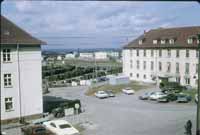
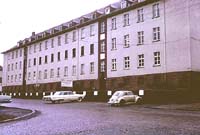
Headquarters, Advanced Weapons Support Command
(Source: Al Galbraith, served with HHQ Co, 59th Ordnance Group - a.k.a AWSCOM, 1967-68)

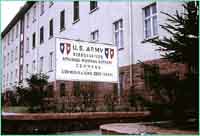
1. Sign in front of HQ building, Husterhoeh Kaserne (43 KB)

2. Several buildings and a motor pool on Husterhoeh Kaserne (86 KB)
 

3. Building 4618 housed HQ AWSCOM, Husterhoeh Kaserne (97 KB)

4. Building 4618 in 2002 (36 KB)
 
Webmaster Note: I mistakenly identified the above building (photo #3 and #4) as Bldg 4611. Al says it was and is Bldg 4618.

 
(Source: Clem Akins, 529th Ord Co, 1966-67 and 1971-73; 64th Ord Co, 1967-69 and 1973-75)
Found your article on the Ordnance Companies interesting but lacking when it came to the special weapons units. Here is some information on the SW units in Europe when I was there. Took me a while to find where I had put this stuff.

The
529th Ord Co was a general support/depot company for most of the Theater. It was located in a cave complex in a small valley near the town of Masswieler a few minutes drive from Pirmasens. The cave complex was built and used by the Germans in WWII and still had the Eagles over the doors. I was there from Dec 66 till Sep 67 and again from Oct 71 till Nov 72 when they closed the unit. The 529th was under AWSCOM (Advanced Weapons Support Command) located in Pirmasens. The 529th had most of the load test mission for the theater and was a parts depot for SW test and handling equipment. We had one MP company collocated with us for security.

I was stationed at the
64th Ord Co at Fischbach from Sep 67 to May 69 and again from Oct 73 to Aug 75. During the 67-69 time there was a Sergeant GS Company (575th Ord Co) I think and two MP companies (193rd & 564th ?) that were assigned to the depot. The 64th was a SW GS Company for the southern half of Europe, the 9th Ord Co having the other half. The 64th had a mission for all SW, rocket motor support for Nike Herk and a full load 8” mission for the SW rounds. There were no extra facilities located at Fischbach so all traveled to Pirmasens for their needs, Commissary, PX, Gym, & clubs. The 64th was a stockpile site and the storage platoon had over 100 people assigned. MAJ Ron Finkbiener was the commander during the 73-75 time frame.

The
197th Ord Bn was created about Nov 72 and was located at Fischbach and had control over the 64th and 525th Ord Co. The commander was LTC Lynn Stevens. By this time the 575th Ord Co was gone.

 
(Source: Joe Luongo, 59th Ord Bde, 1985-88)
I was assigned to the 59th Ord Bde from Dec 1985 to Nov 1988. I started at the Bde staff in the Office of the Assistant Chief of Staff for Surety. I was a physical security inspector. I inspected sites all over the Bde. I went from Flensburg in the north to Füssen in the south. Some of the units that I remember inspecting are the 162nd OD CO, the 74th USAFAD, the 510th OD CO, the 619th OD CO and the 1st USAFAD. There were alot more but those are the one's I remember most.

After 6 months on the surety team and being TDY 3 weeks of the month I took command of the 164th MP CO at Miesau in July of 1986. The 164th was then part of the 3rd OD BN that was headquartered in Pirmasens. The 164th was the biggest MP CO in USAREUR. We had a authorized strength of 284 soldiers. We secured one of the largest nuclear storage sites in Europe. We provided security for air missions all over West Germany. Between air missions, inspections, demos for visiting VIPs and the day to day mission it never stopped. It was a tough command and pretty stressful but it was the highlight of my career. Nothing I did before or after has equaled it. I was very lucky I had great soldiers who always accomplished the mission no matter how bad things got.

After 21 month of command I went to the 3rd ORD to be the S-2.

I retired in 1996 and was called back to active duty in 2002.

I often run into people who served in the 59th. And its alway fun to listen to the stories. Everyone always agrees that there was not doubt what your mission was. Hopefully there will be more comments from other people
Joe Luongo
 
If you have more information on the history or organization of the 59th Ord Bde, please contact me.

 
(Source: Email from Bob Eccles)
I joined the Army in January of 1982. I served in the 59th Ordnance Brigade from roughly April of 1982 to January of 1985. I started out with the 164th Military Police Company based at Miesau Army Depot, where I performed nuclear physical security duties. I am proud to have participated in a couple of events of historical note, specifically securing Pershing Two missiles arriving at Ramstein AFB, and what I believe was the first land convoy of nuclear weapons in Germany since the 1950's.

The second half of my time with the 59th was spent as the driver for the Commanding General, BG Harry Walker. I drove the Commanding General and Command Sergeant Major in an unmarked Mercedes sedan, following the convoy vehicles. We spent a lot of time in the armor-plated and bullet-proof BMW 733-i criss-crossing Germany (West Germany, at the time) and Belgium visiting units of the 59th.

On our way back to Brigade headquarters in Pirmasens, we listened as local radio newscasters reported the convoy. Our CSM spoke fluent German, so he could translate what was being said.

Transporting nukes around Germany (and occasionally Belgium) was pretty interesting by helicopter, too. We flew around in "Chinook" helicopters. I remember once we had to land in a field in the middle of the German countryside, and rush out and set up a perimiter around the chopper. I overheard the pilot say that he had lost hydrolic pressure. Kinda scary!
Bob Eccles

 
(Source: A Look Back ... at the 59th Ordnance Brigade. Final issue of the 59th COURIER, the command newspaper, published in 1992.)
59th's role in NATO.

During its many years of service, the 59th Ordnance Brigade provided a valuable link between the peacetime readiness of U.S. forces and the ability to support forces of our NATO allies in the event of war.

To provide for group self-defense, NATO has three major commands - Allied Command, Europe, (ACE); Allied Command, Channel; and Allied Command, Atlantic.

In wartime, the 59th Ordnance Brigade would have come under the operational control of ACE commanded by the Supreme Allied Commander, Europe (SACEUR). The mission given to SACEUR by NATO is to contribute to the deterrence of all forms of attack against countries and peoples in ACE and, should any attack occur, to take all military measures necessary to preserve or restore the borders and security of Western Europe.

The more than 70,000 square miles for which SACEUR is tasked to defend is divided into four commands - Allied Forces, Northern Europe; Allied Forces, Central Europe; Allied Forces, Southern Europe; and the United Kingdom Air Forces. Within these commands there are various other subordinate headquarters.

Allied Forces, Northern Europe (AFNORTH) is comprised of Norway, Denmark,

  Germany north of the Elbe River, and the adjacent sea areas. A subordinate command of AFNORTH, Allied Forces, Baltic Approaches (BALTAP) is the parent command for Allied Land Forces, Schleswig-Holstein and Jutland (LANDJUT), which contains forces that were supported by elements of the 59th Ordnance Brigade.

The largest of ACE's subordinate commands, Allied Forces, Southern Europe (AFSOUTH), includes Italy, Greece, Turkey, the Black Sea, and the entire Mediterranean Sea.

The third subordinate command, United Kingdom Air Forces (UKAIR), is a single service subordinate command - the Royal Air Force supplies all of the assets. It is a multi-role command, spanning all functions of air power.

The fourth and last major command, Allied Forces, Central Europe (AFCENT), contained most of the units supported by the artillery groups and ordnance battalions of the 59th Ordnance Brigade. AFCENT's area of responsibility extends from the North Sea and the Elbe River to the borders of Austria and Switzerland.

The major subordinate commands of AFCENT are Northern Army Group (NORTHAG), Central Army Group
  (CENTAG), and Allied Forces, Central Europe (AAFCE).

NORTHAG is composed of four national corps from Belgium, the United Kingdom, Germany, and the Netherlands. The headquarters included an element from the 59th Ordnance Brigade to assist in planning and coordination. The NORTHAG area of responsibility stretches from Hamburg to Kassel, and from the inner German border to the Dutch and Belgian borders.

CENTAG, covering the middle and southern areas of Germany, consists of two German corps, two U.S. corps, and a Canadian mechanized brigade. There was also a 59th Ordnance Brigade staff element at CENTAG headquarters.

Exercising operational control over the 2nd and 4th ATAF, AAFCE is responsible for deterring air attacks and responding if attack should occur.

As can be seen, Allied Command, Europe, is a complex organization combining the armed forces of many nations and requiring close liaison to ensure cooperation and, ultimately, the ability to respond in the event of war. The 59th Ordnance Brigade was an important part of this command and an integral element in NATO's deterrence of aggression.


(Source: A Look Back ... at the 59th Ordnance Brigade. Final issue of the 59th COURIER, the command newspaper, published in 1992.)
Headquarters Support Battalion
 

The Headquarters Support Battalion was organized as the Special Troops Battalion on October 1979, to command and control the four separate units assigned to the 59th Ordnance Brigade: Headquarters and Headquarters Company, 165th Signal Company, 22nd Aviation Detachment, and the U.S. Permissive Action Link Detachment. These units provided the brigade headquarters with administrative, logistical, communications, transportation, and classified support.

In May 1983, the Special Troops Battalion was redesignated Theater Support Battalion (Provisional). The Headquarters Commandant was formed the following month to assume the support mission responsibility. The four units were attached to the Headquarters Commandant for administrative and logistical purposes.

In the spring of 1984, Headquarters Commandant was redesignated as Headquarters Command. In August of that same year, Headquarters Support Battalion was created and it assumed provisional status in February 1985.

Finally, in October 1985, Headquarters Support Battalion was activated with the Headquarters and Headquarters Company, 165th Signal Company, 22nd Aviation Detachment and the PAL Detachment under its control. The Headquarters Support Battalion is scheduled to inactivate in September 1992.

Headquarters and Headquarters Company
Headquarters and Headquarters Company, 59th Ordnance Brigade was constituted and activated in the U.S. Army in 1943 as

  Headquarters Detachment, 331st Ordnance Battalion and activated at Camp Livingston, La.

The following year, the battalion was reorganized and redesignated as Headquarters and Headquarters Detachment, 59th Ordnance Group. The Group served with distinction as part of the Ninth Army in World War II and was awarded battle credits for participation in the Central Europe Campaign and the Rhineland Campaign.

Inactivated at Fort Jackson, S.C. in February 1946, Headquarters and Headquarters Detachment was again active in Guam from April 1947 to December 1948.

Redesignated as Headquarters and Headquarters Company, 59th Ordnance Group in 1951, the unit served in Korea and took part in five campaigns. The Group was awarded the Meritorious Unit Citation for its outstanding service in Korea. The unit was inactivated in Korea in May 1957.

In March 1962, the Group was activated in Germany as Headquarters and Headquarters Company, 59th Ordnance Group (Ammunition). Later that year, it was redesignated the 59th Ordnance Group, Advanced Weapons Support Command (AWSCOM).

AWSCOW and the former Special Ammunition Support Command (SASCOM) were consolidated and merged to form a "new" SASCOM in 1972. The new 59th Ordnance Group (SASCOM) moved from Frankfurt to the old AWSCOM headquarters in Pirmasens.

On 22 August 1977, 59th Ordnance Group (SASCOM) was reorganized and redesignated as Headquarters and Headquarters Company, 59th Ordnance Brigade. HHC, 59th is scheduled to inactivate in September 1992.

22nd Aviation Detachment
The 22nd Aviation Detachment was constituted in the regular Army as the 22nd Special Warfare Aviation Detachment in March 1962 and activated at Fort Bragg, N.C. In June 1962, it was reorganized and redesignated as the 22nd Aviation
  Detachment (Special Forces). The Detachment was inactivated in December 1963.

The unit was activated in September 1965 as the 22nd Transportation Company in Pirmasens, Germany and assigned to U.S. Army Communications Zone Transportation Command with attachment to the U.S. Army Advanced Weapons Support Command. The 22nd replaced the 26th Transportation Company which was inactivated. The following month, the activation orders were amended to designate the unit as the 22nd Aviation Detachment.

In May 1967, the detachment was assigned directly under U.S. Army Communications Zone with attachment to AWSCOM. In 1971, and again in 1977, the 22nd Aviation Detachment was named the USAREUR Region AAAA Aviation Detachment Size Unit of the Year. The 22nd will inactivate in July 1992.

Permissive Action Link
In December 1963, the U.S. Army Permissive Action Link Detachment was organized and assigned to Headquarters, U.S. Army Materiel Command, Europe. The detachment was attached to the Advanced Weapons Support Command for administrative and logistical support.

Prior to December 1963, the Army PAL Detachment had been known as the U.S. Army Control Detachment, the U.S. Army Surveillance Detachment, and the U.S. Army PAL Surveillance Detachment.

In September 1970, the PAL Detachment was assigned to the U.S. Army Theater Support Command, Europe, and attached to AWSCOM. In July 1972, the PAL Detachment was placed under the operational control of the Deputy Chief of Staff for Operations, USAREUR, and in May 1974, it was reassigned to the 59th Ordnance Group (Special Ammunition Support Command).

The Permissive Action Link Detachment was the only unit of its kind in the U.S. Army, consisting mainly of officers and noncommissioned officers. The PAL Detachment was inactivated in June 1992.
 
 
165th Signal Company
The 165th Signal Company was constituted in February 1942 as the 165th Signal Photographic Company. The 165th was activated in June 1942 at Camp Crowder, Mo. Serving in the European Theater during World War II, the company received credit for five campaigns and was awarded a Meritorious Unit Commendation.

After the war, the 165th was inactivated at Camp Kilmer, N.J. in March 1946. In February 1957, the unit was redesignated as the 165th Signal Company and was activated at Camp Hood, Texas the following month. The 165th was inactivated at Fort Carson, Colorado in August 1961.

The company was activated once again in August 1967 at Fort Bragg, N.C. and was inactivated there in January 1971. In September 1975, the 165th Signal Company was activated in Germany and assigned to the 59th Ordnance Group. The 165th Signal Company inactivated in June 1992.

Northern Army Group
Working as a part of the NATO team in the largest collocated military complex in
  Western Europe, was the small group of men and women of the brigade's staff
element at the Northern Army Group/Second Allied Tactical Air Force Joint Headquarters in Rheindahlen, near the city of Moenchengladbach.

This facility also served as the headquarters for the British Army of Rhine (BAOR) and Royal Air Force, Germany.

The staff elements main mission was to advise and coordinate the planning of weapons support to the four NORTHAG corps and to 2ATAF and provided a link between the brigade and its administrative locations in northern Germany and Holland and with other NATO commands.

Part of the element's mission was to assist the NORTHAG/2ATAF staffs in planning exercises or operations and to participate in joint exercises in support of various NATO units. In addition, members of the element joined with other representatives of other commands to form NATO evaluation teams which were used to test units of the northern artillery groups of the brigade. Pinpointing problems at the groups and providing assistance comprised a large
  portion of the element's peacetime mission. (See page 61 for history of NORTHAG.)

Central Army Group

In counterpoint to the Staff Element NORTHAG, the brigade established a brigade staff element at Central Army Group/Fourth Allied Tactical Air Force (CENTAG/4ATAF) in Heidelberg.

Collocated with Headquarters, U.S. Army, Europe, and Allied Command Europe Mobile Forces Land, this specialized staff section served as a focal point for coordinating actions and maintaining a visible interrelationship between the brigade and the NATO headquarters for the four separate corps located in central and southern Germany.

While they lived in Heidelberg, "the home of the general," members of the staff element were often called upon to host as well as attend high level conferences, special functions, and be specially trained to monitor, support and participate in major NATO exercises to accomplish their mission while under direct supervision of the 59th Ordnance Brigade commander. (See page 62 for history of CENTAG.)


(Source: Welcome to the 59th Ordnance Brigade, 59th Ord Bde special orientation brochure, no date (probably 1982))
3rd Ordnance Battalion
 

One Of A Kind

The 3rd Ordnance Battalion is a one of a kind unit.

It is the only battalion in the U.S. Army with a general support missile maintenance mission. Its units have the unique advantage, at least as far as the 59th is concerned, of being in or very close to military communities.

The 3rd is also a notable battalion in that it sends its servicemembers to far away places such as Crete (Greece), Italy, Berlin, Grafenwoehr, and Garlstedt in Germany for support of missile firings.

A former 3rd Ord commander once remarked that the average soldier in his battalion was "not only very technically oriented but also liked to get out and enjoy the attractions of Germany".

The 3rd Ordnance Battalion has a wide ranging mission. It provides general support and some direct support maintenance for every type of missile system the Army uses in NATO: Hawk, Nike-Hercules, Pershing, Chapparral, Redeye, Stinger, Lance, Tow, Dragon, Shillelagh, Vulcan gun system and Forward Area Alerting Radar (FAAR).

Although the 3rd's mission is centered around missile maintenance, it has a wide variety of jobs within its ranks with over 68 MOS's among its 942 members.

A little history: The 3rd began as an automotive support unit in the Pacific theatre during World War II (note the cog and palm tree on its crest) and was deactivated after the war. During the Vietnam conflict the 3rd Ord served as a conventional ammunition battalion until its deactivation in April 1972.

  The 3rd's recent history has been dotted with honor, as it became the first unit in USAREUR in 1981 to store and maintain the advanced Stinger missile. That same year, the 3rd also underwent inspection from none other than the Vice-Chief of Staff of the U.S. Army, Gen. Thomas Vessey.

The 3rd also fielded a fine Nijmegen (Netherlands) March team in 1980 which went on to place among the top 10 percent of the 10,000 soldiers that trecked the famous 1000 mile route.

The battalion sends soldiers to the Armed Forces Recreation Centers in Garmisch every year for adventure training. There they are instructed in survival techniques under adverse conditions.

When the 59th underwent a reorganization in 1977, the 3rd reactivated and took under its wing the 4th Ordnance Company in Miesau; the 41st Ordnance Company in Kaiserslautern; the 563rd Ordnance Company in Wiesbaden; and the 579th Ordance Company in Neu-Ulm, which has since been transferred to the 56th FA Brigade.

In providing general support it repairs, maintains, stores, renovates and issues missiles to direct support units around USAREUR, a complicated mission to say the least.

The 3rd also provides direct support for units such as the Berlin Brigade, the 2nd Armored Division Forward and the 7th Army Training Center.

Part of the 3rd's mission is to maintain an 'Operational Readiness Float' in which a reserve of missiles, generators and other support equipment are kept for use by other units when their equipment breaks down.

The 3rd's organic companies, in brief:
The Headquarters and Headquarters Company of the 3rd is situated on Taukkunen Barracks in historic Worms, city of the Protestant Reformation. Soldiers in Worms, when not involved in the affairs of operating a battalion, have ample opportunity to visit the Martin Luther monument, roam through Romanesque and Baroque churches, attend a winefest, or see the opera in this city of 80,000 along the Rhine River. The headquarters also plays host to battalion tournaments in basketball, football and softball each year.
  The 4th Ordnance Company at the Miesau Army Depot near Kaiserslautern services Nike-Herkules and Improved Hawk missiles for the 32nd Army Air Defense Command. Its members take advantage of the many volksmarching (German for "people's walk") and hiking trails in the Miesau area.

The 4th distinguishes itself through an active suggestion awards program that contributed over $ 144,000 in savings during the first five months of 1981 alone.

The 4th is part of the Zweibrucken Military Community and its members have close access to all the benefits of Kaiserslautern as welI.

As a note, the 4th's location is the scene of a yearly gathering of Miesau's Protestants under an oak tree in a sensitive part of the Miesau Army Depot. The tradition is a centuries old token of the religious defiance of the town's citizens.

The 41st Ordnance Company in Vogelweh, near Kaiserslautern, performs ammunition storage, issue, and maintenance functions on a wide variety of missiles, mostly at its two storage facilities in Fischbach and Weilerbach. It also features a Dedicated Delivery Service program whereby missiles are exchanged on site at artillery batteries.

Both the 41st and the 4th are located close to the Kaiserslautern Military Community, which contains approximatelys 50,000 servicemen and has several large exchanges, auto garages, pizza huts, camera and stereo shops, parts stores, and other spacious facilities operated by the Army/Air Force Exchange Service.

The 563rd Ordnance Company in Wiesbaden maintains ten different missile systems. It competes strongly in sports activities within its military community and within the Battalion. During off-duty time soldiers of the 563rd enjoy the many sights in Wiesbaden on the Rhine River and take in an occasional round of golf at a course located adjacent to its Kaserne.

The 3rd Ordnance Battalion isn't the largest battalion-sized unit in the 59th, but it has one of the strongest traditions of excellence to be found in any unit.


(Source: A Look Back ... at the 59th Ordnance Brigade. Final issue of the 59th COURIER, the command newspaper, published in 1992.)
72nd Ordnance Battalion
 

Headquarters and Headquarters Company, 72nd Ordnance Battalion was constituted in the regular Army as Headquarters and Headquarters Company, 36th Quartermaster Regiment (Light Maintenance) in May 1936.

In June 1940 it was redesignated as Headquarters and Headquarters Detachment, 72nd Quartermaster Battalion (Light Maintenance). The battalion was activated at Camp Hulen, Texas in March 1942.

During World War II, the battalion received credit for participation in one campaign. Following the cessation of hostilities, the 72nd Ordnance Battalion was inactivated in France in November 1945.

The battalion was redesignated as Headquarters and Headquarters Detachment, 72nd Ordnance Battalion (Maintenance and Supply) in March 1954. The unit was activated in May 1954 at Verdun, France and assigned to the U.S. Army Communications Zone, Europe.

In 1972, the 72nd Ordnance Battalion was activated under the control of the 59th Ordnance Brigade.

After a few years in Kaiserslautern, the 72nd Ordnance Battalion was moved to the Miesau Army Depot. To be closer to its subordinate units, the battalion headquarters was moved to Muenster-Dieburg in June 1990.

The 72nd Ordnance Battalion had, at the time of its inactivation, seven subordinate units. It was inactivated in June 1992.

  6th MP Company
The 6th Military Police Company was constituted in the national Army in November 1917 as the 6th Training Headquarters and Military Police, an element of the 6th Division. The unit was organized at Camp McClellan, Ala. in February 1918.

The unit deployed to Europe and received credit for participation during World War I, the only brigade unit to do so.

During World War II the unit was deployed to the Asiatic-Pacific, participated in two campaigns, and was awarded a Meritorious Unit Commendation and a Philippine Presidential Unit Citation. The unit was inactivated in Korea in January 1949.

The 6th Military Police Company was activated at Muenster-Dieburg, Germany in September 1977 from elements of the 545th Ordnance Company and the 9th Military Police Detachment which was inactivated. The company was assigned to the 72nd Ordnance Battalion, 59th Ordnance Group. The 6th was inactivated in June 1992.

525th Ordnance Company
The 525th Ordnance Company was constituted in the regular Army in May 1936 as Company K, 58th Quartermaster Regiment. The unit was converted and redesignated in August 1942 as Company K, 3rd Battalion, 58th Ordnance Heavy Maintenance Regiment. In September 1942, it was redesignated as the 911th Ordnance Heavy Maintenance Company. The company was activated at Atlanta, Ga. in February 1943.

The unit was redesignated in February 1947 as the 525th Ordnance Heavy Automotive Maintenance Company and again in June 1959 as the 525th Ordnance Company.

In May 1961, the 525th was assigned to the 82nd Ordnance Battalion of the Advanced Weapons Support Command. With the inactivation of the 82nd Ordnance Battalion in July 1965, the company was assigned directly under AWSCOM. In November 1972, the 525th was assigned to the newly activated 197th Ordnance Battalion.
  The 525th was assigned to the 72nd Ordnance Battalion in October 1990. The company was located in Siegelsbach, Germany. The 525th was inactivated in June 1992.

545th Ordnance Company

The 545th Ordnance Company was activated in September 1942 at Camp Atterbury, Ind. as Company M, 56th Quartermaster Regiment. The unit was converted and redesignated as Company M, 56th Ordnance Heavy Maintenance Regiment in August 1942. In October 1942, it was reorganized and redesignated as the 895th Ordnance Heavy Maintenance Company and in May 1943 as the 895th Ordnance Heavy Automotive Maintenance company.

In March 1950 the company was redesignated as the 545th Ordnance Co. and activated in Yokohama, Japan. It received credit for participating in ten campaigns and was awarded two Meritorious Unit Commendations.

From June 1957 through July 1958, the company was active in Germany. Finally, in June 1959 the 545th was activated in Muenster-Dieburg, Germany from what had been Company C, 15th Ordnance Battalion. The 545th was assigned to the 15th Ordnance Battalion. In February 1977, the 545th Ordnance Company was reassigned to the 72nd Ordnance Battalion. The company was inactivated in June 1992.

556th MP Company
The 556th Military Police Company was constituted in the U.S. Army in June 1945 as the 556th Military Police Escort Guard Company and was activated at Fort Custer, Mich. The unit was deployed to Europe and received credit for participation in four campaigns during World War II and was awarded a Meritorious Unit Commendation. The unit was inactivated in France in 1946.

The company was activated in Siegelsbach, Germany in May 1962 as a result of a physical security force reorganization that detached the security platoon from the 525th Ordnance Company. The company
 
 
was assigned to the 82nd Ordnance Battalion of the Advanced Weapons Support Command.

In July 1962, the 556th was reassigned to the 193rd Ordnance Battalion and then was assigned back to the 82nd in June 1964. In July 1965, the company was assigned directly under AWSCOM as a result of the plan to inactivate the 82nd Ordnance Battalion. Finally, in November 1972, the 556th was assigned to the 197th Ordnance Battalion.

In October 1990 the 556th MP Company was assigned to the 72nd Ordnance Battalion. The company was located at

  Siegelsbach, Germany and inactivated in June 1992.

558th MP Company

The 558th Military Police Company was constituted in the U.S. Army as the 558th Military Police Escort Guard Company and activated at Fort Custer, Mich. in June 1943. The company was inactivated in March 1945 at Como, Miss., but was reactivated in the Philippines in April 1945.

The unit received credit for participation in two World War II campaigns and was awarded a Philippines Presidential Unit Citation. Following several activations and inactivations, the unit was allotted to the regular Army in October 1951.
  The unit was deployed to Korea and was credited with participation in nine
campaigns and awarded three Meritorious Unit Commendations and two Republic of Korea Presidential Unit Citations.

In March 1962, the company was activated in Germany as the 558th Military Police Company and assigned to the 72nd Ordnance Battalion of the Advanced Weapons Support Command with duty at the U.S. Army Special Depot, Kriegsfeld, Germany.

The 558th was inactivated on Nov. 1, 1991, at Kriegsfeld.


(Source: A Look Back ... at the 59th Ordnance Brigade. Final issue of the 59th COURIER, the command newspaper, published in 1992.)
197th Ordnance Battalion
 

The 197th Ordnance Battalion was constituted in the regular Army as Headquarters and Headquarters Detachment, 1st Battalion, 58th Quartermaster Regiment in May 1936. The unit was activated in February 1941 at Fort Lewis, Wa.

After a few reorganizations, the battalion was deployed to Europe during World War II and saw action in Italy, France and Germany. The battalion received credit for participation in six campaigns and received a Meritorious Unit Commendation for its service in Italy. Following World War II, the 197th was inactivated in November 1945.

In January 1967, the battalion was reactivated at Tooele Army Depot, Utah. During the consolidation of the Headquarters Special Depots in 1972, the Headquarters and Headquarters Company and the 197th Ordnance Battalion were activated at the 59th Ordnance Group Special Depot in Fischbach.

In 1977, the headquarters company along with the battalion headquarters was moved from Fischbach to Muenchweiler. With the inactivation of the 3rd Ordnance Battalion in 1991, the headquarters moved to Husterhoeh Kaserne in Pirmasens.

Prior to inactivation of the 59th Ordnance Brigade, the battalion's subordinate units included the 9th, 41st, 64th, and 563rd


Ordnance Companies, the 164th and 165th Military Police Companies, the 41st Ordnance Detachment, the Headquarters and Headquarters Company, and the 619th Theater Air Support Company.

The 197th Ordnance Battalion, along with the Headquarters and Headquarters Company, the 41st Ordnance Company, and the 563rd Ordnance Company are the only 59th Ordnance Brigade assets which are not being inactivated. They will now fall under operational control of the 21st TAACOM.


9th Ordnance Company

The 9th Ordnance Company was organized in February 1921 at Fort Sill, Okla. using personnel from the 9th Light Mobile Ordnance Repair Shop. In October 1939, it was redesignated as the 9th Ordnance (Medium Maintenance). The unit was redesignated as the 9th Ordnance Medium Maintenance Company in 1942, and in November of that year, arrived in North Africa.

During World War II, the 9th served in Sicily, Italy and Central Europe and received credit for participation in six campaigns. For its actions, the unit was awarded the Meritorious Unit Commendation.

Following the cessation of hostilities, the 9th Ordnance returned to Camp Kilmer, N.J. where it was inactivated in March 1946. In April 1949, the company was redesignated as the 9th Ordnance Medium Automotive Maintenance Company and activated in Okinawa in June of that year.

Redesignated as the 9th Ordnance Company (Direct Automotive Support) in November 1952, the unit was inactivated in March 1953. The 9th Ordnance was again activated in November 1953 at Fort Bragg, N.C., but was inactivated there in March of the following year.

  The company was again active from January 1955 through March 1958 at Fort Knox, Kentucky. The unit was activated as the 9th Ordnance Company (Special Weapons and Missile) (Depot Support) in December 1958 at White Sands, N.M. In June 1959, the company arrived in West Germany and was assigned to the 82nd Ordnance Battalion, Advanced Weapons Support Command, with duty at Miesau Army Depot.

In May 1961, the 9th Ordnance Company was transferred to the 72nd Ordnance Battalion, and then in September 1965, the company was assigned directly under AWSCOM when the 72nd Ordnance Battalion was inactivated.


In January 1971, the 9th Ordnance Company, along with the 4th Ordnance Company and the 164th Military Police Company, was made part of the Miesau Special Depot under AWSCOM.

In June 1972, the unit received the Best Mess Award from the Theater Army Support Command.

In November 1972, the Miesau Special Depot was disbanded when the 72nd Ordnance Battalion was activated, the 9th was assigned to the 72d. Finally, in June 1983, the 9th Ordnance Company was reassigned to the newly organized Theater Support Battalion (Provisional) which in June 1985 was redesignated as the 3rd Ordnance Battalion.

During the historic chemical retrograde, the 9th Ordnance Company was responsible for the vehicular to rail transload phase of the operation.

On July 26, 1990, the 9th Ordnance Company received the first 20 vehicles to download at the Reserve Support Activity, Miesau. All 100,000 chemical rounds where staged and accounted for 28 days later.

The company was also responsible for the upload of the munitions onto
 
 
the trains which would transport them to the port at Nordenham.

On July 17, 1991, the Meritorious Unit Award was presented to the 9th Ordnance Company for distinguishing itself during the Chemical Retrograde.

In February 1991, the 3rd Ordnance Battalion was inactivated and the 9th Ordnance Company, still located in Miesau, was assigned to the 197th Ordnance Battalion.

The 9th Ordnance Company will again inactivate in August 1992.

41st Ordnance Company
The 41st Ordnance Company was constituted in the regular Army in May 1936 as Company C, 1st Battalion, 32nd Quartermaster Regiment. In June 1940, the unit was redesignated as Company C, 70th Quartermaster Battalion and moved to Camp Gordon, Ga. in May 1942. In August 1942, the company was converted and redesignated as the 3419th Ordnance Medium Maintenance Company.

In January 1943, the company was reorganized as the 3419th Ordnance Medium Automotive Maintenance Company. The unit deployed to Europe and received credit for participation in four campaigns during War World II. Reorganized and redesignated as the 41st Ordnance Medium Automotive Maintenance Company in June 1947, the unit was inactivated in Germany in September of that year.

The company was activated in Japan in March 1950 and deployed to Korea where it received credit for participation in one campaign. In November 1951, the unit was inactivated in Japan.

Activated at Fort Bragg, N.C. in May 1952, the company was reorganized and redesignated as the 41st Ordnance Company in November of that same year. The 41st was inactivated in Thailand in September 1966.

  In September 1975, the 41st Ordnance Company was again activated, this time at Weilerbach, West Germany, and was assigned to the 72nd Ordnance Battalion of the 59th Ordnance Group.

Two years later, in September 1977, the company was reassigned to the 3rd Ordnance Battalion. The 41st Ordnance was transferred to Special Troops Battalion (Provisional) when the 3rd Ordnance Battalion moved to the 32nd U.S. Army Air Defense Command. The company was then assigned to the Theater Support Battalion (Provisional) when it was organized and then to the 3rd Ordnance Battalion in June 1985 with its return to the 59th Ordnance Brigade.

The 41st Ordnance Company was reassigned to the 197th Ordnance Battalion in October 1990 when the 3rd Ordnance Battalion was inactivated.


64th Ordnance Company

The 64th Ordnance Company was constituted in the regular Army in October 1933. It was activated in February 1941 at Savanna Ordnance Depot, Ill. as the 64th Company (Ammunition). In October 1942, the company was redesignated as the 64th Ordnance Ammunition Company.

The 64th deployed to North Africa in November 1942 and went on to participate in six campaigns during World War II. In September 1946, the unit was redesignated as the 64th Ordnance Base Depot Company and activated in Adak, Ark. in April of that year. The company's existence was short, however, as it was inactivated two months later.

The 64th was redesignated in October 1958 as the 64th Ordnance Company (Special Weapons and Missile) (Direct Support). It was activated in December 1958 at Fort Sill, Okla. and tasked to provide support to the U.S. Army Artillery and Missile School.

The 64th Ordnance Company deployed to West Germany and arrived in Fischbach in
  October 1959. The company was assigned to the 82nd Ordnance Battalion of the Advanced Weapons Support Command with the mission of commanding and operating the Fischbach Ordnance Depot.

In April 1962, the unit was reorganized as the 64th Ordnance Company (Special Ammunition) (Depot Support). As a result of plans to inactivate the 82nd Ordnance Battalion in September 1965, the 64th was assigned directly under AWSCOM in July. The AWSCOM Special Depot, Fischbach, was organized in December 1970, creating a headquarters to command the 64th as well as the other AWSCOM units at Fischbach.

With the merger of AWSCOM and the Special Ammunition Support Command in November 1972, the Headquarters, Special Depot, Fischbach, was disbanded and the 64th was assigned to the newly activated 197th Ordnance Battalion.

The 64th Ord. Co. inactivated in June 1992.


164th MP Company

The 164th Military Police Company was organized and activated as the 164th Military Police Prisoner of War Processing Company in January 1944 at Fort Custer, Mich. The 164th arrived in New Guinea in August 1944 and then on Leyte in the Philippines in October of the same year. For its actions in World War II, the company was awarded a Philippine Presidential Citation and received credit for participation in three campaigns. The unit was inactivated in January 1946 on Leyte.

The 164th was activated and assigned to the 8th U.S. Army in Korea in 1951. During the Korean War, the company participated in five campaigns and was awarded two Republic of Korea Presidential Unit Citations. It was inactivated in Korea in December 1953.

The unit was redesignated and activated as the 164th Military Police
 
 
Company in March 1962 in Kaiserslautern, West Germany. In the fall of 1962, the 164th was assigned for duty at Miesau Army Depot. In March 1967, the 44th and 100th Military Police Detachments were attached to the 164th.

From January 1971 through November 1972, the 164th was part of the Miesau Special Depot, a command subordinate to AWSCOM. In March 1971, and again in March 1972, the 164th received the AWSCOM Commander's Trophy for having the best sports program in the command.

In November 1972, the company was assigned to the newly activated 72nd Ordnance Battalion. In August 1975, the military police detachments were inactivated and the personnel transferred to the 164th.

In June 1983, the 164th was transferred to the new Theater Support Battalion (Provisional) which became the 3rd Ordnance Battalion in June 1985.

The 164th was assigned to the 197th Ordnance Battalion in October 1990 after the inactivation of the 3rd Ordnance Battalion.

The 164th MP Co. will be inactivated in August 1992.

165th MP Company
The 165th Military Police Company was constituted in October 1944 in the Army of the United States as the 165th Military Police Prisoner of War Processing Company and activated at Fort Sam Houston, Texas. The unit was reorganized and redesignated in March 1945 as the 165th Military Police Escort Guard Company, and was inactivated in October of that year at Vancouver Barracks, Wash.

In September 1951, it was allotted to the regular Army and the following month it was activated in Korea. The company was reorganized and redesignated as the 165th Military Police Company in February 1953. For its actions in Korea, the 165th was credited with participation in five campaigns and was awarded two Republic of Korea Presidential Unit Citations. The 165th was inactivated in Korea in April 1954.

In March 1962, the 165th was activated in West Germany and assigned to the 193rd Ordnance Battalion of the Advanced Weapons Support Command. In April 1964, it was reassigned to the 82nd Ordnance Battalion, and then directly under AWSCOM in July 1965 as a result of the plans to inactivate the battalion.
  The 165th was assigned to the Special Depot, Fischbach, in December 1970, and then to the 197th Ordnance Battalion upon the battalion's activation in November 1972.

The 165th MP Co. was relocated to Pirmasens in January 1992, and is scheduled to be inactivated in September 1992.


563rd Ordnance Company

The 563rd Ordnance Company was activated as Company G, 57th Quartermaster Regiment at Camp Livingston, La. in June 1941. In August 1942, the company was reorganized and redesignated as Company G, 57th Ordnance Heavy Maintenance Regiment, and the following month, it was redesignated as the 900th Ordnance Heavy Maintenance Company. In October 1943, the unit was redesignated as the 900th Ordnance Heavy Automotive Maintenance Company.

During World War II, the company received credit for participation in five campaigns in Europe. The company was inactivated in England in 1946.

The unit was redesignated in February 1947 as the 563rd Ordnance, Heavy Automotive Maintenance Company, and in May 1947 as the 563rd Ordnance Medium Automotive Maintenance Company.

Activated in Germany in June 1947, the unit was reorganized and redesignated as the 563rd Ordnance Company in April 1953, only to be inactivated two years later in France.

The 563rd was activated in June 1964 at Fort Dix, N.J. and then inactivated there in 1967. Activated once again at Redstone Arsenal, Ala. in September 1969, the company arrived at Camp Perry in Wiesbaden, West Germany in March 1970 and was assigned to the Advanced Weapons Support Command.

In August 1970, the 563rd assumed operational control of the 255th Ordnance Detachment and its mission of Chapparal/Vulcan support. In September 1971, the 563rd assumed responsibility for Redeye support for the Berlin Brigade. The 255th Ordnance Detachment was inactivated in March 1973, but the support mission remained.

In September 1977, the 563rd was assigned to the 3rd Ordnance Battalion and then to Special Troops Battalion (Provisional) in November 1982, Theater Support Battalion (Provisional) in May 1983, and finally 3rd Ordnance Battalion in June 1985.
  The 563rd was assigned to the 197th Ordnance Battalion in October 1991 due to the inactivation of the 3rd Ordnance Battalion.

619th Theater Air Support Company

The 619th Ordnance Company was constituted in the Army of the United States as the 619th Ordnance Ammunition Company in October 1942. The company was activated at Fort Knox, Ky. in November 1942 as an organic part of the armored force and was transferred to the European Theater in November 1943. For action in World War 11, the 619th was credited for participation in four campaigns and was awarded a Meritorious Unit Commendation. After the war, the unit was inactivated in February 1946 at Camp Kilmer, N.J.

In June 1949, the 619th was reactivated in Japan and later transferred to Korea where it participated in 10 campaigns and was awarded another Meritorious Unit Commendation and a Republic of Korea Presidential Unit Citation.

The unit was redesignated as the 619th Ordnance Company in April 1954, and in June 1955, it was inactivated in Korea. The 619th was reactivated in June 1959 at the U.S. Army Special Depot, Kriegsfeld, when Company A, 15th Ordnance Battalion was redesignated as the 619th Ordnance Company. The 619th was assigned to the 72nd Ordnance Battalion of the Advanced Weapons Support Command in May 1961. (The 15th Ordnance Battalion was activated in April 1942 and was inactivated in - February 1946, receiving credit for one campaign in World War II.)

With the inactivation of the 72nd Ordnance Battalion in September 1965, the company was assigned directly under AWSCOM. The 619th was again assigned to the 72nd Ordnance battalion when the battalion was reactivated in November 1972.

In November 1991, the 619th Ordnance Company was reassigned to the 197th Ordnance Battalion, relocated to Hahn Air Base, and redesignated as the 619th Theater Air Support Company (Provisional).

The 619th TASC is scheduled to be inactivated in August 1992.


(Source: A Look Back ... at the 59th Ordnance Brigade. Final issue of the 59th COURIER, the command newspaper, published in 1992.)
294th US Army Artillery Group
 
The 294th U.S. Army Artillery Group was constituted in the Army of the United States as the 294th Field Artillery Observation Battalion in February 1944. The battalion was activated in April 1944 at Fort Jackson, S.C.

Following training, the 294th went to Europe and received battle credit for the Central Europe Campaign. After returning to the United States, the 294th was deactivated in October 1945 at Camp Bowie, Texas.

Headquarters and Headquarters Battery, 294th Field Artillery Battalion was reorganized and redesignated in January 1966 as Headquarters and Headquarters Detachment, 294th U.S. Army Artillery Group. The group was activated in May 1966 at Itzehoe, Germany as part of the 515th U.S. Army Artillery Group (sic). (Webmaster Note: Probably was the 514th USAAG.)

The 294th Artillery Group relocated from Itzehoe to Flensburg, Germany in November 1974. The 294th USAAG inactivated in June 1992.

13th U.S. Army Field Artillery Detachment

The 13th U.S. Army Field Artillery Detachment was organized in August 1960 as the 13th U.S. Army Missile Detachment at Fort Sill, Okla. Arriving in Germany in 1961, the 13th was assigned to the Special Ammunition Support Command and further attached to the 552nd U.S. Army Artillery Group. The detachment was reassigned to the 294th U.S. Army Artillery Group in June 1966. The detachment was located in Kellinghusen, Germany. The 13th USAFAD inactivated in May 1992.

75th U.S. Army Field Artillery Detachment
The 75th U.S. Army Field Artillery Detachment was organized in May 1965 as the 75th U.S. Army Missile Detachment at Fort Sill, Okla. The unit departed the United States and arrived in Germany in November 1965. Assigned to SASCOM's 552nd U.S. Army Artillery Group, the detachment became operational in April 1966. The unit was transferred to the 294th U.S. Army Artillery Group in June 1966. The detachment was located in Flensburg and inactivated in May 1992.

99th Ordnance Company
The 99th Ordnance Detachment was constituted in the regular Army as the 59th Ordnance Company in January 1922. It was reorganized and redesignated as the 59th Ordnance Ammunition Company in March 1943. The company served in the Asian-Pacific Theater during World War II and received credit for the New Guinea Campaign.

It was inactivated in 1947, but was activated again in 1950 in Korea as the 59th Ordnance Ammunition Renovation Platoon. The unit received credit for eight campaigns during the Korean War.

It was redesignated as the 99th Ordnance Detachment in November 1954 and deactivated in June 1955.

After serving in Vietnam and receiving credit for 11 campaigns, the 99th was deactivated there in November 1972.

The 99th Ordnance Detachment was reactivated in Germany in November 1974 in Flensburg, then inactivated in May 1992.
294th USAAG Subordinate Units - Personal Recollections:
99th Ordnance Detachment
13th US Army Field Artillery Detachment
75th US Army Field Artillery Detachment

99th Ordnance Detachment


13th US Army Field Artillery Detachment
(Source: Email from Dave Phillps, 13th Arty Det, July 1970-Dec 1971)
I served in the 13th Arty (294th Group) from July 1970 to December 1971. The 13th was located on the Liliencron Kaserne in Kellinghusen, Germany. The 294th (of which the 75th FA was a party) was located in Itzehoe.

When I arrived, the commanding officer was Cpt. Dieter Hoffmann. Lieutenants Alexander K. Miller and ? Corcoran (can't remember his first name, but his dad was an Army 3-star general) were there, along with Sergeants Howard Norman, William C. Dodd, Ronald Havranek and Kenneth Zellner.

I knew how to type and although I had been trained as an Honest John Rocket Crewman, they quickly made me the Detachment Clerk to replace Dave Knapp who had served his time and was going home to New York. I had a Top Secret clearance and helped out in our "Crypto" or "War Room."

I have fond memories of my time at the 13th, and spending about every night downtown at the High Chaparral where Margaret and her husband ran this dance casino. I believe it opened in 1969. We were good customers (though shortly after getting out of the Army I swore off drinking and smoking and haven't touched either since that time). A close friend of mine at the 13th (Ronald M. Nunez) and I got Margaret to set up charge accounts for the soldiers and we were able to put the drinks on our bill and pay up once a month when it was payday. To our knowledge, not a GI that participated in charging his drinks ever failed to pay the bill on time.

Mel Chambers (E-7; married to a German woman) was our essential "First Sergeant." Cpt. Dieter Hoffmann was German born, American educated, and a career army officer who served in the Americal division in Vietnam prior to being stationed in Kellinghusen . He was replaced by Cpt. Clinton L. Stokes II (or the III), who was followed by Cpt. Frank M. Harford. Harford served as a Lieutenant on the SASCOM inspection teams that toured sites in Europe. After getting out of the military he went to law school and was working in southern California.

When I arrived in July 1970, Major McAleer was in charge of the 294th, followed by Maj. Thomas E. Kinney. Major Kinney's wife was from England. I have communicated with some folks since leaving Germany, including Howard Norman's daughter, Susan Norman Chrispell, and Sergeant George Perez (who worked out of the 294th) and we have put together names of people we remember serving at the 13th, 75th, and 294th Group. They include the following:
 
(Click here for extensive list of former members of the 13th Arty Det from the early 1970 timeframe)
 
I am not sure what else to discuss about our time there in Kellinghusen. A lot of us were homesick for our girlfriends in the States, but we made the most of it. Germany was beautiful, the people were very kind to the GIs since there were so few of us located in Kellinghusen (45 minute north of Hamburg) that we were probably a novelty of sorts. The weather was cold in the winter and the "Hawk" would blow cold! Summers were perfect and it seemed to stay light forever. We made up for that in the winter.

We played a lot of horse shoes, volleyball and had some great softball games. We turned the big bay area in the building into individual "rooms" so the soldiers could have a little privacy, and those with seniority got to work their way into a hall-way room (real rooms with doors!) and which were shared by 2 guys. We had our own little PX there in the 13th, and it could not have been larger than 10' x 12'

We took turns with the 75th in sending supply trucks to Bremerhaven for rations, supplies and food and mail. The 75th had a few more men than the 13th, so they made the run 3 times a week and the 13th made it the other 2 days. I took that trip a couple of times, and it was memorable taking that big 10-ton truck onto the ferry that crossed the Elbe River. We would go downstairs on the ferry and buy some knockwurst, all the while watching the waves rise and fall through the port windows. Riding in the back of one of those trucks, covered by a canvas top, was memorable! (read: COLD) One time there were 4 of us and we started drinking the Lowenbrau and Beck beer we were bringing back to stock our beverage lounged downstairs of the kitchen are at the 13th (the dungeon). Beer only cost 15 cents a bottle, so the German soldiers loved to come into our lounge downstairs and drink cheap beer. They didn't get paid as much as the American shoulders. Well, we drank all we could drink on the 5 hour trip home and figured it would keep us from dying from the cold.

Cecil Wheeler could make a jackass sound better than a real jackass, and as we wound through those numerous, little German towns, the people could hear a big jackass sounding off in the back of this truck, and empty Lowenbrau bottles flying out the back. What a trip.

I have written pages of personal history and memories, and if you think they are worth sharing, please let me know and I can send you some. Thanks for letting me share these memories. They really were specials days at a special time in our lives. I hope to hear from anyone else who was there at the 294th/75th/13th, and hope everyone is doing well. I know Sgt. Howard Norman (wife was Bertha, and children included Susan, Wanda, and Steven) died from leukemia about 10 years ago. He was loved by about everyone. He had a hobby of fixing old German clocks and all us guys bought a wall clock, or granddaddy off him.

 
75th US Army Field Artillery Detachment
(Source: Email from Steven C. Mortenson)
While doing some research on my great uncle who served in France in WWI with the 331st Field Artillery, I ran across your web site. It brough back some long lost memories. Some of the best of my life. I was assigned the 294th Artillery Group on 9 Jan 70. When I arrived at the 294th in Itzehoe, Germany, on 11 Jan 1970 I was immediately reassigned to the 75th US Army FA Detachment also located in Itzehoe, Germany. The 294th and the 75th were in the same building on Freiherr von Fritsch Kaserne. There were less than 20 of us (if memory serves me) in both the 294th and the 75th. It was a very small group which served for a very enjoyable duty.

We had two groups, The individuals that maintained and guarded the SW and the other took care of all the administrative/communication/security activities. LT Alexander Miller was our officer for the 75th.

I served with the 75th USA FA Detachment until 14 Mar 1972 when I received an early out with President Nixons Phase Down Early Release Program.

During my duty with the 75th, I worked in the security room maintaining all the classified documents, coding and decoding messages, COQ (Charge of Quarters) duties several times a week and managed the post exchange.

I used to make supply runs to Bremenhaven one to two times a week. In the summer it was nice making the supply runs via the Elbe ferry, however in the winter it was cold in the Unimog (German Truck) and we would have to go via Hamburg. There were no freeways and the trip seems like to take enternity. On one trip through Hamburg in Jan 1972, the driver was playing with my 45 cal pistol and accidently pulled the trigger and blew a hole in the roof of his truck. Having a hole in his truck roof was a hard one for him to explain.

I enjoyed the German people and my fellow soldiers. To this day, there is a German couple that I exchange Christmas cards.

I agree with you, the 294th was part of the 514th USAAG and not the 515th USAAG. During my time with the 75th USA FA, the 75th USA FA was located with the 294th in Itzehoe Germany and probably moved to Flensburg with the 294th in 1974.

Attached are a couple of pictures from the 75th USA FA Detectment.

75th FA Det - 1970-72
Itzehoe


1. Hqs Bldg, 294th Gp & 75th FA Det (KB)

2. SAS entrance (KB)

3. Maj McAleer, 294th Gp (KB)

4. SERGEANT of RakArtBtl 650 (103 KB)

5. Warhead container (KB)

6. German UH-1's (KB)


(Source: A Look Back ... at the 59th Ordnance Brigade. Final issue of the 59th COURIER, the command newspaper, published in 1992.)
512th US Army Artillery Group
 
The 512th U.S. Army Artillery Group was constituted in the Army of the United States in February 1943 as the 512th Field Artillery Battalion. The 512th was activated at Camp Rucker, Ala. in June 1943.

Following training, the battalion went to Europe where it participated in four World War II campaigns.

After the cessation of hostilities, the 512th returned to the United States and was inactivated in December 1945 at Camp Kilmer, N.J.

In September 1948, the battalion was redesignated as the 463rd Field Artillery Battalion and allotted to the Organized Reserve Corps. Redesignated as the 512th U.S. Army Artillery Battalion in March 1952, the unit was withdrawn from the Army Reserve and allotted to the regular Army in December 1952.

The 512th was active in Japan from March 1955 to March 1956.

Headquarters and Headquarters Battery, 512th Field Artillery Battalion was redesignated in September 1959 as Headquarters and Headquarters Detachment, 512th U.S. Army Artillery Group.

The group was activated in October 1959 at Fort Bliss, Texas and moved to Italy where it was inactivated in November 1961.

The 512th U.S. Army Artillery Group was reactivated at Fort Sill, Okla. in March 1962. The 512th arrived in Germany in July 1962 and was assigned to the Special Ammunition Support Command with further assignment to the 548th U.S. Army Artillery Group.

In April 1965, the group headquarters and the 510th Ordnance Company relocated from Urlau to Guenzburg.

In 1970, the 512th was moved permanently under operational control of the 59th Ordnance Group, which was later redesignated the 59th Ordnance Brigade.

The 512th inactivated in June 1992.

2nd U.S. Army Field Artillery Detachment
The 2nd U.S. Army Field Artillery Detachment was organized and activated at Fort Sill, Okla. in September 1962 as the 2nd U.S. Army Missile Detachment. In January 1963, the detachment moved to Germany and was assigned to the 512th U.S. Army Artillery Group. The detachment was inactivated in June 1991.

24th U.S. Army Field Artillery Detachment
The 24th U.S. Army Field Artillery Detachment was organized and activated in January 1961 as the 24th U.S. Army Missile Detachment at Fort Sill, Okla. Upon arrival in Europe in July 1961, the detachment was assigned to the 548th U.S. Army Artillery Group and then to the 512th U.S. Army Field Artillery Group in July 1962. The detachment was inactivated in May 1992.

36th U.S. Army Field Artillery Detachment
The 36th U.S. Army Field Artillery Detachment was organized and activated in October 1959 at Fort Sill, Okla. as the 36th U.S. Army Missile Detachment. Upon completion of training, the 36th Detachment moved to Germany in 1960. The unit was assigned to SASCOM upon its organization. The detachment was further assigned to the 548th U.S. Army Artillery Group and then to the 512th U.S. Army Artillery Group in July 1962. The unit was inactivated in May 1992.

74th U.S. Army Field Artillery Detachment
The 74th U.S. Army Field Artillery Detachment was organized and activated in April 1965 at Fort Sill, Okla. as the 74th U.S. Army Missile Detachment. The detachment moved to Germany in June 1966 and was assigned to the 512th U.S. Army Artillery Group in support of the German Air Force's 1st Surface-to-Surface Missile Wing.

In January 1971, the two U.S. missile detachments assigned to the 512th, the 74th and 82nd U.S. Army Missile Detachments, were combined. The 82nd was merged with the 74th and redesignated as the 74th U.S. Army Field Artillery Detachment. The 82nd had supported the 1st SSMW from November 1969 until January 1971, and was the first U.S. Army unit to receive a unit to unit streamer from the German Air Force.

Since its deployment in 1966 the 74th U.S. Army Field Artillery Detachment had provided continuous support of its strategic NATO mission along with the 1st SSMW. In 1990 the 74th and the 1st SSMW close working relationship was recognized with the USAREUR Partnership award.

With its formal inactivation on 15 July, 1991, the 74th completed over 25 years of service in support of the NATO alliance.

The 74th was one of only two Pershing IA units in the world.


84th U.S. Army Field Artillery Detachment

The 84th U.S. Army Artillery Detachment was organized and activated in December 1966 at Fort Sill, Okla. as the 84th U.S. Army Missile Detachment. The 84th moved to Germany in January 1967 and was assigned to the 512th U.S. Army Artillery Group. The unit was inactivated in May 1992.

510th Ordnance Company
The 510th Ordnance Company was constituted in the Army of the United States as Company F, 54th Quartermaster Regiment in May 1936.

The company was activated in June 1941 at Fort Dix, N.J. and in June 1942 it moved to Fort Meade, Md. The unit was redesignated as Company F, 54th Ordnance Regiment in August 1942, and in October 1943 it was redesignated as the 872nd Ordnance Heavy Maintenance Company.

In April 1943, the 872nd was transferred to Dawson Creek, Canada. Later that year, the company was redesignated as the 872nd Ordnance Heavy Automotive Maintenance Company.

The 872nd moved to Fort Ord, Calif. in April 1944 and was alerted for overseas movement. Departing the United States in January 1945, the 872nd arrived in France in January 1946. For its service in the European Theater of Operations, the company received credit for two campaigns.

After the war, the 872nd remained in Germany until March 1946 when it returned to the United States for inactivation later that month.

In February 1947, the unit was redesignated as the 510th Ordnance Heavy Automotive Maintenance Company.

The company was redesignated in April 1959 as the 510th Ordnance Company for assignment to the Armed Forces Weapons Project. The 510th was activated in June 1959 at Sandia Base, N.M. as a special weapons and missile general support company.

In August 1962, the 510th arrived in Germany and was assigned to the 512th U.S. Army Artillery Group. The 510th was inactivated May 1992.

512th USAAG Subordinate Units - Personal Recollections:
510th Ordnance Company
2nd US Army Field Artillery Detachment
24th US Army Field Artillery Detachment
36th US Army Field Artillery Detachment
74th US Army Field Artillery Detachment
82nd US Army Field Artillery Detachment
84th US Army Field Artillery Detachment

510th Ordnance Company
(Source: Email from Thomas McGeeney, 510th Ord Co, 1962-64)
Have been looking for where SASCOM went. I was in the 510th Ordnance Company when it deloyed in 1962. We joined the 512th USAAG at Urlau (), Germany. It was a Bundeswehr Ammo depot. I rotated back in 1964 as my enlistment was up.

The Nickle 'N Dime (510th) was suppose to deploy earlier, probably in 1959, but the political, governmental aspects weren't right so they trained as a unit and disbanded. Then in January 1962 they were reorganized again. Most of the personnel on Sandia Base were brought in and given a promotion. I enlisted in the Army in March of 1961 and by April 1962 I was SP4. Three of us in the company got E4 promotions that month. All the E4's that came to the Army that month went to the 510th. The push was on to get the best in that unit and get it over to Germany. We got the promotions. E8, E7, and E6 in December 1961 and their promotion party was when I first arrived on December 30, 1961.

My buddy in the 510th was a personnel clerk and worked at 512th personnel section. He and the rest of the clerks there used to tell me about the personnel actions. Some of tlhem were pretty funny. They had to administer the Missile Detachments. Some supported German artillery units, others the French.

During the time when the French Army was being kicked out of Algeria, the 512th ran some paper problems, pretending to issue ammunition. This brought the French soldiers to our depot to similate an ammo issue. This gave us a chance to work with the French. We had a Cajun from Louisiana, and a French Canadian from New York. They handled the translation. The 512th had a couple of German interpreters.

I went to the Army language school and took chinese mandarin, but never completed the course. The French officers would tell us how the French Army was being shot up by American War Surplus Sniper Scopes, their nylon, rayon uniforms stood out so sharp detail on the sniperscopes.

Oh, one of the funny incidents. One of the Missile Detachments had a 1st Sgt that keep going AWOL, with a German girl. When they got him back, bust him a rank and before they could reassign him he would go AWOL again. This went on for some time. Eventually they had him at Sgt E5 and had to bust him, only they needed a Dept of the Army Order (from the Pentagon) as the 1st Sgt was an NCO in his MOS and below Sgt E5 was only a Specialist rating in E4. So a General Order from the Dept of The Army was gotten to bust him from NCO to Sp4. Funny thing when me and my personnel clerk buddy rotated, there was the former 1st Sgt on our troop ship in brand new fatigues. Sp4 rank an all.

About the Missile Detachments, I only came into contact with them by way of my buddy who worked at 512th Personel section. Also, all the two clerks that worked with him used to form our 'drinking group' when we went to Leutkirch, town just north of Urlau. All that Urlau had was a train station and our Bundeswehr Ammo Depot. And maybe a gasthaus. They hauled the sidewalks in at dark.

Herlazhofen (?) had a Moor Bad and in the summer it was popular with all the local girls wearing bikinis, which in 1962 just drove us American GI's wild. The Hotel at Herlazhofen had a cellar and the owner made it into a niteclub with the arrival of the two American Army units. It was within walking distance of the Depot, if one was young. I walked it and it took about 45 minutes. I had a VW and used it most of the time. The owner called it "The Kellar Bar", us Americans called it The "Killer Bar". On Saturday nights it had a dance with a 5-piece band. All the Greek and Italian girls, who worked at the local factories would come. Along with all the Greek and Italian boys, who looked on the girls as their private property. Funny thing there were no fights and with the highter intelligence of the sodiers of our units I never witnessed any problems.

One incident sticks out. We had a security platoon of 111's infantrymen, who ran 'gatekeeper duty' while a German Army Infantry Company had SASP security. These security people, 3 PFC's, were attending a dance one saturday night and they rented a room at the hotel. Two of them had a girl in the room and wouldn't let the third member in the room. Not to be denied access, the soldier went to the end of the hall and climbed out on the eave to crawl the 6 feet to enter a window into the room. It was winter and there was snow and ice and our soldier probably had too much to drink, anyway he either slipped off, or was pushed off as he tried to get in the room. Knowing the character of the personnel involved and the two in the room didn't want him in anyway, he probably was helped off the eave as he tried to enter the window. It happened as I was due to rotate home. He suffered serious injury, landing on his feet, it broke both ankles and knees I think. He was from Puerto Rico and after he got out of Augsburg Army Hosp, he was sent home to Puerto Rico. They were setting up a Court Martial to find out what happened the week I left. I got the information on his status when I wrote to people in the unit when I was back in the States. When I reported to the Company, the 1st Sgt asked me if I would pick him up at the Leutkirch Station, as I was coming in passed it. It was 6:00 AM and I had a girl in Memmingen that I visited at Night, coming back to the unit in the morning (I had to use a pass and because of this didn't get any 3 day passes). I was sorry to see him have this accident.

The missile detachments. I remember there was one at Saar Louis, I believe, or Alsace-Lorraine. Can't remember. We went on a German Army maneuver near Nuremberg. I had to ride in a Gemany Army 10 Ton truck, one of our ammo movers. The 5th Transportation Battalion was our Host Unit. It was headquartered at Kempten. It had a Administrative Co, where our jeeps and sedans and drivers for them came. Then it's 2nd Company was Infantry for our security and the 3rd Company was the truck company for ammo hauling. I think they had 60 of them. Not the small 1 and half Mercedes Unlitum but the big 5 or 10 ton jobs.

When we first arrived there was a Kantine at the entrance to the Urlau Ammo Depot, outside the gate. It was a walk to go down to it, but for the lack of anything to do, we would hike on down. There was a lot of Construction going on and all the workers used this Kantine. Later it was moved up to the German part of the base and there was an Open House, The 1st Sgt had me put on Class A's and attend as a representative of the 510th. They had an NCO section and Senior NCO so it was pretty nice. It was about 75 ft. from our orderly room/operations section so for a break we used to go over to the Kantine/Mess for coffee. Also, as a German Army Kantine it served Alcohol all day. Many the mornings I needed a little hair of the dog and there was Bluna (orange soda) and Steinhaeger. It pulled me through.

Just remembered that when Overseas pay ended they kept all the SASCOM units drawing it. That $12.00 a month was real nice. I don't remember the exact date, sometime after we were at Urlau. Maybe early 1963. In any event Stars and Stripes carried an article about it and named those US Army units that were still authorized to earn Overseas pay. Yes, you guessed it, there is your list of SASCOM Detachments, etc. We were listed as being stationed at UrLau, Germany and everytime for the next month or so, we would be 'razzed' by the 4th Armored when we went to their PX at Wiley Barracks. It was all good natured. As I remember, they even listed Turkey and Greece as well as Germany. Don't know if they listed the actual unit designation, and I think they did, but I know there was Urlau, Germany.
 
Here's some more on the 510th Ord Co. Look at the map, in the middle find Ulm. That was headquarters Combat Comband A, 4th Armored Division. Also where the Football team for the Divison played their games. Wiley Barracks was where we stayed when in Ulm, transit barracks on the top floor. Everytime I was there the floor was littered with condums, unopened. This was in 1962 and I don't thnk the Army has changed since then.

Follow Ulm east and you have Gunzburg. Continue south and you hit Memmingen, where I used to take a pass to be with a girl before duty the next day. Remember I picked up the poor Pueto Rican that 'fell' off the eave and smashed up his legs. From Memmingen continue south to Kempten, headquarters for our NATO host unit, 5th Transportation Battalion of the German Bundeswehr. From Kempten there is a small road that goes Northwest to Urlau. I used to use this when I was hitting the night spots there. They had more of a 'rough house crowd' something like Ulm. Ulm had the 4th Armored Division and one never knew when Manuevers were on in the Gasthaust you where in. South of Urlau is Isny, where Field Marshall Rommel had a summer home. When Hitler had the attempt on his life, it got a going over. Also, US units arrived and wanted to check it out, also. We had CID stationed with 512th and their Capt would fill us in on all this trivia. Coming back to Leutkirch follow the road Soutwest to Lindau on the Boden Sea, just north is Friedrichshafen, where count Zeppelin built his air ships. We used to bo to dances on Sunday afternoon in Memmingen, then changed to Lindau. It was great.
The Beatles were just getting started, but only radio Luxemberg had their music. Radio Luxemberg, all the GI's remember that. The East Germans ran one too, but their English just stunk, music was great, but their trying to be hip just didn't cut it. We were in London when Pres. Kennedy was assassinated, and the Douglas House (US Air Force Hotel for service men) was hosting an All Air Force football championship. All the teams in Europe. Spain, everywhere. When the news broke Saturday, we had heard rumors since noon or around then, as we visited bars. At 6 or 7 in the evening they had an English TV program, I think it was like our Medic, where it is an Operating room. This was being played in the bar we were in. During the program announcements were made about the presidents condition. From when they took him to the hospital and during the surgery. Bad taste on the Bristish, they had a regularly scheduled TV Show that was a doctor bit during surgery. After 15 minutes of the show, with announcements of the president's condition, they had a woman in a formal evening gown playing the harp. Real bad scene, but it was a regular program schedule.

One Sunday at Lindau all they had was Stark Bier. 22% alcohol, tasted like wine. We usually drank the 11% draft. You really were floating after we had 1 pitcher for the 5 or 6 of us. Imagine us trying to consume our normal amount and having it twice as strong. Boy were we wasted. What a time, though.

One day we had a Russian Army Colonel in a Mercedes with Military Mission Plates and driver. He was in uniform and driver was a German civilian. He was trying to get a room at the gasthaust we used in Leutkirch, and the girl said they didn't have any. We were coming in and he was 3 feet from us talking to the girl. We all called the base per instructions. Our CID Capt told us the next day that the French were chasing that car all over Bavaria. It seems that Urlau was in the southern part of Germany and the French had the southern part. Also, before our company arrived the German radio announced that the US Army 510th Ordnance Company was going to be stationed at Urlau, Germany with Nuclear Weapons. I got this from a German Lawyer I met who lived in Leutkirch. He and his wife took me on several vacations with them. Unfortunately both died several years after I left. I got the news from the lawyers mother who I had met. Two years ago the sister of the lawyers wife visited me here in Long Beach. She married and had a son. The son also visited the previous year.

We used to use the German Doctor that did Sick Call in the morning at the Bundeswehr Infantry Comany, but operations were done at US Army Hospital in Augsburg. We did have an automobile accident where the enlisted man went to the Leutkirch Hosp, then back to the Bundeswehr Infantry Company Dispensary. He was an American enlisted man that got drunk and stole an NCO's car after a company party in Leutkirch. Since they wanted the Morning Report to read "The Defendant was kept under Armed Guard", a detail was drawn up where a guard stood over him 24 hrs a day at the Despensary. Since he was in the headquarters platoon, my platoon, we all had a turn at guarding him. He wasn't going anywhere and he wasn't violent, but the Morning Report had to read, "that he was under armed guard". It was storming with thurnder and lightning and our weapon was .45 automatic in a shoulder holster. With the lightning, I got scared and took the shoulder holster off and put it around my hip, didn't want any ammo going off next to my heart. Kind of stupid, but with all those German Army bunkers stored with explosives, and the lightning rods on them, my 25 year old mind was all over the place. About the only problem was when the officer of the day dropped in on a Sunday and observed the prisoner putting the automatic back together because the 'guard' was unfamiliar with the side arm. His weapon, like most of the company, was the M-14. Needless to say the Officer of the Day didn't find any humor at all in it. The OD was an old Cavalry soldier from during WW II and probably got commissioned in the mid 50's. He was the 3rd ranking officer and when our CO was relieved, the executive officer took over and the Cavalry soldier took as Executive Officer. The Executive Officer was the Operations Officer, who I worked for. I tell you about the CO being relieved next time.

We in the 510th had also the 8-in shell, and I haven't seen it listed only Honest John and Nike Hercules.

Here's a picture of the 'Ole Nickle & Dime' when we passed in review at Sandia Base. It was April of 1962. We were lined up as follows. All the high ranking NCO's were on the right side of the company so their chevrons were viewed by the reviewing stand. All officers were in the front row, plus needed high ranking NCO's to fill out the ranks in the front row. All tall soldiers to the front. Because of my height, I was in the second row, but hidden by SP5 Freeman (2nd soldier in the front row). This is counting from the right file of the company. MSgt Walmsley is the 'Heavy Set' soldier in the middle of the picture, SP5 Freeman is to his right. 2Lt Silvera is to his right saluting and SFC Cashman is to his right. 1Lt Holland is to his right saluting and SFC Pulliam is to his right. The officer saluting is Capt Greenberg. Behind MSgt Walmsley is SSgt Pruitt and behind him is Sgt Horn. We had a parade every week or once a month I can't remember. Maybe once a week as we are missing some senior officers. Major Clute, our CO, was leading with the guidon bearer, SP4 Crowley, who are out of the picture. This ought to bring back some memories if any of the people in the picture happened to be surfing the net and find it. You have a great web wite on all of the units that gave NATO their Nuclear 'PUNCH'. Thank goodness it was never needed. OH, I kept my military shot record card, as it shows me being innoculated for Yellow Fever in December of 1962. Yellow Fever isn't necessary for duty in Germany, but Cuba it is. We were all vacinated for Yellow Fever, as that was the time of Cuban Missile Crisis. Thank Goodness Russia 'Blink". We had just arraived in August/September and about 2 or three weeks later our COMMO section RTT's were all light up with Operation Immediates. None were addressed to us, but somebody was really getting ready to "Kick Ass & Take Names". Morning formations were a little uneasy and the 1Sgt always kept us appraised, then our M14s and Ammo arrived, which was normal for a new unit to Germany, but it didn't help calm us. The Yello Fever was the big jolt. Thank goodness we had a quiet Xmas.

510th Ord Co - 1962-64
Urlau


1. Urlau Ammo Depot (88 KB)

2. Urlau Ammo Depot (82 KB)

3. Sp4 McGeeney (90 KB)

4. Bunk ready for IG Inspection (103 KB)

5. Sp5 Rogers (35 KB)

6. German Bundeswehr trucks (58 KB)
 

7. At the local gasthaus (107 KB)

8. Troopship returning to US (103 KB)

9. 510th Ord Co passing in review at Sandia, April 1962 (123 KB)


510th ORD CO, APO 35, UNIT ROSTER - SEPT 1963:

Page 1, 2, 3, 4, 5

Two
soldiers I met in this unit, they were room mates, and we all used to go out during unit training while we were at Sandia Base. Anyway the older was Franklin Freeman and he make E-8 I think.  Talked to him on the phone in the 1980's.  He used to live in Long Beach, CA, my town and when we were hitting the clubs he used talk about Long Beach.  We had some mutual friends. I mention him because he stayed in this field and made 1st Sergeant.  Probably some of you remember him.  He isn't on this roster as he got out.  His enlistment was up 6 months after we made the unit move to Germany.  He wouldn't sing a RE UP slip unless he made E6, his position rank.
 
It was a "Power Play".  Everybody going into the 510th was guaranteed a stripe.  Franklin was a SP5 but he didn't have time in grade.  There were several people with time in grade as SP5 but they weren't in this Nuclear Field until they joined the 510th right out of school.  Franklin worked this field for some time at Killeen, TX.  He came up from there to join the 510th with Capt Downs, SFC Cashman and several others who knew this job and had worked it for several years.  He told me over the phone that he enlisted within the 90 day period and returned to Nuclear Weapons.  SSgt Annis was the one who got Franklin's stripe because of time in grade.  I think he was a cook before he went to Nuclear School.

Anyway Franklin's name isn't there.
ORGANIZATION of the 510th Ordnance Company in 1963

Section OIC / NCOIC  
Command Section CPT Alfred N. Downs 510th Ord Co CO
Communications Section SGT Myron R. Sele  
Operations Section CPT William E. Mercer  
Security Platoon 1LT Myles Bynum  
Maintenance Platoon Hqs CPT Paul L. Greenberg  
Electrical Section CWO Milton E. Cunningham  
Mechanical Section CWO Charles F. Newberry  
Calibration & Technical Repair Section SP5 Terrel J. Vickoren  
Special Section CWO James A. Lormand  
Supply Section 2LT Donald A. Gaertner  
Storage & Issue Platoon Hqs CPT Donald V. Holland  
Storage Section SGT Leoncio A. Gil  
Service Section PFC Gary D. Reich  

24th US Army Field Artillery Detachment
(Source: Email from Kenneth J. Bowen)

Not only did we provide support to the GE 1st Mountain Div, but we also had warheads designated for 1st Bn, 36th FA at Reese Kaserne in Augsburg, GE.  We hardly ever communicated with them, though. 

Since we were on the kaserne (Ritter Von Leeb) that was the headquarters of the GE 8th Artillery Regiment, most of our day to day operations were in support of the Germans.  We supported an Honest John Bn, an 8-in Bn, and a 155mm Bn.  While I was there, we had the unique experience of moving all our weapons from an old obsolete site to a newly constructed on.  We used Chinooks.  It's funny,  we couldn't tell anyone what we had but all you had to do was ask any local and he could tell you where the "Amerikanische Atomwaffen Lager" was located.

I was there from July 1, 1973 to August 22, 1975.  The Bader-Meinhof gang was active then, and there were times when I had to carry a loaded weapon while traveling to the site.  I was the site security officer.  The support between us and the Germans was mutual.  We provided custodial support and they provided facilities and vehicles with drivers.  Most of them could speak a little English.  You would have thought that a mountain division would have lighter artillery than 155 mm and 8" SPs.  That didn't stop them from going where they wanted, though.  Going to the field with the Germans was quite different than going with a US unit.  I was always with the regimental headquarters and we would move into a town, find a Gasthaus, and set up shop in one of their larger rooms.  Occasionally, we did have to rough it and spend the night in the woods. That was only at Grafenwoehr.
Kenneth J. Bowen


36th US Army Field Artillery Detachment
 
(Click here to read Dave Hodgeboom's email on the ADM engineer platoon that supported II GE Corps)
 
(Source: Training Times, August 1983)
Small but highly efficient detachment; Hemau supported by Hohenfels

by Ed Caum

South of Hohenfels, 20 minutes by car, is a small detachment with a very big mission.

Hemau, a German kaserne with an American detachment, falls under the Hohenfels community when it comes to the support of this small, elite detachment.

The 36th US Army Artillery Detachment's 56 soldiers provide fire support to the 4th Artillery Regiment and to the 2nd Co., 210th Engineer Battalion of the 2nd German Corps. The detachment's mission is ensuring the custody, security, organizational maintenance and transfer of special weapons for their German counterparts.

All community medical, commissary and engineer support is the responsibility of the Hohenfels commander.

The breakdown of the detachment is not as exceptional as its mission. First Platoon is made up of artillerymen; Second Platoon consists of engineers; and the Headquarters Platoon includes everyone else: administrative clerks, cooks, etc., according to 1st Sgt. Glen T. McClure.

"Our chain of command consists of both U.S. Army and NATO superiors even though we fall under NATO for operations," explains McClure.

The mission the detachment fills is demanding but the soldiers here are the best at what they do, and they have the record to prove it.

"In the last two years of Special Weapons Tactical Inspections we have received no deficiencies and no comments. This means the inspectors found nothing adverse on either us or the host nation," McClure says proudly.

"
These inspections check our procedures for storage, transportation and assembly," he says.

"Being the type of unit we are, we have many more inspections than the average unit and we keep above accepted standards because the soldiers here know their jobs and know them well," he says. "These inspections set us apart from most other detachments of this type in Europe. We have a track record that is hard to beat.

"When the inspectors do come to a unit like this it's the young soldiers, the PFCs and the Sp4s, that make or break it.

"If they're motivated and have the desire to excell, which has to be instilled in them, they're going to pass the inspection."

Motivation is not a problem for these secluded soldiers. "We keep their motivation up by taking good care of them and taking an interest in everything they do," says Capt. David R. Champion, detachment commander. "We take good care of them and their families. Almost every soldier that serves here extends once or reenlists."

A few of the soldiers have family members who live in a nearby Bundeswehr housing area that has 24 apartment units dedicated to U.S. Forces personnel.

"We have 23 command sponsored family members living in the Hemau area and eight noncommand sponsored," says McClure.

"When you look at our soldiers on a day-to-day basis you can see they don't settle for an acceptable standard. They shoot for the top," says McClure.


74th US Army Field Artillery Detachment
(Source: Email from Russell Stanley, 1969)
Just to add a little local color to the history of the 74th USA Arty/Msl Detachment...
 
I arrived in the unit mid 1969 (my first assignment after FAOBC and Pershing 1A School) and was one of very few officers assigned to the unit.  CPT Frank Armstrong (last I heard was a hospital administrator in Denver, CO) was CO, 1LT Jim Hess was XO and MSGT ("Top") Culberson was 1st SGT.  Some of the officers who immediately come to mind were 2LT Allen Ryan, 2LT Gregory Pritchett and another 2LT Dave (?) (who lived with Armstrong and Pritchett).  Hess also ran the Infantry/security platoon in addition to all the XO ash and trash duties while the rest of us were assigned to one of four firing support teams (supported by an E5 or E6) each assigned to direct support of a Luftwaffe firing battery.  I worked closely with Hauptmann Jost Bayert and developed an off duty friendship that included dinners at each others homes, skiing together at Garmish and weekend tours of Munich and the countryside with our wives. 
 
When I first arrived, the LT's had to rotate the Special Ammunition Site (SAS) and Quick Reaction Alert (QRA) site duty among the Officers (excluding Armstrong) which meant we had 24 hour duty every third day.  It was pretty tedious especially when we knew that the people (and generally all the wives) who weren't on duty were at an ongoing party that rotated among the homes of the Officers not pulling duty.  We were later joined in 1969 2LT John White, 2LT Dick Jolliffe and 2LT Vic McGuire.  They added welcome depth to the duty roster and freed some of the original officers to focus on "staff" type duties, such as a full time S2, that needed some attention.  Armstrong left and was replaced by CPT Meredith (who was the exact opposite of Armstrong).  2LT Jim Ashby (last I heard was a banker in Greensboro, NC), an Infantry Officer, later arrived and took over the Infantry Platoon from Hess.  Hess left and I took over as XO in early 1970 and became a constant challenge to 1SGT ("Chuck") Culberson.  His sage counsel, candor, patience and interest in my performance as XO has forever indebted me to him (and all the other professional NCO's we were so lucky to have during my assignment at the 74th) and, I'm sure, made things much easier for all those with whom I worked.
 
During this time, we had two Pershings counted down and "ready to fly" at the site located just outside the perimeter of Schwabstadl and a number of weapons at the SAS ready for field deployment.  Our focus was, first and foremost, security and control of the weapons at the QRA site and the SAS site, and then, training for the frequent special ammunition handling (for example, destroying the weapons at the SAS, transporting the weapons and transferring weapons from one missile to another as necessary) proficiency reviews by our parent organizations.  The remainder of our time was spent on individual military training (for example, we upgraded from the M-14 rifle to the M-16 rifle during that time and had to qualify everyone in the unit on the new weapon before that person pull a duty tour) which was a challenge since some part of the Enlisted, NCO and Officer force was always unavailable for training.
 
The advance party for the 82nd (Arty Det) arrived in early to mid-1970 and we spent a good deal of our time working out the details of joint custody and how we would share the joint responsibility for security at the SAS.  MAJ Mandeville (by the way, he was from Chickasha, OK) was CO of the 82nd, 1LT Bob Manatt was XO (he later was plant foreman at the creosote plant in DeQueen, AR).  We were jealous when the rest of the unit arrived with a full TO&E of Officers, NCO's and Enlisted men (we were still struggling to get up to full strength) but we were happy to see them since, once they qualified to pull duty, they relieved us of half the requirements for a SAS Duty Officer.  Off the top of my head, some of the other Officers were 2LT Maas, 2LT Mockenhaupt and CW4 Cullenbine (who last I heard was a ski instructor/bum in Red River(?), NM) just to name a few.  Chief Cullenbine was assigned (thank you, MAJ Mandeville) to technical support of both units since the 74th had not had, until that point, an embedded technical support Warrant Officer.  Chief Cullenbine was probably one of the most welcome additions from the 82nd.
 
Because of our location, the nature and size of our unit, our assignment and our close living conditions among all ranks, we had been generally isolated from most of the disruptive influences prevalent through out the military in the early 70's.  The arrival of the 82nd brought a whole new dimension to life at the 74th.   We suddenly had an Field Grade Officer in our midst, we had to coordinate support and custodial responsibilities and there was a little natural competition between the units.  We also had a larger number of troops running around during the off duty hours in the small towns in which we were stationed.  During WWII, that area of Germany had been bombed extensively and was a vital part of the Nazi war machine with production facilities, concentration camps and last resort strategic defensive positions.  Most Germans knew we were there supporting the Luftwaffe but since most of us lived in the small towns "on the local economy" we (and our wives) just had to get used to some of the strange looks we got when we frequented local bars, restaurants, clubs and shops.
 
MAJ Mandeville was great to work with but the (merger of the units) hand writing was on the wall and he, naturally, was interested in what was happening at the 74th after the 82nd got settled into their assigned area.  It made things a little dicey every once in while since we were beginning to have some on, and off, duty discipline problems and recreational drug use was becoming a real issue.  That was a particularly sensitive issue because of the nature of our assignment.  
 
I left for RVN (2nd Bn, 11th FA, 101st Airborne ("On Time, Sir")) and missed the actual merger of the two units.  I kept in touch with some people for a while but we've all eventually gone different ways.  All-in-all, it was great 18 months in Germany and I would have loved to go back for another tour.  It was a great time to be there with a great group of Officers, NCO's and Enlisted men (everyone of them - even though most were draftees and only making the best of the situation).  We all should have enjoyed it more...

(Source: Email from Lou Scheiderich, 1971-73)
I was stationed at Schwabstadl with the 74th Artillery Detachment from Feb 1971 to Aug 1973. What a great assignment. I lived in Klosterlechfeld just down the road on the third floor of the Gasthaus Bayerische Löwe with my new bride. It was like a 2 1/2 year honeymoon, no interference from in-laws, not much money either, but the whole of Europe to explore. The way we pulled duty in those days, between the 2 Q sites (Webmaster: Schwabstadl and Landsberg-Süd?) and the SAS in Lagerlechfeld it was very conducive to 3 day passes. We took every advantage to get out and explore the countryside.

I developed a deep love for the country of my forefathers during those years and have been back dozens of times including two assignments as a government civilian in Stuttgart. We maintain a very close relationship to this day with the family who put us up in Klosterlechfeld during our time at Schwabstadl.

(Source: Email from Bill Selosky, "B" Team, 74th USAFAD, 1977)
When we had our down time after our duty at the Q our building went from one extreme to another.  Initially everyone would head out to the Augsburg PX for cigarettes, and or adult beverages, their German girlfriends home, or headed to the Bahnhof to head down to Munich where the discos, the district, and -- when in season -- the Octoberfest woukd keep you busy. During these periods, the building would be extremely quiet.

As everyone would return, the building became extreme.  You would hear everything from Zeplin to Bootsy at volumes the discos would envy.  Most of the guys would have their smaller groups they would hang out in designated rooms. Occasionaly the entire place went wild and the room doors would open and the real parties would begin.

ADDITIONAL INFORMATION:
I arrived at "B" Team 74th USAFAD, Schwabstadl Kaserne in the fall of 1977. I remember the fall being so beautiful and winter turning into a gray color, as if life became a black and white photograph.  Upon my arrival, my team was on their 30-day compound duty at the Kaserne in Schwabstadl. There was still down time, but our unit worked normal hours during this 30 day period and had free weekends with the exception of duty over at the headquarters building when scheduled as such. 
 
After our 30-day compound duty we would pack up, load onto a German driven bus with our weapons and proceeded to the Q.  The ride always seemed so long, and I felt as if we were purposely driven in circles before our arrival at the pad.  Upon arrival at the Q, the other team would be packed up and begin to load as soon as we exited the bus. We would check our weapons into the weapons room unless assigned to relieve the team on a pad.  Signal, cooks, and Officers would make a flawless shift of command without ever missing a beat, or attention to the security at hand.
 
Our stay at the Q was just another cycle that was 8 hours on, and 8 hours off, 3 pads, 3 P1A's per pad, two Americans, and two Germans per pad.  In this joint effort -- we were the custodians of the warheads, while the Germans were the owners of all the hardware.  This is also the reason the Germans drove us everywhere, even for medical attention.
 
Periodic permeter inspections of the woodline around the Q would usally produce empty Russian K ration cans.  It was as if they wanted us to know that they knew we were there, and we did.  We were also alerted ocassionally to look in the sky and we would see satellites traveling across the heavens.  There was talk that they were Russian satellites and that they could read our names in the dark that were sewn onto our OD green wardrobe.  I never really bought into that, but who really knows...

 
(Source: Email from John Maxham)
I was stationed in Schwabstadl Germany with the 74th USAFAD during the years of 1977-79.

We had four teams A-B-C-D and HQ. I was assigned to "B" Team for 1 year, "A" Team for 1 year and Hq for 8 months. We had Pershing missiles that were in a town called Ochsenhof which was near a town called Kempten up in the mountains in Bavaria. We would go there every 6 weeks to change team member.

Schwabstadl is near a town called Schwabmunchen. Lagerlechfeld Base was across the street. What a great time I had. I was a spec- 4 and was in charge of a squad. Many many stories. I will be going back in 3 weeks. I met my wife (German) while station in Schwabstadl. Her family has a farm over there.
John Maxham

 
(Source: Email from John W. Shank II)
I was stationed in Germany for three different tours. As I looked your various web pages, a thought comes to mind. There were three field artillery battalions and two US artillery detachments over 100 mile from the border waiting to excute their mission. These units: 1/41 FA, 1/81 FA, and 3/84 FA along with the 74th USAFAD and 85th USAFAD on QRA status with your Pershing1a and Pershing II missile.

The 74th and the 85th were supported by the German 1st and 2nd Surface-to-Surface Missile wings. I am sure that a lot of veterans from 1962-89 were not aware of the massive firepower backing them up. The men and women who manned the Pershing missile are proud to have been your "ace in the hole." I thank God we never had to release that monster.

In 1989, the hard, and long hour paided off when that wall came crashing down. Ladies and gentlemen, JOB WELL DONE!

First of all, there was only one warhead detachment (74th USAFAD, 512th US Army Artillery Group in Gunzburg) -- our counterpart was the German 1st Surface-to-Surface Missile Wing out of Landsberg. As for Landberg Süd, the older guys said it was and old Nike site, but we used it for training. Our garrison was located in Schwabstadl () and the QRA site was located at Ochsenhof (); the custodial storage site was located on the Lechfeld Air Base (), a short distance from Schwabstadl.

I don't remember the name of the kaserne that the 1st SSW was at. I have made an interesting discovery with Google Maps on the internet. If you search for Ochsenhof Germany and then click on Ochsenhof/Gorisreid you will see an aerial view of Ochsenhof. The guard towers are no longer there and main guard isn't either. You can also look at the Lechfeld Airbase, the bunkers are still there. Camp Redleg (Waldheide) () can also be viewed, but there's nothing left of the site but air hangar. You can still see the outline of the site.

I was assigned to both 74th USAFAD (1977-80) and the 3/84th FA out of Heilbronn (1982-86).

 
ADDITIONAL INFORMATION

Here is a picture I found on the net of Ochsenhof. In the photo, our barracks is on the left and all the buildings in the late 70's were painted white. This photo was take near the perimiter fence. The main gate is out of view behind our barracks.

74th USAFAD - 1962-64
Schwabstadl
Some photos that were taken in about 1978-79 at Landberg Sud
 

1. (KB)

2. (KB)

3. (KB)

4. (KB)

5. (KB)


82nd US Army Field Artillery Detachment
 
(Source: Email from Charles Harden)
After training at Ft. Sill, OK as a 15E10, Pershing Missile Crewman (Pershing 1a), I was assigned to the 82nd USA Artillery Detachment (Lechfeld) and arrived there in March, 1971. At that time both the 82nd and the 74th USA Arty Dets were in a training mode for receipt of the first Pershing 1a equipment to be given to the FKG 1 of the German Air Force. Our other mission at that time was warhead security at the Special Ammunition Storage site (SAS) on the Lechfeld Air Base. Training included use of the “Permissive Action Link” (PAL) mechanism to enable the warhead, mating the warhead to the missile, security operations at the SAS, and use of shaped charges to destroy the warheads should there be a chance of them falling into unauthorized (German or Warsaw Pact nation) hands.

We shared the guard duty at SAS with the guys from the 74th, but after consolidation of the 2 units in the spring or summer of 1971 the teams were rearranged to make best use of available personnel, and I was sent over to Schwabstadl (at the south end of Lechfeld airbase) to join a team at what had been the 74th USA Arty Det. The CO at the 82nd was Major Craig Mandeville out of some little town in Oklahoma, and the 74th was commanded by CPT Thomas Morse, affectionately known as “Mad Dog.” Upon consolidation of the units, MAJ Mandeville became CO of the 74th and “Mad Dog” became XO. MAJ Laurence Mooring followed as the next CO probably in 1972, and in about 1973 he was replaced by MAJ John Kearns. First Sergeants Charles Culberson and subsequently Echevarria ran the Orderly Room through 1974 when I left the unit.

After consolidation, the 74th had a TO&E strength of about 230 men. It was generally a “cushy” assignment but with a lot of boredom after our teams were repositioned at the Quick Reaction Alert (QRA) site south of Landsberg, and stood guarding the missiles. I quickly saw the futility of a 2 year stint on guard duty and offered my services to 1SG Culberson as a typist. When I left the unit in 1974, I had qualified as a personnel specialist as was the unit administrative NCO.

All things considered, it was a great way to do military time, and in retrospect it is apparent that the Pershing Missile had a great deal to do with “winning” the cold war. I’m glad to have been a part of it.
Charles Harden

 
(Source: Email from Bill Newton)
I was with the 82nd Missle Det (Pershing 1A warhead support) with SASCOM in the early 70's. We were located at Lager Lechfeld (Lechfeld Air Base - ) and later, when the unit was merged with the 74th at both Lager Lechfeld and Schwabstadl. An interesting time and I've recently converted some slides from that time into digital. You're welcome to post them. They are from the SAS site (on the airbase - hush hush) and from some training days.

82nd USAFAD - 1970s
Lager Lechfeld


1. Pershing 1A (KB)

2. Inside the double fence (KB)

3. Igloo in the SAS site (KB)

4. Ops building (KB)

5. Barracks buildings (KB)

6. One of the barracks (KB)
 

7. Two F-104's of Jabo 32 (KB)

8. (KB)

9. (KB)
 

10. (KB)


SASCOM Organization late 1964
 
(Source: A Look Back ... at the 59th Ordnance Brigade. Final issue of the 59th COURIER, the command newspaper, published in 1992.)
514th US Army Artillery Group
 
The 514th US Army Artillery Group was constituted in February 1943 in the Army of the United States as the 514th Field Artillery Battalion, (155mm Gun)(Tractor Drawn). The battalion was activated later that year at Fort Lewis, Wash.

After completing unit training, the battalion departed Fort Lewis and traveled to Fort Bragg, N.C. where it was assigned to the XVIII Corps for further training in May 1943.

The 514th arrived in Europe in October 1944 and received credit for participating in four campaigns.

In August 1945, the 514th returned to the United States where it was inactivated in February 1946.

In September 1948, the 514th Battalion was redesignated as the 958th Field Artillery Rocket Battalion and allotted to the Organized Reserve Corps. The battalion was active from September 1948 through August 1950 at Fresno, Calif.

In March 1952, the 958th Field Artillery Rocket Battalion was redesignated as the 514th Field Artillery Battalion and it was allotted to to the Regular Army later that year.

Headquarters and Headquarters Battery, 514th Field Artillery Battalion, was redesignated as Headquarters and Headquarters Detachment, 514th US Army Field Artillery Group in May 1961.

Headquarters and Headquarters Detachment, 514th US Army Artillery Group was activated in Germany and stationed at Mönchengladbach in December 1961. The Group was subordinate to the Special Ammunition Support Command. The 514th Group's mission was to implement the SASCOM Special Ammunition Support Program in cooperation with the Northern Army Group (NORTHAG) and Second Allied Tactical Air Force (2ATAF).

With the merger of SASCOM and AWSCOM in October 1972, the 514th USAAG was deactivated.


The personnel and spaces made available from the deactivation were used to establish the 59th Ordnance Group Staff Element at NORTHAG. The staff element at NORTHAG was inactivated in April 1992.

 
(Source: A Look Back ... at the 59th Ordnance Brigade. Final issue of the 59th COURIER, the command newspaper, published in 1992.)
548th US Army Artillery Group
 
The 548th US Army Artillery Group was constituted in the Army of the United States as the 548th Field Artillery Battalion in March 1944.

Headquarters and Headquarters Battery, 548th Field Artillery Battalion was redesignated as Headquarters and Headquaters Detachment, 548th US Army Artillery Group in May 1961. The 548th US Army Artillery Group (Provisional) was organized and assigned to the Special Ammunition Support Command in August 1961.

In October 1961, Headquarters and Headquarters Detachment, 548th US Army Artillery Group was (officially) activated and assigned to SASCOM.

In April 1962, the group was further attached to the US Army Element (Support Command), Headquarters, Central Army Group (CENTAG). Consurrently, the 548th Headquarters and Headquarters Detachment moved to Seckenheim.

With the merger of SASCOM and AWSCOM in October 1972, the 548th USAAG was inactivated and its subordinate groups assigned directly under the new 59th Ordnance Group. The liaison role performed by Hqs 548th became the responsibility of the 59th Ord Gp Staff Element at CENTAG which was composed of spaces from the 548th. The staff element at CENTAG was inactivated in June 1992.
Webmaster Note: According to some information I found some time ago, HHD, 548th USAAG was originally located at Lüdenscheid, Germany, a small town northeast of Köln (Cologne). Can anyone confirm and provide details?

 
(Source: A Look Back ... at the 59th Ordnance Brigade. Final issue of the 59th COURIER, the command newspaper, published in 1992.)
552nd US Army Artillery Group
 
The 552nd U.S. Army Artillery Group was activated in August 1943 at Fort Bragg, N.C. as the 552nd Field Artillery Battalion.

The battalion deployed to Europe and participated in five campaigns during World War II.

Following the cessation of hostilities, the battalion returned to the United States and was inactivated at Camp Myles Standish, Mass. in November 1945.

The 552nd was redesignated as the 471st Field Artillery Battalion in June 1947 and allotted to the organized reserves. The 471st was active in Chicago, Ill. from June 1947 through November 1950.

In March 1952, the battalion was redesignated as the 552nd Field Artillery Battalion. In December it was withdrawn from the Army Reserve and allotted to the regular Army.

Headquarters and Headquarters Battery, 552nd Field Artillery Battalion, was redesignated as Headquarters and Headquarters Detachments, 552nd U.S. Army Artillery Group in September 1959. The batteries of the former battalion were concurrently disbanded.

The 552nd U.S. Army Artillery Group was activated at Fort Sill, Okla. in October 1959.

Five months later, in March 1960, the 552nd arrived in Germany and moved into its new headquarters in Ludensheid, Germany.

The 552nd was assigned to the 514th U.S. Army Artillery Group when the 514th was established as a SASCOM intermediate subordinate headquarters in December 1961.

In August 1963, the 552nd Artillery Group Headquarters moved to Soegel, Germany.

The 552nd U.S. Army Artillery Group was the only 59th Ordnance Brigade artillery group with detachments located outside of Germany.

The 552nd USAAG inactivated in June 1992.


1st U.S. Army Field Artillery Detachment

The 1st U.S. Army Field Artillery Detachment was organized in October 1963 as the 1st U.S. Army Missile Detachment. The 1st USAFAD was activated at Fort Sill, Okla. in September 1964. In March 1965, the unit arrived in Germany and was assigned to the Special Ammunition Support Command. The 1st was further assigned to the 570th U.S. Army Artillery Group which was Army Artillery Group subordinate to the 514th U.S. Army Artillery Group.

In October 1978, the 1st U.S. Army Field Artillery Detachment was assigned to the 552nd U.S. Army Artillery Group. The 1st was located in Wesel, Germany and inactivated June in 1992.

5th U.S. Army Field Artillery Detachment
The 5th U.S. Army Field Artillery Detachment was activated at Fort Sill, Okla. in June 1962 as the 5th U.S. Army Missile Detachment. The detachment arrived in Germany in February 1963 and was assigned to the 552nd U.S. Army Artillery Group. The 5th was located in Gross-Dunsen, Germany and inactivated in May 1992.

8th U.S. Army Field Artillery Detachment
The 8th U.S. Army Field Artillery Detachment was activated at Fort Sill, Okla. in December 1961 as the 8th U.S. Army Missile Detachment. After successfully completing training, the 8th USAFAD arrived in Germany in June 1962. The unit was assigned to the 552nd U.S. Army Artillery Group and temporarily located with the 26th U.S. Army Detachment.

In February 1963, the 8th moved to Havelterberg, Netherlands. In September 1964, the 8th USAFAD was reassigned to the 570th U.S. Army Artillery Group, but returned to the 552nd in June 1966.

The 8th was one of only two 59th Ordnance Brigade units stationed in the Netherlands and was inactivated in June 1992.


23rd U.S. Army Field Artillery Detachment

The 23rd U.S. Army Field Artillery Detachment was organized at Fort Sill, Okla. between February and December 1958 as the 23rd U.S. Army Missile Detachment. Activated in January 1960, the 23rd USAFAD arrived in Germany in June 1960. Although initially assigned to the 570th U.S. Army Artillery Group, the 23rd Detachment was transferred to 552nd U.S. Army Artillery Group in June 1966. The 23rd, located in T'Harde, was one of only two brigade detachments located in the Netherlands.

The 23rd USAFAD was inactivated in June 1992.

25th U.S. Army Field Artillery Detachment
The 25th U.S. Army Field Artillery Detachment was activated in January 1961 at Fort Sill, Okla. as the 25th U.S. Army Missile Detachment. Arriving in Germany in May 1961, the 25th USAFAD was assigned to the 552nd U.S. Army Artillery Group. The 25th was located in Barme and inactivated in May 1992.

32nd U.S. Army Field Artillery Detachment
The 32nd U.S. Army Field Artillery Detachment was activated in March 1951 at Fort Sill, Okla. as the 32nd Field Artillery Counter-mortar Radar Detachment. It deployed to Korea and participated in the UN Summer-Fall Offensive. For its service, the 32nd USAFAD was awarded the Republic of Korea Presidential Unit Citation. The 32nd was activated at Fort Sill in 1959 and arrived in Germany in March 1960. The unit was assigned to the 552nd U.S. Army Artillery Group. The 32nd was located in Nienburg and inactivated in June 1992.
 
81st U.S. Army Artillery Detachment
The 81st U.S. Army Field Artillery Detachment was activated at Fort Sill, Okla. in February 1966 as the 81st U.S. Army Missile Detachment.

The unit arrived in Germany in June 1966 and was attached to the 26th U.S. Army Missile Detachment of the 570th U.S. Army Artillery Group.

In August 1966, the 81st moved to Duelmen, Germany. The detachment was reassigned to the 552nd U.S. Army Artillery Group in October 1978. The 81st inactivated in June 1992.

  162nd Ordnance Company
The 162nd Ordnance Company was constituted in the Army of the United States as the 162nd Ordnance Platoon and it was activated in June 1942 at Camp Edwards, Mass. Following training at the Amphibious Training Center, Corabeele, Florida, the unit moved to Brisbane, Australia.

The 162nd was redesignated as the 162nd Ordnance Company, 2nd Engineer Brigade. The unit served in two campaigns in the Asian-Pacific Theater. After the war, the 162nd returned to the United States in October 1946 and was stationed first at Fort Ord, Calif. and then at Fort Warded, Wash.
  With the outbreak of the Korean War, the unit was transferred to Japan and it later deployed to Korea earning credit for seven campaigns. The 162nd was redesignated as the 162nd Ordnance Company, Amphibious Assault Brigade and allotted to the regular Army in August 1952.

The company was inactivated in Japan in July 1955. It was reactivated in May 1959 at Sandia Base, N.M. as the 162nd Ordnance Company (Missile) (General Support). The unit arrived in Germany in April 1960 and was assigned to the 552nd U.S. Army Artillery Group. The unit was located in Soegel and was inactivated in June 1992.
 

552nd USAAG Subordinate Units - Personal Recollections:
Hq/Hq Det, 552nd Artillery Group
162nd Ordnance Company
1st US Army Field Artillery Detachment
5th US Army Field Artillery Detachment
8th US Army Field Artillery Detachment
23rd US Army Field Artillery Detachment
25th US Army Field Artillery Detachment
32nd US Army Field Artillery Detachment

Hq/Hq Detachment, 552nd Artillery Group
 
(Source: Letter from Dalyn Simmons, HHD 552nd Arty Gp, 1959-61)
I was with the Hq/Hq Detachment, 552nd Artillery Group from October 1959 until August 1961, as a FA Operations Intelligence Assistant. I was previously stationed with the 20th Aviation at Fort Bragg, N.C., when they moved the unit to Fort Sill in August 1959.

In October of 1959 Headquarters & Headquarters Detachment, 552nd Artillery Group was activated from the Headquarters & Headquarters Battery, 552nd Field Artillery Battalion at Fort Sill, Okla. The unit began recruiting personnel from other units to make up a Headquarters Detachment immediately. They told us we were going overseas but would not tell us were.

In December 1959 a group of 17 personnel were picked to go on the advance party. Around the 20th of December we all went home for Christmas and were told to report at Fort Hamilton, N.Y., on the 27th for departure to Luedenscheid, Germany.

We departed Fort Hamilton the next day and flew to Shannon, Ireland where we took on fuel and then on to Frankfurt, Germany. On the 28th of December we were transported to Dortmund, Germany where we were stationed with the British and Canadians. While we were at Dortmund, we would go to Luedenscheid daily (approximately 50 miles) until the Headquarters and Barracks were ready for use.

We moved to Luedenscheid around the 20th of January 1960.

The main body of the 552nd arrived in Ludenscheid in the middle of March 1960 and the 162nd Ord Co in the middle of April 1960.

The barracks was a two story building made of cut stone in the shape of a (T). Both the 552nd and the 162nd shared the same building, with the Headquarters on the ground level and the billets on the 2nd floor. The Kaseme was a combined NATO force. The Germans were security, with Dutch and Belgium transportation at the start, later they brought in the Scottish and British as security. There were also French, British, and German units coming and going.

The Kaserne was located on Buckesfelder Strasse on the edge of Ludenscheid. The Americans just called it the Kaseme, but the Germans called it Flak Kaserne and it was renamed by Belgium as "Quartier La Lys." This is where our motor pool and Barracks were located.

Our weapons site was located some distance from the kaserne near the village of Sanssouci. (Webmaster Note: there is a very small village by that name northeast of Lüdenscheid, north of the town of Balve.) They were also other sites located around Ludenscheid, near the villages of Hellersen and Baukloh which was renamed "Yser" by Belgium (Webmaster Note: the old German Kaserne Baukloh was named Quartier Yser by the Belgians. Both Belgian kasernes, Yser and La Lys, had ammo depots nearby). We were told the reason this location was picked was because it was a weapons storage area during WWII that was never found by the Americans or Russians.

We were part of the Special Ammunition Support Command with units stationed inside and outside of Germany, this was the United States commitment to NATO. The weapons included the 8" atomic cannon, Honest John, Lacross, and Corporal surface to surface missiles.

While I was with the 552nd we never had an insignia, or shoulder patch everyone wore the USAREUR shoulder patch, and all personnel were cleared for the highest security.

I cannot remember all of the support units call numbers, some that vaguely come to mind are:

23rd FA Det------------------------------ `t Harde, the Netherlands
25th FA Det------------------------------ Barme, Germany
32nd FA Det----------------------------- Nienburg, Germany
162nd Ord Co---------------------------- Ludenscheid, Germany

I do not remember if they were any US Artillery units stationed with them or not but we worked with the British and Canadians located in Dortmund, Germany. A German unit located around Dusseldorf - Koln area and also a unit near Pirmasens.

Every year NATO would play mock war games in Bonn, Germany and the Hq & Hq Det 552nd Artillery Group would participate.

Back to the start-up. The first couple of weeks the 552nd was in Ludenscheid, we would go to Dortmund, Germany and draw rations and supplies from the British and Canadians. After that we went by convoy to Giessen, Germany where we would get all of our rations, mail and also the payroll. We used German civilians to run our mess hall until the 162nd arrived.

We had no PX on the Kaserne until around August of 1960 and it was the bare necessities. In November or December we opened a small lounge with food and a bar.

Ludenscheid was a very friendly and clean village. The relationship with the German civilians in Luedenscheid was great, they received us very well and we them. Some of the most frequent hangouts were the Gaststatte Westfalenhof, Gasthof Zur Krone, Trocadero and the Schuetzenhalle where most of the larger events were, such as the October Fest. Always something going on there.

I cannot remember all the personnel in the unit but will name the ones I remember:

552nd Group Commander---------Colonel Badger
Major ---Philopena.
Captain ----Serbenski
Captain ----Grannan
1st Lt--- Love
1st Lt--- Jenkins ---------------Hq Det Co

  Sgt Maj ----Hayes   Spc DeMatties
  MSgt----Waterman   Spc Sommerville
  Sgt Bagnell   Spc Green
  Sgt ----Poe   Spc Reed
  Sgt ----McCauley   Spc Gaylord
  Spc Errol McNearney   Spc Yoshiokia
  Spc Simmons   Spc Shuttleworth;Col Badger's driver
  Spc Collins    
  Spc Nicholas    

We also had a Lt Colonel who was second in command and three Warrant Officers but I cannot remember their names.

That is all the personnel I remember, but I am still in touch with McNeamey who now lives in Idaho. His wife is from Ludenscheid, and still has family there, also one of her best friends who is from Ludenscheid to now lives in Calif. Between the four of us and their families who are still in Germany we will work on trying to update the early history of the 552nd.

I have copied some pictures that Errol McNeamey and I had and hope that you can use them. I also had one document with the 552nd letter head on it that I am sending. I hope this will clear up a few questions that you might have between the 552nd in Luedenscheid and the 552nd in Soegel.

HHD 552nd Arty Gp
Lüdenscheid


1. GO #27, 15 Aug 1961 (263 KB)


2. 552nd Arty Gp Honor Guard (121 KB)

3. McNearney & Simmons (127 KB)

4. Col Badger, Gp CO (104 KB)
 

5. Scottish Highlanders (130 KB)

6. Maj Philopena, Det Cmdr (124 KB)

7. Sgt Maj Hayes (123 KB)
 

8. Col Badger, Gp CO (118 KB)

9. Several det members (121 KB)


10. MSgt Waterman (95 KB)


11. McCauley, Gaylord & Bagnell (119 KB)

12. Spc Sommerville (124 KB)


13. McNearney & Shuttleworth (159 KB)


14. Spc De Matties (97 KB)

15. Several det members (76 KB)

16. Officers Club (156 KB)
 

162nd Ordnance Company
 
(Source: Email from Paul Agostino, 162nd Ord Co, 1960-62)

I was stationed in Lüdenscheid,Germany from 1960 through July of 1962.

I was with the 162nd Ordnance Company that was moved from Sandia Base, New Mexico to Germany in April of 1960 (April maybe wrong.) We traveled from Sandia Base to the Brooklyn Army Terminal by train, 9 days, from Alburqueque, where we boarded the MSTS Gen W. Darby to Bremerhafen, Germany. In Bremen we then traveled 2 days by train to Lüdenscheid, Germany.

We were stationed on a Belgian base on Heedfelder Strasse in Lüdenscheid. We were an atomic weapons maintenance and delivery unit for guided missiles. We setup a storage depot across town, aprox. a 20 minutes ride, where we stored missiles and 8” howitzer shells.

While there we maintained the interior guard force and NATO troops secured the outside.
These forces consisted of Bundeswehr infantry and transportation, also Dutch, Belgian and the British Army of the Rhine consisting of the GORDON HIGHLANDERS and ROYAL SCOT GREYS whose home base was in Sellar, Germany.

We delivered missiles to Holland, Belgium and around Germany by truck and helicopters.

I left Germany in July of 1962 for Brooklyn army terminal to be discharged. I have not been able to find any info on my unit

It was my understanding we were the first unit to bring atomic weapons into Europe.


(Source: Email from Gerna Benz, 162nd Ord Co, 1963-66 and 1970-)
I was assigned to the 162d Ordnance Company in early spring of 1963 following an assignment with the 96th Ordnance Company at Red River Army Depot, Texarkana, Texas.  I believe the Commander of the 162d was William C. Powell and our First Sergeant was Dicky Henderson (both excellent individuals).
 
I enjoyed the city of Luedenscheid where the 162d was first stationed at in 1963 as it had a large population and a very energetic night life.  Our weapons site (Sansucci) (1) was located some ways from the company's headquarters (a combined Belgium/German/American Kaserne) in the town of Luedenscheid and it was an adventure each time we had to drive to work. I recall that the site was within a valley, surrounded by hills on both sides with our site in the center. The Germans supported our transportation and security at the site and the Belgians supported our supply and security at the Kaserne.
 
I was with the initial security team (two vehicles, eight men USA, Germans also had a team) that drove from Luedensheid to Soegel to reconnaissance both the primary and alternate routes and the final destination to our new site in Lahn.  Sogel was a total opposite from Ludenscheid, in all aspects but a superb location for what our units mission was to entail.  Site Lahn was large, new and self sufficient.  We had an excellent tri-perimeter area for security and our new igloo's were large enough to easily move our containers with out the problems that we had in our older location.  The new maintenance building was designed to handle individual shop sections and a main bay for receipt and shipment of items.  Overall, S&I, Operations, Security USA and German Security forces were all in one simplified location, with facilities capable of running a 24/7/365 operation.
 
My duties were amplified in 1963-66 due to my TS security clearance. I started in Security and also worked in Operations, S&I, Maintenance and finally Documents Custodian.  I took the first German helicopter flight from Lahn to Massweiller, Pirmasens, Verdun and Orleans, France.  A combination flight for calibration of equipment and Documents transfer. I averaged a flight every two months with the German Helicopter unit from Rheine Bentlage until I went to Vietnam in April 1966.
 
I was assigned  to the 1st Cavalry Division in my initial PMOS of 11C in April 1966.  I served four years in Vietnam with the 1st Team and returned to Soegel on a Congressional Direct Assignment in April 1970 as a SSG E6. 

I was assigned to QA/QC for Site Lahn and also as the Senior Demolition Instructor/Trainer for all units within the 552d USA Arty Group. Major John M. Hebert was commander 162nd Ordnance Company, from 1970 - 1973.  He was very supportive of our Emergency Destruct plan and instrumental in our ability to modify and implement that change. If there was ever a person who was the soldier's commander, it was John M. Hebert. 

I implemented the pre-cut/pre-cap/pre-mold demo system for Emergency Destruction of all weapons systems in 1970-71 at Site Lahn and reduced the Emergency Destruct time for all systems from 1.5 days to 3 hours and I think our best time during a major NSI/TPI was under two (2) hours for complete site ready.  We also incorporated complete the NATO Hazardous Marking Symbols into all our sites and did a dual bi-lingual text for information concerning the hazardous markers.  Prior to this, all hazardous markings at US site facilities were following US markings and in some cases, not appropriate to NATO symbols.
 
I inspected all Class V ammunition and explosive stocks at each USA missile site facility and gave 'live' explosive demolition training to all 552d USA Arty Group units utilizing electrical, non-electrical blasting caps, 1/4 block of tnt, c-4, detonation cord and 15 lb shape charges.  Each man in every unit was tasked to support the weapons destruct plan and as such were required to understand and undertake this live training. I used more 15 lb shape charges for training in Europe then any other unit in the army, at any time.  We excelled in readiness at Site Lahn and maintained the highest standard for Emergency Destruct training through out the Army.

I found some pictures of the original first group of members from both the 162nd and the 552d USAAG in Sogel (Photo #1).  This snap shot was taken at our recently acquired all ranks club. I'm in the dark suit standing, second row on the right. 

In 1963 when Siet Lahn first became operations, we had three perimteres: outside, inner fence and exclusion area. My last visit there in 2004, I noticed many changes to the entrance gate area and facilities within the site.  The two housing area's of Von Steuben Strasse and Im Eikel were turned over to East German refugee's in the middle 90's and many of them came from East Germany, Russia, Ukraine, Bosnia, etc....

I still maintain a close relationship with many of the citizens of Sogel and we often speak of the many men and women from the 162/552 that passed through, many of the citizens of Sogel still reflect highly on the Americans. 

A very good friend to all was Fidi Schmale and his family.  His gasthaus was right outside of the gate and he allowed us to run decals until payday. He and his wife passed away a few years ago.

(1) Webmaster: is this possibly Balve-Sanssouci, northeast of Lüdenscheid or just south of Hemer?
 
ADDITIONAL INFORMATION provided by Gerna Benz:
1.  Sansucci was a little town/area outside of Ludenscheid, where our site was located.  It was not a large facility, a small maintenance area, holding area and perhaps five or six igloos. German security was on the outer perimeter and USA inside.
2.  Because I was at Ludenscheid only for a four or five month period, my understanding is that the 162nd mission at that time was support to various NATO units (Belgium, British and German). I am in contact with some of the members who were in Ludenscheid and I can check with them. Ludensheid was not far from Köln and all of the units were within two+ hours maximum.
3.  The mission for the 162d at Soegel was (SA/GS or SW/GS). 
4.  The mission surely increased in size: in Ludenscheid we supported only a few units which; with our move to Soegel, I think we gained an additional four or five and also two in Holland.
5.  Site Lahn was the largest SW/GS site in Europe. I have been to the other sites under SASCOM.

162nd Ord Co - 1963-66
Lüdenscheid -- Sögel


1. Group photo, 1963 (KB)

2. Gerna's 'ride,' TDY 1963/64 (KB)

3. 162d Admin Bldg, 2004 (KB)

4. Old Trp bldg, Maint Plt, 2004 (KB)

5. Site Lahn; Road inside perimeter, 2004 (KB)

6. Fidi's Gasthaus, 1963 (KB)
 

1st US Army Field Artillery Detachment
 
(Source: Email from Paul Herbold, 1st USA MSL Det, 1964)
I recently found some online info about the 1st US Army Missile Detachment and the 150 Bn (German SERGEANT missile unit) under the 59th Ordnance page.

I was one of the 2 second lieutenants who was charged with organizing and deploying the detachment to Germany in 1964. I have a very good recollection of its early history and many of the individuals both US and Bundeswehr with whom I served. I was with the detachment for 2 years. I would be very happy to provide my recollections "for the record" if you are interested.

1st USA Missile Detachment (Sergeant) - Recollections of Paul E. Herbold, Maj, FA, USA (Retired)

Alphonse (Al) A. Masella and I were in the same class at the FA OCS School at Ft. Sill. We graduated in class 5-64 in April 1964 and were both assigned to the 3rd Bn, 38th Artillery (Sergeant) at Ft. Sill. We both attended the Sergeant Missile Officer course in spring of 1964.

One day in early summer we were both summoned to the Bn Cdrs office. After reporting, the Commander handed me a DA Telex addressed to him. It read: “You are hereby directed and authorized to organize the 1st USA Missile Detachment, TO&E 6-500D, to deploy an advance air detachment to the Federal Republic of Germany (FRG) on/about October 1964”. The colonel handed me the “twix” and said: “Lt, your mission. Since Al and I had the same date of rank, it became a matter of age, who was senior. Al was a couple of months older than I, so technically he was in charge. In practice we shared responsibility. We obtained the TO&E and begin recruiting personnel for the advance detachment. The individuals were: SFC James Allen; SGT Bryce Holcomb (MN); SP4’s Gilland; Watts (TN); Koepnik (IA) & Frye, plus me (WA) and Al (NJ). These individuals were selected after interviews from within the ranks of the 3/38 th. We begin requisitioning our equipment and materials, and training for a Ft. Sill and then a 4th Army nuclear technical proficiency inspection/nuclear safety inspection (TPI/NSI).

The TPI/NSI format included a simulated convoy, during which there would be an air or ground attack, then movement to a launch site where the missile would be assembled (rocket motor; guidance section; and warhead). Then we would go through the process of enabling the warhead and missile pre-fire procedures. The process was very structured and every task was read from the manuals by a reader, and then executed and checked. We continued recruiting personnel to leave behind with the main detachment, and I believe we were at about 50% strength when we deployed, but the Det Cdr had not yet been assigned.

I drove my POV from Ft. Sill To Charleston to put it on a ship to Germany, then met the other 7 member of the Advance Air Detachment at LaGuardia (I think). We flew a commercial jet to Rhein Main in Frankfurt, then took the train to Muenster where the 570th Arty Group was located (This was our higher HQ). We billeted there for the next several month’s, during which time we contacted the various elements of the 150th RAK Arty Bn. The 150th was spread all over N. Germany, with 6 Batteries, each in a different location. We conducted joint training with these elements, and successfully completed TPI/NSI’s conducted by the 514th Arty Group (Next higher HQ above the 570th), SASCOM (Special Ammunition Support Command), and USAREUR (U.S. Army Europe).

During the USAREUR TPI/NSI, I was serving as the “Courier Officer” for the simulated Nuc Wpns Convoy when I was involved in a very serious motor vehicle accident. I was initially treated at a local German hospital, but was transferred that same day to the British Military Hospital in Muenster. This was because we were still attached to the 570th Arty Group, and they received their support from the British. Despite me being out of the picture, Lt Masella stepped in and our team successfully passed the inspection.

These SASCOM units operated under an agreement between the U.S. and the FRG called the “Service to Service Technical Agreement”. It specified the relationship and responsibilities of each party, particularly logistics and support. We were to provide immediate custody and control of the warheads, and technical training to our supported unit, and they were to provide the outer layers of security forces, and virtually all logistical support. Our TO&E was extremely lean. We had individual weapons (M-14’s and M1911 .45 Auto pistols), some tools, off line cipher equipment (TSEC/KW-7), electronic equipment for enabling the warheads when authorized by Presidential Authority and we were provided with the codes. In accordance with our “Service to Service Technical Agreement” the 1st USA Missile Det was to receive virtually all other support from the FRG. This included everything from German tactical vehicles (with drivers, since we had NO vehicle of our own), primarily DKW jeeps and 5/4 Ton Mercedes Unimog’s, to toilet paper and typewriters. Some of the detachment members we left at Ft. Sill had been in Germany before and were wise enough to fill a conex container with good old U.S. toilet paper. (The German variety was similar to paper towel material). Our clerks had to get used to the German typewriters because several of the keys were different. It fell to me to do most of the negotiating with the German Standortverwaltung (Similar to our General Services Administration) to secure the support the unit needed. Despite the agreement, nearly everything we got required some negotiating, and I was the only unit member who spoke German.

After a major surgery for a ruptured spleen, performed by a Colonel Newton (British Army) and a couple weeks of recovery, I was transported by Huey on a stretcher to the 97th General Hospital in Frankfurt where I completed my recovery. When I returned to the unit, it had moved from our temporary quarters in Muenster to the Schill Kaserne in Wesel, and had been joined by the remainder of the personnel and dependents who had remained behind at Ft. Sill. This included our 1st Detachment Commander, Capt. Bill James. Later he was replaced by Capt. Chuck Fleming during my tenure there.

While the Detachment was in Muenster, Lt Masella met Claudine Montfort, the daughter of Sergeant Major Montfort and his French War Bride. After the unit moved to Wesel, the relationship continued and they were married at the great gothic cathedral in Muester. This would have been sometime in 1965 or 1966. I was not able to attend the wedding because the Detachment had become operational and we had a 7-24 on site duty officer requirement. With only 3 officers in the unit, the commander elected to go and I had the duty that day. Al and Claudine are still together, and he has an insurance agency in partnership with their daughter.

Although the unit was operational, our warheads were temporarily stored with another unit, pending completion of our own storage facility near Wesel. If necessary we would convoy to this facility, pick up our warheads and deploy with the 150th to the field.

The officers of the 150th Bn all spoke very good English, some even with a noticeable British accent, and most of the NCO’s spoke at least some English. Many of the Senior officers and NCO’s had served in the “Wehrmacht” during WWII. Some 150th Bn personnel I remember were its Commander, Oberst Leutnant Kuhne; Deputy Commander Maj. Karl Conrad Woerple; Hauptman Michael Gerischer and his wife Antje (my younger daughter is named after her); Leutnant’s, Luetten; Von Der Mosel; OberStabsFeldwebel Hoek; OberFeldwebel Glaetzel. Michel Gerischer and his wife lived on the first floor of the two story duplex we shared at Juelicher Strasse 9 in Wesel.

Most of the German Officers and many of the NCO’s had spent time at Ft. Sill receiving training on the Sergeant Ballistic Missile. I remember a very funny incident involving my comrade Hauptman Michael Gerischer. We both parked our cars in the vacant space between our duplex and our neighbors (and my life long friends: Theo and Marianne Wassenberg. They have both passed away, but we still have some contact with their children who were 7 to 12 years old when we were neighbors). One fine Saturday, I was there washing my car when Michael pulled in in his Opel Record. He was the epitome of a fine German Officer in the Gray uniform. He climbed out of the car, and then said in a voice loud enough for me, and anyone nearby to hear: “G__ Damn GERMAN drivers”, then slammed the door. Mike and Antje became very good friends and when he was promoted to Captain, my ex-wife and I were invited to celebrate with them with a bottle of the “wine of the century” which was a 1959 Riesling (“Trocken Auslese”) from the vineyard of Aloys Fischer on the Mosel. He and his father always bought a supply of wine from that vineyard. By the time we drank it in 1965, it was selling for nearly $100 per bottle. We 4 spent several hours sipping it a drop at a time. Later when I was promoted to Captain he gave me a bottle of it to celebrate. Michael retired from the Bundeswehr as an Oberst Leutnant.

I have more to tell about how the Detachment was welcomed to Wesel by the Burgermeister, field maneuvers with the 150th, joint weapons familiarization with the 150th; life in Wesel; St Barbara’s Day Parties in the German Kasino (Officers Club); “Dining in with the officers of the nearby British 154th Forward Ammunition Depot in Wuelfen”.

I will continue this later. Let me know if this is the kind of stuff you are interested in, and also perhaps questions you might have. Those might help jog my memory.


5th US Army Field Artillery Detachment
 
(Source: Email from John Vallor, 5th Arty Det, 1975-76 and 552nd Arty Gp, 1976-77)
I was browsing your website after searching for information about the 5th Artillery Detachment in Duensen, Germany.  I was stationed at the 5th from March 1975 through August 1976. Do you know when the Det closed?  I was also at the 552nd Artillery Group in Soegel from Aug 1976 to Aug 1977 when I left the service.

I was S-2 of the 552nd from August of 1976 to August of 1977. I've got to think about who was the Group Commander, a Lt. Col (I remember he was a West Pointer).  My boss was Jake Wiekel (probably misspelled), an ADA Major who was XO.  

We supported both the First German and the First Netherlands (and only Netherlands) Corps Artillery. The 552nd had, I think, nine FA dets and perhaps four ADA dets, each with four teams. The unit was actually based on a Luftwaffe base in Soegel.  We had an Ordance Company in Soegel with us as part of the Group. In fact, I roomed with the Ord Company commander, a Major, who's name also escapes me.

I'll keep searching through papers and picture and will scan and send what I have.  I think I have pics of the 5th in Duensen (don't remember the "Gross" part of the town name).  Duensen (actually spelled with an umlaut over the u and only one e) was a tiny little town (same spelling applied to Soegel).  Interestingly, the Det was located right next to the bunkers where V-2 rockets had been stored during WW2.  Many of the bunkers (earthen) were still in place but not used and not safe. 

I was one of several Lts in the unit (promoted to Captain in August 1976), typically numbering from one to four of us.  The unit had about 36 troops total and was commanded by a Captain. My team supported an 8" battery commanded by Baron Schultz, a German Captain.  Very nice guy.
For the life of me I can't remember what specific Bundeswehr units we supported.  I'll keep thinking.

23rd US Army Field Artillery Detachment
 
23rd Missile Detachment Patch (courtesy Harold H. Bergers, the Netherlands)
 
(Source: Email from Harold H. Bergers, the Netherlands)
Last week I obtained an old and rare patch of the 23rd U.S. Army Missile Detachment which was stationed at SAS Doornspijk in 't Harde, The Netherlands. The patch shows a U.S. soldier on wooden shoes, a traditional Dutch windmill and a boat with the Dutch flag. Today I made a picture of it and I hope you can use it for your website. You built a fantastic site!
 
Related Links:
Das Sonderwaffenlager Lahn - the special weapons depot at Lahn operated by the 162nd Ord Co; a very nice page (in German) that is just one of many informative pages of Manfred Tegge's Relikte in Niedersachsen & Bremen web site. Great current photos of what is left of the depot!
Das Sonderwaffenlager Diensthop - the special weapons depot near Dörverden operated by the 25th USAFAD; another page (in German) on the Relikte in Niedersachsen & Bremen web site. Great current photos of what is left of the depot!

 
(Source: A Look Back ... at the 59th Ordnance Brigade. Final issue of the 59th COURIER, the command newspaper, published in 1992.)
557th US Army Artillery Group
 
The 557th U.S. Army Artillery Group was constituted in the U.S. Army in February 1943 as the 557th Field Artillery Battalion. The battalion was activated in May 1943 at Camp Gruber, Okla.

Following training, the battalion travelled to Europe where it received credit for participation in four campaigns.

Headquarters and Headquarters Battery, 557th Field Artillery Battalion was redesignated as Headquarters and Headquarters Battery, 436th Field Artillery Group in June 1947, and activated in Chicago, Ill. The group was inactivated in Chicago in December 1948.

Redesignated as Headquarters and Headquarters Battery, 557th Field Artillery Missile Battalion in July 1952, the unit was allocated to the regular Army.

In February 1955, the battalion was redesignated as the 557th Field Artillery Missile Battalion (Corporal), and it was

activated at Fort Bliss, Texas in April.

The battalion was inactivated in Germany in June 1958 and the battalion, less the headquarters, was disbanded.

The Headquarters was redesignated in June 1963 as Headquarters and Headquarters Detachment, 557th U.S. Army Field Artillery Group. The group was activated at Fort Sill, Okla. in December 1965.

In December 1965, the 557th U.S. Army Artillery Group received reassignment orders to the Special Ammunition Support Command in Germany. The 557th proceeded to Herbornseelbach, where it remained until it inactivated in June 1992.

3rd U.S. Army Field Artillery Detachment
The 3rd U.S. Army Field Artillery Detachment was activated in September 1962 at Fort Sill, Okla. as the 3rd U.S. Army Missile Detachment. The detachment was assigned to the 4th U.S. Army and attached to the 1st Field Artillery Missile Brigade, Field Artillery Missile Training Command.

With subsequent mission assignment to provide special ammunition support to selected non-U.S.-NATO units, the 3rd USAFAD departed the United States and arrived in Germany in February 1963.

In June 1970, the detachment was reassigned to the 557th U.S. Army Artillery Group. The 3rd was located in Phillipsburg

and inactivated on Feb. 15, 1992.

7th U.S. Army Field Artillery Detachment

The 7th U.S. Army Field Artillery Detachment was activated in December 1961 at Fort Sill, Okla. as the 7th U.S. Army Missile Detachment. The detachment was assigned to the 1st Field Artillery Brigade, Field Artillery Missile Training Command. The unit satisfactorily completed training in March 1962 and subsequently arrived in Germany in May of that year.

The 7th USAFAD was assigned to the 512th U.S. Army Artillery Group until June 1966 when it was reassigned to the 557th U.S. Army Artillery Group and located in Treysa. The unit inactivated in June 1992.

30th U.S. Army Field Artillery Detachment
The 30th U.S. Army Field Artillery Detachment was activated in March 1951 at Fort Sill, Okla. as the 30th Field Artillery Counter-mortar Radar Detachment. The detachment served in Korea, receiving credit for one campaign and was awarded the Republic of Korea Presidential Unit Citation. The unit was inactivated in Korea in October 1951.

In September 1959, the 30th was redesignated and activated as the 30th U.S. Army Missile Detachment. The detachment arrived in Germany in
 
March 1960 and was assigned to the 557th U.S. Army Artillery Group in June 1966 and sent to Giessen. It inactivated in June 1992.

83rd U.S. Army Field Artillery Detachment
The 83rd U.S. Army Field Artillery Detachment was activated in December 1966 at Fort Sill, Okla. as the 83rd U. S. Army Missile Detachment. The detachment was assigned to the 3rd Battalion, 38th Artillery for command and support and further to the 9th Field Artillery Missile Group of the III Corps.

The 83rd arrived in Germany in August 1970 and was assigned to the 557th U.S. Army Artillery Group. The 83rd was located in Montabaur and inactivated in June 1992.

85th U.S. Army Field Artillery Detachment
The 85th U.S. Army Field Artillery
  Detachment was constituted in the U.S. Army in November 1966 at Fort Sill, Okla. as the 85th U.S. Army Missile Detachment. The detachment was assigned to the 2nd Battalion, 79th Artillery. In November 1968, the unit was reassigned to the 2nd Battalion, 44th Artillery.

In August 1969, the 85th moved to Europe and was assigned to the 5th U.S. Army Artillery Group in November of that year.

In October 1979, the detachment was reassigned to the 557th U.S. Army Artillery Group. The 85th was one of only two Pershing 1A warhead detachments in the world. The 85th U.S. Army Field Artillery Detachment was inactivated in April 1991 in Geilenkirchen, Germany.

96th Ordnance Company
The history of the 96th Ordnance Company dates back to the activation of the 8th Mobile Repair Shop in August 1914 at
  Camp Hancock, Ga. The unit was reorganized as an inactive Army unit in the 1930s and in 1939 it was disbanded and renamed the 96th Ordnance Company. The company was activated in World War II and saw service in the Asian-Pacific Theater, earning a Meritorious Unit Citation.

Deactivated in Hawaii in 1948, the company was reactivated in 1952 at White Sands Proving Ground, N.M. where it remained until its deactivation in 1957.

On Jan. 6,1959. the 96th Ord. Co. was activated as a Special Ammunition, General Support unit at Sandia Base, N.M.

In January 1961, the 96th moved to Red River Army Depot, Texas where it remained until July 1966. At that time, the company moved to Germany and was assigned to the 548th U.S. Army Artillery Group with further assignment to the 557th U.S. Army Artillery Group. The 96th was collocated with the group headquarters in Herbornseelbach. The 96th inactivated June 1992.
 

557th USAAG Subordinate Units - Personal Recollections:
96th Ordnance Company
3rd US Army Field Artillery Detachment
7th US Army Field Artillery Detachment
30th US Army Field Artillery Detachment
83rd US Army Field Artillery Detachment
85th US Army Field Artillery Detachment

3rd US Army Field Artillery Detachment
 
(Source: Email from Ed Arroyo, 1969-72)
I was stationed in Germany with the 3rd USA Army Missile Detachment in Philippsburg between the years of 1969 to 1972. It was great duty and I got to meet a lot of great people both from the German military side as well as the citizens who lived in the small town down the road from the Kaserne.

I do remember that the group was very small when I got there. I believe that there were a total of 33 missile and howitzer folks there. About an equal half were married and living off post or living in the one building unit just passed the entrance to the kaserne. We were part of SASCOM and so were stationed there as part of the host nation NATO agreement. Unlike other missile groups that were stationed on U.S. Army bases in Germany.


Our Captain at the time was I believe Captain Shumate. My Honest John (team) sergeant for my group had the last name of Carter. Our mission at the time was to be the support group for the German missile battery that was there. They were cross-trained on the mating of the rocket motor to the warhead and then my group would do all of the arming and final firing of the missile. We were trained on the warhead as though it were a nuclear device.


Our times were primarily spent performing these routines at least once a week with both the Germans and with our own unit. There were also two 8-inch howitzer equivalent groups that trained Germans, too. One of the Sergeants in charge of that group had the last name of Kelly. I wish I could remember more names.


Along with both missile and artillery groups there was a radio group stationed there and we had a large radio tower. I believe they were called STRATCOM.


All in all it was great duty there. For several of us, we were able to manipulate the rules a little and acquire things that our Army counterparts couldn't. I was able to purchase an automobile and drive before reaching the proper rank. Others were able to move out and live in apartments.


As I recall, the town was a very friendly town. What I learned was if you tried to learn their culture, they would always make you feel comfortable. I remember going to meet everyone on Friday nights at various dance halls. Everybody would invite us over to have a drink and relax and enjoy their music. I have sat down many times since then to think about the many great moments I had while stationed there. I wish I could find those that were stationed there during my stay, but those folks have all gone their separate ways.

 
(Source: Email from Phil Palmer, 3rd USAFAD, 1981-1983)
I came straight to Germany from AIT and was assigned to the 3rd USAFAD in Phillipsburg from the 557th in Herborn-Seelbach. I arrived at the 3rd USAFAD in December of 1981 and left for Ft. Knox in July of 1983.

My MOS was 76Y and I was the unit armorer and supply clerk for the duration of my stay. I also filled in on guard duty at the munilager (SW depot -- southeast of Phillipsburg (
)). My job was to keep the arms room up, make trips to the 557th twice a week for supplies, pick up new personnel and pick up any paperwork that had to go back to the 3rd. I also made many trips to Heidelberg, Karlsruhe, Mannheim and other locales for supplies or weapons.

I was also the CQ runner every other night almost my whole time there. My main job as the runner was to wax the floors at night to a very bright shine. The reason for that being so important was that the 3rd was called the "showplace of the 59th". Everything had to be clean as a whistle because when the higher-ups wanted to give a tour of a special weapons unit to a general or senator, the 3rd was where they took them.

I read some of your site and saw a reference to BG Harry Walker. I received a nice letter from him when I left the 3rd.

I also have a few pics from the 3rd and philippsburg if you are interested. I will try to post the pics that I have and send you the links hopefully within the next week or so.

I also have my Bundeswehr Ausweis for Salm Kaserne (Bundeswehr Kaserne at Phillipsburg) and a dress 59th Ordnance patch. Don't know if you know this but the 59th didn't have it's own insignia/patch until mid 1982 or so. Before then we wore the USAREUR patch. The one that was blue with the flaming sword.

7th US Army Field Artillery Detachment
 
(Source: Email from Edwin Murwin, 7th Msl Det, 1962-64)
I was assigned to the 7th Artillery Missile detachment from August 1962 until Febuary 1964. I served with Jerry Lovitt and he was one of the best comrades you could ever serve with. The duty for the first year was almost unbearable but after a change in command it became much more pleasant. With Guard duty every 4 days and weekend duty once a month. The rest of the time we were training. 

We had no PX. We had a mess hall with a mess sergeant (E6), a first cook (Sp5) and an E4 cook. We also had a movie every night. Sunday afternoon was free to all personel and also dependents.

I was assigned the projector which was issued in Giessen and when clearing, I had forgot about clearing the projector. So, I suppose it is still there. We were custodians for special weapons for the German army and we depended on them to supply us for everything concerning transportation. We usually walked to Treysa when we were on pass. Some of the off post personel had cars and some bicycles.

Roershain was a small town also near by, but few if any americans ever went there since we all had our special hangouts in Treysa, i.e. Gasthaus May and Hotel Borj.

I was In Honest John and we also had an 8 inch section.

If we had an emergency we were sent to the German dispensary for meds unless our apc tablets would take care of us. For regular dental or other sickness we went to the American dispensary in Giessen.

Once a month if we were lucky we could go to Giessen on the ration and mail truck. In the dead of winter this ride could be a little chilly. But there we could visit a real American PX otherwise we had to use the German canteen with limited and high cost merchandise.

However the only action I saw was Jerry Lovitt get in a fight.

(Source: Email from Jerry Lovitt, 7th Msl Det, 1963-65)
I served in the 7th (MSL) Det, 512th Artillery Group at Treysa Germany from May 1963 thru Dec 1965.  It was the best possible duty a U.S. Army soldier could have. 

We had the Honest John and 8-inch warheads and supported the III Corps German Army.  They were inactivated in 1992 and I wondered if you had any info on them

 
(Source: Email from Dave Hart, 7th USAFAD, 1981-84)
I was stationed at the 7th ARTY DET in Treysa from 1981-1984. I was the only power generator mechanic for the unit. My duties were maintaining the 1.5kw gen sets and the AN/GRC-165 radio sets. When not performing these duties, I was either pulling guard duty at the ammo site, or pulling EMAS/SANRAS duty [CQ] at the detachment.

We were totally supported by the Germans -- transportation, billeting [both on post/off post]. All of our food, mail, pay and logistical support came from Giessen.

The ammo site that we pulled [custodial agent] guard duty at was located outside a small town called Roershain (). We worked alongside the german soldiers from the 4/22 Rocket Artillery battallion (4te Kp/RakArtBtl 22). Our site housed both 155mm and 8in atomic munitions. Our mission, once hostilities began, was to assemble the round.and then hand over control to the German Artillery unit assigned for firing of the round. These were the most memorable times of the 10 years that I spent in the Army.


I am happy to help in any way  pertaining to the 59th Ord Bde site. I hope this helps. The det was made up mostly of 13B (MOS) personnell. There were two teams [Alpha and Bravo]. I believe Alpha was 8in and Bravo was 155. Each team leader had an E6 in charge. The Mess section consisted of an E6 mess sgt and an E4 cook. We had German nationals [3 women] who helped prepare food and did 'KP'. There was an E6 supply sgt and an E4 supply clerk [also performed duty as unit armorer]. The 2 Lieutenants were in charge of the weapons teams [8in and 155]. One of the Lt's was XO and responsible for OPSEC/COMSEC and the other was Mess Officer/Supply Officer and Pay Officer. There was also an E6 who was responsible for classified material/PAL, and was in charge of the unit lounge.

The detachment commander was an O3 (CPT). In the orderly room there was an E8/1SG and a clerk [E4]. These personell handled all matters dealing with pay, promotions and orders [PCS -- permanent change of station/ETS -- estimated termination of service]. We had a day room/class room, laundry room, a one room PX and a lounge.

Other personnel billeted were signal personnel who worked at the microwave site at the top of the hill [one E4 and two E5's] There were also two TAC/SAT operators [one E4 and oneE5] These personnel worked shifts in the security room along with the CQ .The personnel assigned to this unit were all PRP 9Personnel Reliability Program] and those who pulled CQ were EMAS/SANRAS qualified.

When pulling guard shifts at Roershain, there were 3 guards in the SSCC [american]. In the control tower were all Germans, in each corner tower was 1 German and the controlled area was patrolled by 2 Germans. The exclusion area [bunker area] consisted of 2 bunkers, one maint. and assy. bldg and a fire pond. In winter months the gate CA was responsible for keeping one corner open in the pond in case of a fire. These times during the Cold War really drove the point of nuclear war home. It really opened your eyes when the siren sounded and you were running down range alongside a German machine gun crew, not knowing if it was for real or not.

I hope this helps you out with your page. This was all seen through the eyes of a then "18" year old Light Wheel Vehicle/Power Gen. mech.

83rd US Army Field Artillery Detachment
 
(Source: Email from Michael F. Boyce, 83rd MSL Det, 1968-1970)
I was drafted in April 1968 and went to Fort Bragg and then Fort Polk for Infantry AIT. After AIT I believed that I was going to Vietnam but was sent to Germany.  Spent a couple of weeks in 21st Replacement Bn in Frankfurt being interviewed etc before being sent to Herborn,  557th FA Group, for further assignment of the 83d Missile Det in Montabaur. I left at the end of 1970 returned to civilian life and came back in the Army in Nov 72.  Was reassigned to Fort Sill 3/38th FA (I was one of the last persons assigned to 3/38 as we deactivated it, I was then assigned to 9th FA Group unitl I was reassigned to Germany for 2d tour)  because I had been reclassified to a 15B Sergeant Missile Crewman at Montabaur. I actually got in personnel and went back to Germay to Bad Kreuznach and was assigned to the Regional Personnel Center RPC-BK, these were 5th Corps units that supported Corps units.  We supported 8th ID units and some 32 ADDCOM units.  Returned to US in early 77 (Seneca Army Depot, NY State) went back to FRG as PSNCO for 2/28FA in Ansbach.  I was at the 210th when it became a Brigade in 1980.  Finished my career at Readiness Group - Seneca and spent last 5 years with the Selective Service System in Washington, DC.  Retired in Dec 1990 and still work for the VA here in Washington.
Michael Boyce
 

MEMORIES OF THE 83RD MSL DET

Remember I am going back a long time but here goes:

I arrived at the 83rd Missile Detachment in September 1968 after completing Basic Training at Fort Bragg and Infantry AIT at Fort Polk, Louisiana. My MOS was 11B and my rank was PFC at the time. When I arrived in Germany I was sent to the 21st Replacement Battalion in Frankfurt (downtown not the new one that came later in Rhein-Main AB) where I spent about two weeks on KP while being interviewed for various assignments. At the time the 21st seemed to be having problems assigning so many troops. Eventually, some of us were told that we would be going to the Artillery. Of course we were surprised because we were Infantryman and wanted to be in Vietnam because we would only have to do the 1 year tour and then be released from active duty. In Germany we would have to remain on active duty until just before our ETS.

One morning about 25 of us were put on a train and told that we were going to Herborn. I still remember that train ride especially looking at the women with unshaved legs. We arrived at the 557th Artillery Group and were given rooms and processed by their personnel folks and sent for in-processing to Giessen. Giessen was our finance and personnel office. I also got my government furniture from Giessen as I was married and brought my wife to Montabaur. The Standort provided housing units for the married folks regardless of rank. We probably had 12 sets of quarters in Montabaur.

I remember being given a choice of remaining in Herborn or being sent out to the detachments. One of the old timers at Herborn advised us to go to the detachments because that was much better duty. So I elected to move out. About 12 of us were sent to the 83 rd Missile Detachment in Montabaur at Westerwald Kaserne. When we arrived they were very happy to have us. They did not have a commanding officer and all but two of the 15B, Sergeant Missile Crewman had rotated back to CONUS. We were told that we would be reclassified to 15B and must get top secret security clearances as well as receive screening under the DoD Personnel Reliability Program (PRP). (I would remain in that program and be a part of administering it for many years after that) As part of the processing we were sent to Wiesbaden Medical Center for physical and psychological screening. I still remember talking to the “shrink” about whether or not I had any problems with using nuclear weapons against Warsaw Pact entities.

The detachment was organized as follows:

  Detachment HQ    
  Detachment Commander Field Artillery, Captain  
  Detachment Sergeant 15B40 SFC (E7) SFC Dale J. Ellsworth (I was to serve with 1SG Ellsworth in the 3/38 th FA Bn. at Fort Sill several years after leaving the 83d Msl Detachment)
  Detachment Clerk 71B Sp4  
  Mess Sergeant   SFC Orsini
  1st Cook Sp6  
  Cook Sp4  
  S2 Sergeant   Detachment contained more than 10,000 classified documents.
  Supply Sergeant    
 
 
Communications Unit – (not assigned to 83rd MSL Det)
These folks were assigned to a Communications Detachment in Giessen. There were about 5 members including the chief who was a Sp6. They monitored 3 Collins Single-Side-Band radios that were used to receive test and actual (never got any actual messages, thank God) release messages.
 
  Team One (Convoy Operations) (My Team)
  Team Chief   Lt Sadek
  15B SSG (E6) Sergeant Wayne Gwynne
  Asst Chief SGT 15B SGT (Me) - made E4 shortly after arrival; was made acting Sergeant and received blood stripe after one of few old timers that was in unit when we arrived was reduced in rank.
  3- 4 team members    
  Team Mission – supported A Battery, German 350th Rocket Artillery Bn. On technical inspections we were responsible for the load carrying vehicles. These included 3 1956 Mercedes 5-ton trucks and a wrecker. We would always do a transload on TPI (Technical Proficiency Inspections)(moving the warhead from one vehicle to another). The hardest task was to work with our German soldiers to make sure these vehicles did not have any oil or fuel leaks had proper tie downs etc. Germans thought these rules were stupid but the TPIs were extremely important for all of us. We worked very well with the German soldiers their battery commander was a good friend of ours and they always acceded to our requests. In fact they locked these vehicles up and only our team and they could perform maintenance on these vehicles and they needed our permission to take them out. We did go out and train with them on several occasions. We even were able to get the same drivers as they required training because we always maintained the two man rule when we handled warheads. We had to maintain a perimeter around any load carrying vehicles (i.e. one man on each corner of the vehicle). We also had to be able to perform all of the duties of the other teams if required. Even the wrecker had to have two persons on board once it was attached to the warhead for transloading onto another vehicle. TPI inspectors were always looking for slip ups.
 
  Team Two (PAL)  
  Team Chief   a Lt.
  15B SSG (E6) SSG Billy D. Prather
  Asst Chief 15B SGT  
  3- 4 team members    
  Team Mission – This was the PAL team. They were responsible for performing permissive action link procedures during the TPI and maintained all of the detachments PAL equipment.
 
  Team Three (Maintenance)  
  Team Chief   a Lt.
  15B SSG (E6) SSG Leamon (Sweet Daddy) King (I would later serve with SFC King at the 3/38 th at Fort Sill)
  Asst Chief 15B SGT  
  3- 4 team members    
  Team Mission – Performed all of the required maintenance on the warhead containers including removing rust, painting, and ensuring that all of the bolts and safeguards were maintained in good working order.
 
  Team Four    
  Team Chief   a Lt.
  15B SSG (E6) Sergeant Robby Herrington
  Asst Chief 15B SGT  
  3- 4 team members    
  Team Mission – Team was responsible for destroying warheads should there be a danger that they fall into the wrong hands. We used to practice this procedure periodically. We did this covertly.
 
The following procedure was performed by each team on the TPI:

 Each team was responsible for mating the warhead to the missile. Of course we maintained the warheads and the Germans controlled the missile and launchers. Each team performed MAIT operations on TPIs besides their primary functions of convoy ops, maintenance, PAL, and destruction.

We did get a commander and a couple of other officers to fill out our authorization within a few months of my arrival in the unit. I believe that we had on Lt. Terry (can’t remember last name) on board when I arrived.

All things considered this was a very good assignment. The TPIs were conducted through the fall and winter months. I remember that they started with:
  557th Group Inspection  
  548th Group Inspection  
  Another Group – can’t remember  
  USAREUR Inspection the "big" one (I remember being hugged by a German 3-star who was the German III Corps commander after we passed the first USAREUR inspection.)
     

Also had the Atomic Energy Commission inspection, I remember that the inspectors were all O6 rank from Army, Navy, and Air Force.

During my assignment we never failed a TPI or other inspection. If a unit failed a TPI they were required to be retested within 30 days. They would begin a comprehensive 30 training cycle, usually the unit commander was relieved, and a report was immediately sent to the Congress. Not something that you would take lightly.

Normal duty days consisted of studying. We were always studying our classified manuals because everyone in the unit was required to be able to lead if required. On many inspections team members were required to make decisions without input from the Team Leader or Sergeants. Each member was required to be capable of leading the team and providing required support to the host nation.

Of course we always had three persons on custodial agent duty at our storage facility. The facility housed the basic load of warheads for the 350th Rocket Artillery Bn. The Germans had a guard house outside of the gate and they provided security in the cleared zone and at the perimeter in between the outer and inner fences. They had guard houses at the corners of the sight. The cleared zone outside of the fences was patrolled by German guards with dogs.

Inside the inner fence were our guardhouse, a generator building, a maintenance building, and two bunkers. There were 3 soldiers on duty at all time, a senior custodial agent (E4) and two members. Two soldiers were awake at all times while the other slept. Duty was for 24 hours at a time. We were called custodial agents and were drilled with the specific actions that we could take for certain situations. One of the guards always carried the keys to the bunkers on a chain around his neck. The major duty was to protect the weapons from outsiders and to maintain the ability to destroy them if apparent takeover by host nation appeared eminent.

This was difficult because we were always outnumbered and being watched by the German soldiers. Guard duty was usually very boring however at times penetration tests were conducted by the Germans or Americans to see if we were on our toes. Once or twice we had SMLM..Soviet Military Liaison Mission vehicles come down the road to our site even though this road was off limits to them. I remember one time when I arrived at the site to find an American Colonel spread-eagled in the road. He was looking for directions and someone sent him down the wrong road. We received visitors at our building on Westerwald Kaserne on many occasions because we were the only Americans in that part of Germany. We got along fine with the Germans in Montabaur although the Poliziei did get frustrated with us playing bumper tag with our POV’s while racing around the narrow streets of the town. We all learned to speak quite a bit of German because we worked with them and were sort of isolated. We went downtown a lot, shopped, enjoyed the restraunts, and guest houses. The local German kids our age still believed the states were full of cowboys and gangsters. We did little to change their opinion. Overall we did not have any problems with the local people. We were the first Americans to be stationed in Montabaur since the 1st Infantry Division was there in WWI.

Duty consisted of CQ for NCOs and OD for officers. There was always an officer and NCO on duty. I was a senior custodial agent and pulled guard duty at the storage facility for quite a few months until I was promoted to E5. NCOs and officers pulled CQ and Officer of the Day respectively. These Detachments were the only time that I pulled CQ armed with a 45 auto. There was always an officer on duty because of the two man rule. We would receive various test messages through the Emergency Action Message System (EMAS), delivered via the single sideband radios operated by the communication section at anytime day or night.

When we went out on major exercises (and in wartime) each one of our teams supported one of the 350th Rocket Artillery Battalion’s firing Batteries. Of course we were dependent upon the Germans for transportation and support because we had no vehicles. We did have our own FM radios (housed in a footlocker that we used to communicate with the detachment headquarters when we were deployed with our German batteries. The 83rd Msl Det participated in a year long test of these radios that were made by Collins. I believe that the test results were mixed. I do remember being in Frankfurt for the demonstration of the radios to the SACEUR at the time General Lyman Lemnitzer…pulled back the canvas on our UNIMOG, German truck to catch us kicking our radio in the footlocker to get it going. That was a memorable moment. We also marched in General Lemnitzer’s change of command. I remember the less than warm reception we received from the Germans who were throwing trash and other items at us while we were marching.

We also had a requirement to go to the field once every quarter. We usually satisfied this requirement by going out in the field behind the detachment and having an all night picnic. We really did not have the right kind of field gear to spend many nights in the field.

The Germans provided us with drivers and vehicles so we could go to Wiesbaden and get the mail everyday. We got to know these guys very well and they event hung around the Detachment after duty hours. They ate with us…and we ate very well. We had a club upstairs in our building, complete with beer and wine, fussball, and pool tables. Each night we had American movies in our mess hall. I was in charge of movies and the small PX. This was a part time job that required me to go to Mainz and get stock for my PX and deal with the AAFES movie folks in Bad Nauheim. Sometimes we would ride to Wiesbaden on the mail truck to go to Wiesbaden or Mainz to the clothing sales store or commissary. One of our favorite places was the PX audio sales facility in Mainz Kastel. Everyone had a 200 watt stereo system.

In those days you always had a pass and we could never have more than 10% of our folks on pass at any one time. Passes were controlled by the Detachment Sergeant. Those of us with families that lived off post had passes that allowed us to go from work to home but we were required to call in whenever we went to Wiesbaden to go to PX, commissary, or hospital. We traveled to Herborn 557 th for various duties such as promotion boards meetings etc. We also went to Giessen for personnel and finance matters.

During the summer we spent a lot of the duty days studying maintaining equipment, playing volleyball and other activities. I enjoyed going to Koblenz and driving up and down the Rhine going to castles. We were also close to Koln and Worms. During the fall and winter we were very busy getting ready for the TPIs. We also participated in Reforger and other exercises with our German batteries. We went to the German NCO club and associated with our German counterparts. I remember being in meetings with the 350 th Bn commander on several occasions and we received briefings from them on various subjects periodically. We worked together very well even though the German troops were mostly draftees and not highly motivated. We used to go to the rifle range and fire their weapons (we enjoyed the Uzi) and drive their motorcycles. So we had a lot of interaction with the regular troops. We depended on them for much of our support. They were our mission to a large extent.

Sometimes a convoy of special weapons would overnight at our storage facility and we would let the drivers and other folks stay in the gym on the Kaserne. We were also tasked as convoy commanders or surety officers when special weapons were being transported around the country. This was an extra duty that we provided because we were trained in proper procedures for transporting and securing special weapons. We were fully versed in the NASICP procedures. I think that stood for Nuclear Accident Significant Incident Control Procedures. I went on a couple of convoys as surety officer because there was a shortage of officers in Europe at the time.

I also did some work for the mess sergeant, mostly typing. Typing a skill that served me well during my 23 year career. In conclusion this was the best job any soldier could have. I remember thinking they are actually paying me to do this. I enjoyed the responsibility and trust that was placed in us and we took great pride in honing our skills so that we did our jobs the best that they could be done. There was no room for mistakes in much of what we did.


FOLLOW UP QUESTIONS:
1. Can you remember where the SW depot (basic load for the 350th Msl Bn) was located?
That was at our site and I can't remember the name of the little town. It was very close to Montabaur, need to look at a map. [Webmaster: the SAS site was near Horressen (
), a few klicks southwest of Montabaur.)

2. Can you remember how many firing batteries the 350th had?

I believe that they had 3 firing batteries.

3. I noticed that the four teams of the 83rd were organized along functional lines - convoy ops, PAL, maintenance and warhead security/destruction. But if there were two or three firing batteries, wouldn't there have been two or three corresponding Convoy Ops teams, one for each battery?
We were organized according to the tasks that we performed on the TPIs, except each team performed mating operations on every inspection. Each of our teams supported a specific battery. I believe that our team was responsible for moving all of the weapons to a location near our firing site. The batteries would have come to us to receive weapons once release was authorized. Each one of us was capable of performing all of the duties.

4. Total strength of the Det?
Detachment strength was about 30 not counting the signal element. I visited the unit in the 70s and the signal element had been replaced with the troposphere setup. There was a large antenna in back of the building and a phone on the Det sergeant's desk. We moved with the 350th to our firing site during a Reforger exercise. That was the only time the whole Battalion was deployed.

 
(Source: Email from John Moser, Det Commander, 83rd FA Det, 1972-73)
I was a young captain commanding the 83d FA Det., 557th USAAG from about mid-1972 to late 1973.   It was one of the detachments collocated with and supporting the III German Corps. After completing my tour with the 83d, I was reassigned to SASCOM Hq, as Asst. S-3, Plans and Operations.  My job there was to plan for deployment and employment of classified weapons for all of the six non-U.S. Corps supported by SASCOM, deployed from the north sea to the Alps mountains. These were one Corps each from Great Britain, Belgium, Holland, and three West German corps.  The two U.S. Corps were in the center, between two of the German Corps.  
It was a snap compared to the demands of that small isolated "custodial" unit. My memories of those days in Montabaur are vivid in some respects, and fading in others.  I remember that it took about two hours to drive to my next higher U.S. headquarters (557th FA Gp), and just about as long to get a phone call through to them through the German Bundespost system.  That was our only telephone service, and it came through our local German military host organization (350th Rocket Artillery Bn.) switchboard.

Of course, for emergencies, we had a USAREUR-wide "command net", provided by a separate U.S. communications unit collocated with us.  It had a crew of about six or so enlisted, as referenced by other contributors.  The command net provided instant communications with USAREUR, but was used only for test messages and actual release messages, none of which thankfully we ever received.  Otherwise, administrative communications with any higher U.S. organization was dreadfully slow. 

Our organic operational communications consisted of High Frequency (HF) Single Side Band (SSB) radios.  They also had continuous wave (CW) Morse code capability, but none of us were trained for that. They were the model AN/GRC-165 and weighed about 60 pounds each.  They were never intended to be used "mobile", but we did.  They were our only means of communicating with deployed teams of the detachment and with higher headquarters.  They were a constant problem primarily because they were vacuum tube operated (not solid state), and required "tuning" to each frequency before transmitting.  If not done correctly, it was easy to burn out the power tubes and disable the radio's ability to transmit.  They were quite similar to HF radios used by HAM (Amateur Radio) operators of the time. We had about 5-6 of these, one of which was always available in the duty officer's area when in the detachment was in garrison.  The others went out when we deployed a team(s) with the firing batteries of the 350th Rocket Arty Bn (German), who where our hosts and partners. 

We had great times with them and they were very professional.   We spent a lot of time practicing missile assembly with our hosts and also working with them on security.  We maintained "custody", and they provided security... in multiple levels. 

I do recall that we were under constant pressure because of very short times to react to any incoming USAREUR "test" messages, and ANY breach of security, no matter how small, could be career ending.  In my time at Montabaur, there were eleven changes of command among the several missile detachments and the one ordnance company of the 557th FA Grp.  Mine and two others were at the end of successful tours.  The other commanders were either relieved (fired), generally for failure to pass tortuous and often unannounced inspections (both technical and security), or Reduction-in-Force (RIF) downsizing of the army after Vietnam.   I recall it was about half and half. 

SASCOM had a reputation, for those in the know, as a place NOT to be assigned if you were a young junior field artillery officer arriving in Europe.  Of course, few of us had connections to know in advance just how professionally hazardous a tour in SASCOM could be.  Less than half survived their command tours in the 557th Group, and I heard it was about the same in the others.  I was lucky (and worked/sweated a LOT!).  While failing a SASCOM inspection wasn't of much concern to SASCOM commanders (because they made them intentionally over-kill), failing the annual USAREUR inspection could and frequently did cost a detachment commander his job.  There was also the greatly feared "Defense Nuclear Agency" (DNA) inspection.  They only occurred about every 2-3 years per detachment, and if you were lucky there wouldn't be one on your watch.  I had a DNA and two USAREUR (and innumerable SASCOM) inspections during my tenure, and passed them all - pure LUCK!  You could fail an inspection for a minor cut on a truck tire that happened to be "down" and not visible when the vehicle was stopped during the convoy phase of an inspection, until the inspectors asked for the vehicles to be rolled forward exposing the cut.  This, even though the trucks were provided by, maintained and driven by our German hosts!

Aside from the unceasing and incredible pressure EVERY DAY of your command, there were some enjoyable moments socializing with our German military hosts and the local community.  We also only had about 40 Americans, along with about 500 German military, in the town of Montabaur, pop. about 15,000. located 20 miles east of Koblinz on the Rhine.  We were far removed from any other U.S. units and our few numbers had a much smaller impact on the local community than most large American military installations.  We were very favorably thought of by local residents. 

It was also THE ONLY TIME in my 26 year career that I had absolute hire-and-fire authority.  Everyone in the detachment was subject to the Personal Reliability Program (PRP), including our three cooks!  There were a lot of technical factors that could disqualify someone, but it still only took the commander's subjective judgment that a soldier wasn't suitable and he departed on the next truck, to be reassigned back into a regular USAREUR unit.   I only resorted to it twice, and then only after consulting with the other two officers and a few senior NCO's.  One was at the request of local German authorities regarding a married soldier's indiscretion with local ladies, and the other for blatant alcoholism.  Not a bad percentage, given the general quality of the American army in Europe  of the early 1970's. 

Other than my tour commanding a 155mm howitzer battery in the First Infantry Div. during the TET offensive in Vietnam, this was the most demanding and high-pressure job I ever had.   One old and highly respected deputy SASCOM commander that I admired greatly did admit one night at the club in Pirmasens (after one beer too many), that "SASCOM has a habit of eating its own" (meaning destroying the careers of too many junior commanders), and that as a group they would fair much worse in future assignments and promotions than  the general group of young artillery officers.  I regret to say that he seems to have been right.  

The full story of how much they and the NCOs and enlisted men contributed and how little they were appreciated will probably never be known.   I offer the following small example, not for self aggrandizement (much too late for that!), but to illustrate.  The story of how I "bet my bars" one night to provide security for a USAREUR "special weapons" transport helicopter that made an emergency landing 20 miles from our site and to which I sent security at the expense of our own is also not widely known, except for a few very senior officers at SASCOM and the generals at USAREUR.   We learned of the emergency landing through intermittent and unreliable telephone communications (hours apart) with 557th Gp operations.  All I knew was that it was a "load carrier"; it was down; we were the closest U.S. unit; USAREUR was "screaming" at SASCOM for help; and it appeared it was us or nobody because bad weather prevented flying.  Remember, this was in the German III Corps area, completely outside the U.S. Corps or USAREUR's support areas. However,  I never received any guidance about what action, if any, I should take and wasn't able to actually speak or communicate with higher authority until the next day.  With the cooperation of our local German host unit, who provided the actual guards, I reduced security at my storage site, without authority, to provide resources to guard the downed helicopter.  It had two "custodial agents" on board but no guards.  I sent guards from our host German unit and some additional U.S. custodial agents who secured the helicopter until mid-afternoon next day when the weather cleared and the cavalry arrived from USAREUR.  It wasn't just SASCOM or USAREUR rules I violated by reducing security at my storage site. It was also DA and DOD rules!  It was a potentially career ending decision.  It turned out well, and everyone up the chain subsequently "blessed" the operation, but I sweated blood that night.  The German III Corps Commanding General, whose troops I'd "diverted" from their assigned duties,  received personal recognition from the USAREUR Commanding General.  I was "rewarded" at the end of my command tour with an assignment to SASCOM HQ, rather than a staff job at 557th HQ, ostensibly for success with inspections and a good annual Inspector General report.  But I'll always think this incident had an impact and contributed to my being among the lucky few to survive commanding a SASCOM custodial unit.  

SASCOM's contribution to winning the Cold War, relative to its size and numbers (a couple thousand at most), is disproportionally far greater than the better known U.S. corps, in which I also served on other European assignments.  SASCOM (59th Ordnance Gp), though its subordinate organizations, controlled far more power than did the U.S. corps.  Unfortunately, the junior officers, NCOs and enlisted men who made it work in those small isolated custodial units will probably never receive appropriate recognition.  They certainly never received adequate professional recognition.

 
(Source: )
558th US Army Artillery Group
 
.

.

.

 
(Source: SETAF Outlook Special Orientation Issue, June 1981)
559th US Army Artillery Group
 
.

Colocated with SETAF Headquarters in Vicenz is the headquarters of the 559th US Army Artillery Group.

Subordinate units at Vicenza include the 62nd Engineer Company, the 69th Ordnance Company, the 19th Ordnance Detachment and the 167th Signal Company.

Detachments of the 559th are also located in the towns of Bressanone (Brixen), Oderzo, Codogne, Longare, Conselve, Ceggia, Chioggia, Bovolone, Zelo, Monte Calvarina and Cordovado (see map below).

The 559th Artillery Group provides technical advice and assistance to Italian field artillery and air defense units. Soldiers of the 559th work closely with Italian counterparts, and many of them come to know the Italian people and culture thoroughly.
 
Nuclear Warhead Custodial Units, 1980


  Bressanone 11th USAFAD - unknown
  Oderzo 12th USAFAD - unknown
  Longare 28th USAFAD - unknown
  Ceggia 34th USAAD - Nike Hercules
  Monte Calvarina 47th USAAD - Nike Hercules
  Longare 69th Ord Co - nuclear warheads
 
Related Links:
NIKE sites in Italy - a FLICKR page with lots of great photos of the various Nike sites formerly supported by the 559th USAAG in Italy. (Submitted by Marco Colliva, Italy, via Tom Page from the Radar Museum Website.

 
(Source: A Look Back ... at the 59th Ordnance Brigade. Final issue of the 59th COURIER, the command newspaper, published in 1992.)
570th US Army Artillery Group
 
The 570th U.S. Army Artillery Group was organized in May 1922 as the 570th Field Artillery Battalion under the 218th Brigade in the Organized Reserves. In March 1944, the battalion was allocated to the Army of the United States, and activated in April 1944, at Fort Jackson, S.C.

The unit deployed to the Pacific Theater and participated in combat operations for which it earned the Asiatic-Pacific battle streamer.

In July 1947, the battalion was redesignated the 946th Field Artillery Battalion and allotted to the Organized Reserves.

In August 1955, following the Korean conflict, the 570th was redesignated the 570th Field Artillery Missile Battalion and activated as a Corporal Missile unit at Fort Bliss, Texas, in September 1955.

In February 1964, the battalion headquarters was redesignated as Headquarters and Headquarters Detachment, 570th U.S. Army Artillery Group, the rest of the battalion's subordinate units were disbanded, and the new group headquarters was activated at Fort Sill, Okla.

In July 1964, the group arrived in Germany and the headquarters was established in Muenster-Handorf.

The 570th was inactivated on 15 June 1992.

27th Ordnance Company
The 27th Ordnance Company was constituted in the Army of the United States in February 1943, as the 176th Ordnance Depot Company.

The company was activated in April 1943, at Fort Lewis, Wash. The 176th deployed to the European Theater and received credit for five campaigns during World War II. The company was awarded a Meritorious Unit Commendation for action in the European Theater.

In January 1962, the 176th Ordnance Depot Company was redesignated as the 27th Ordnance Company (Special Ammunition) (General Support) and allotted to the regular Army. In March, the 27th was activated at Sandia Base, N.M., and the following year the company was assigned to the 5th U.S. Army Artillery Group in Germany.

In July 1988, the 27th Ordnance Company, located in Bueren, was assigned to the 570th U.S. Army Artillery Group. The 27th Ordnance Company was inactivated in June 1992.

26th U.S. Army Field Artillery Detachment
The 26th U.S. Army Field Artillery Detachment was constituted in the regular Army, February 1951, as the 26th Field Artillery Counter-mortar Radar Detachment. The unit activated at Fort Sill, Okla. in March 1951 and deployed to Korea, where it received the Republic of Korea Presidential Unit Citation. In October 1951, the unit deactivated in Korea.

The detachment was redesignated the 26th U.S. Army Artillery Detachment in May 1958, and activated a month later at Fort Sill, Okla. The detachment was assigned to Special Weapons Support Command in June 1960, and assigned to the 5th U.S. Army Artillery Group, located in Germany, in November 1963.

The 26th U.S. Army Missile Detachment inactivated in Germany, February 1967, only to be activated again in Germany in November 1976. In March 1988, the unit was reorganized and renamed the 26th U.S. Army Field Artillery Detachment.

During this reorganization the unit was assigned to the 570th USAAG and moved from Paderborn to Sennelager. The 26th inactivated in Sennelager in May 1992.

4th U.S. Army Field Artillery Detachment
The 4th U.S. Army Field Artillery Detachment was activated in September 1962 at Fort Sill, Okla, It was originally designated the 4th U.S. Army Missile Detachment and assigned to the 5th U.S. Army Artillery Group. In January 1963, the 4th Missile Detachment, along with other units of the 5th USAAG, left for Germany and arrived in Bremerhaven in February 1963.

In September 1970, the 4th Missile Detachment was redesignated the 4th U.S. Army Artillery Detachment. In October 1978, the 4th was reassigned to the 570th USAAG. The unit was inactivated in June 1992.

69th U.S. Army Field Artillery Detachment
The 69th U.S. Army Field Artillery Detachment was constituted in April 1963 in the regular Army as the 69th U.S. Army Missile Detachment. It was activated in September 1963 in Menden, Germany. It was then reorganized and redesignated as the 69th U.S. Army Field Artillery Detachment in June 1970 and assigned to the 570th USAAG. The unit was inactivated in May 1992.

583rd Ordnance Company
The 583rd Ordnance Company was activated in May 1940 as Company C, 100th Ordnance Battalion at Camp Sutton, NC. The unit departed the United States in February 1944 and served in five European campaigns during World War II. Company C was redesignated as the 583rd Ordnance Ammunition Company in April 1950.

In January 1953, the company was redesignated as the 583rd Ordnance Company and reorganized as an ammunition depot. The company was inactivated in December 1954.

In January 1959, the 583rd was activated in Dahn, Germany and assigned to the U.S. Army Communications Zone. It was later assigned to the Advanced Weapons Support Command, headquartered in Pirmasens.

Effective Dec. 1, 1964, the 583rd Ordnance Company was assigned to the Special Ammunition Support Command, and it was further assigned to the 570th U.S. Army Artillery Group. The 583rd Ordnance Company was inactivated in May 1991.

 
(Source: Email from Michael Wood, son of Tommie Wood, S-3, 570th Arty Gp, 1967-70)
I was indeed a pleasure to find your website as it brought back many memories.  It is not that I was in the ADA  although I would, in the 1970's, serve in the Army in Mainz with the 4-69th Armor, but my father was Maj Tommie Wood, S-3, 570th ADA in June of 1967. 
 
Do not know if you are interested in this sort of thing, but our family arrived in Greven, Germany in January 1967.  The 570th had arrived in Handorf in November 1966.  We made our way to Greven because housing being built in Handorf and not yet been completed, so temporary housing was found in Greven.  Eventually 44 American families would be living in Greven with no PX, Commissary, Dispensary, or Schools, think the Army referred to it as a “remote tour”.  Coincidentally, about three hundred yards from our little community was Dutch Air Force Family Housing, I assume serving the Dutch Airmen who manned the Nike sites. Sometime in early 1968 housing opened up in Handorf as well as a small PX and commissary.  Our family then made the move to Handorf. A three room school house for grades K-8 was also opened.
 
Despite being the son of a Nike Officer for 18 years, the only time I ever saw a Nike Herc up close and personal was by accident. One day in the summer of 1968, while bored out of my mind and riding around on my bike I managed to find a small road which seemed to lead to nowhere, or so I thought.  As I turned a bend In the road I suddenly found myself looking at four or five Nike Herc’s that were out of their bunkers and pointing toward the clouds.  I think I was close enough to the nearest Nike, I could have hit it with a rock.  I was dumbstruck, impressed, and awed by the sight.  I also figured out I had better depart the area before they turned the dogs loose.
 
We left Handorf in 1970, and my dad headed for Vietnam.

570th USAAG Subordinate Units - Personal Recollections:
583rd Ordnance Company
4th US Army Field Artillery Detachment
15th US Army Field Artillery Detachment
26th US Army Field Artillery Detachment
69th US Army Field Artillery Detachment

4th US Army Field Artillery Detachment
 
(Source: Email from Jeff Hill)
When I was there it was the 4th USA Missile Detachment, and was part of the 5th USA Artillery Group, which reported to the 548th Group, thence to SASCOM.  It was renamed the  4th USAFAD a month or so after I left (I left in mid-August, 1970).  I guess we were a "missile" detachment because we had Honest John rockets, but they were just large, rocket propelled field artillery.  We also had 8" howitzer support, definitely field artillery.  Some of the other units in the 5th group were ADA, Nike Hercules.  One was in Körbecke, close to Soest and the Möhne See, supporting the Luftwaffe.  Overall there were 5 or 6 detachments in 5th Group, and an Ordnance company based in Büren.  About half were FA, half ADA.   

When I arrived my CO was Cpt. Leonard P. Phister, ADA.  He was a shake-n-bake officer picked up as an E5 and run through a short course in the early days of the Viet Nam conflict.  His duffle bag still had his rank of SP5 stenciled on it.  He was a bit stiff, but a straight shooter.  He was the only commander I ever worked for who took the time to sincerely thank me for doing a good job.  When he left the unit was taken over by Lt. Paul S. Muther, FA, ROTC with a Harvard psychology degree.  He came to the unit from the 33rd USA Missle Det in Dellbruck (outside Cologne).  (I may have misspelled Dellbruck.  I think I'm missing an umlaut or something.  It doesn't look right.) 

As noted above, at that time we reported through to SASCOM, and I don't think any of us had any direct knowledge of a 59th Ordnance Brigade. 

Like most of the custodial detachments, we were attached to a NATO unit, in our case the Belgian First Corps Artillery, composed of the 14th and 20th Artillery Bns.  I can't recall which was the Honest John unit and which was the 8" unit. 

There were about 30 of us in the 4th, plus another 4-5 from STRATCOM attached to us to manage the HF-SSB radio and the "Tropo", microwave radiophone with line-of-sight or bounce-off-the-troposphere comms to some other unit from a 150 foot tower.  We had our own barracks across the street from the Belgian Kaserne (Houthulst Kaserne), and were colocated with several other Belgian units including a helicopter squadron (The Blue Bees, recon), a Hawk unit (never saw a missile, but bought a car from one of them), and an ordnance/maintenance unit of some sort. 

I always thought that the weapons depot was pretty lightly defended when I was there, considering what it held.  When I came back on a nostalgia visit in 1995 after the place had closed down, found that I must not have been alone in my thoughts.  They had considerably beefed up the defenses, an armored gun tower, concrete firing pits around the depot, armored HQ building at the depot with gun slots under all the windows, etc. 

Typical of the Army, we had a hole in one of the fences around the depot, but it was OK and we never got dinged on an inspection because it was budgeted to be fixed in a future NATO budget slice.   The hole in the fence was OK because the paperwork was OK.  :-(

The Belgians had an odd mix of equipment, some very old, some very modern.  For light trucks, for example, they had what appeared to be brand new Mercedes Unimogs.  For Jeep class vehicles they had old, overhauled WWII US Jeeps and Land Rover Minervas.  The trucks designated to carry special artillery rounds to firing positions in time of war were re-hab WWII deuce and a 1/2, with a box on the back to carry components and enable assembly in a warm, dry surrounding...sort of like a heavy duty military camper conversion.  If we needed a truck and driver from them to go somewhere and pick something up, we often got a brand new MAN Diesel 5-ton equivalent.  They had the standard Honest John 5-ton truck launcher and support trucks.  The 8" howitzers were older SP units, the M55.  I'm sure they got rid of the M55s and went to the M110 eventually, as the 55's were as big as a house.  The Honest Johns were eventually replaced with Lance systems.  I assume the Belgians also acquired some 155 SPs, because I've seen mention of 155 warheads there after I left. 

The 4th was still using M14s then (M16s came a couple months after I left), and the Belgians were using the FN FAL.  We never trained with the Belgian weapons, which was first-class dumb.  In case of war, all our supply and support was to be through them.  If your M14 broke (it was a fine weapon, don't get me wrong), guess what, you were going to get a FAL to replace it, or maybe one of their nice 9mm submachine guns.  Of course, we spent precious little time with our own weapons - most of us were much more proficient with a mop.   

We did not socialize much (at all) with the Belgians.  Typically one was posted to our barracks with a Unimog or VW bus at all times as a driver, and one of them looked me up in Colorado a couple years after In got out of the army.  It was a shame, because they are really decent people, and I've made some good friends over the internet by donating some pictures to their web site.  Belgium is also a beautiful country.  There was a Canadian unit across town (they left shortly after I did, and were replaced by a British unit).  We socialized a lot more with them, used their Maple Leaf Store (PX equivalent) and their medical facilities. 

We also spent exactly zero time learning even a few words of Flemish or French to communicate with them, which could have had really serious mission impact in a tough situation.  Luckily, all young Flemish Belgians at that time listened to English language radio stations (Radio Luxemburg featured Wolf Man Jack) and studied English in school.  Some of the Waloons did too. 

Nor did we spend any time learning their badges of rank - as a SP4 I just waved to the Belgian Colonel and said "Hi!"  They all saluted me when I drove on their post in uniform because I had my own car and low-ranking Belgian soldiers weren't permitted cars.   No one seemed to mind.  Like I said, nice people. Ordinary human courtesy was just fine.  I guess their Colonel would have reamed a Belgian who just waved, though. 

Curiously, the most frequent question I have been asked by the Belgians who have contacted me like you did, through their web site, was whether or not we actually had any weapons in the igloos.  A significant number of them were convinced that we were just a decoy unit, that the USA was never going to really give any special weapons to the Belgian Army, and there weren't enough Americans there for it to be the real thing.

For all the little custody units like the 4th that were scattered all over NATO, we were largely invisible.  In the 35 years since leaving the Army, I've met many former soldiers but only once have I met someone from a SASCOM unit.  Our obscurity can best be summed up by my experience at the Gutleut Kaserne in Frankfurt, the XXXX Replacement Bn that all EMs went through when they first arrived in Germany.  We would spend several days there while they verified our orders, checked to be sure we were who we said we were, arranged travel, etc.  Twice, maybe three times a day there would be a formation with hundreds of soldiers lined up and a guy at the front calling off names and destinations when our orders came in.  Same guy every formation, he must have known where every military post in Germany was by then.  On my day, he called out, "One man to....uh....Werl!"  He then bent over to the guy standing next to him, forgetting to cover the mike, and asked, "Where the fuck is Werl?".  He then called my name and told me to report to a sergeant by the bahnhof.  I was sure I was headed for the end of the Earth.

What did you do in the Army, and where?  I assume you were a career soldier.  Who else would put so much effort into a web site.  I was in and out, no desire to stay.  Went on to graduate school, have been in the computer business for a long time. 

 
(Source: Email from John G. Hodgson)
I was stationed in Werl with the 4th USAFAD from Feb. 1986 until September 1988. My team (5) worked with artillery elements of the 20th (?) Beligian Artillery Regiment (Flemish) based in Soest using special weapon systems for the the 155mm howitzer. I would like to hear from anyone who served in the unit when I was there (jhodgson@students.wisc.edu). The Fourth was based in Werl from its arrival in Germany during the early 60's and I think the last American soldiers left in 1993 and the flag was lowered one final time. This was a former Luftwaffe Kaserne and one of the bases that German Paratroops used for the invasion of Holland in 1940. I think we were one of the only units who had to deal with multiple languages-Flemish (Dutch) speakers and French (Wallone). Some good stories there. Anyway, I can't imagine a better place or way to spend the end of the Cold War. Still a "Professional"
John G. Hodgson

15th US Army Field Artillery Detachment
 
(Source: Email from John C. Calhoun, 15th USAFAD, 1974-75)

I served with the 15th USAFAD which was part of the 570th Artillery Group, 59th Ordnance Brigade (SASCOM).

The 15th USAFAD was operationally attached to NORTHAG - BAOR - 1st British Corps - 1st Division - Division Artillery - 45 (pronounced FOUR FIVE) Medium Regiment Royal Artillery. This unit was stationed at Barker Barracks (the Germans called it Panzer Kaserne) in Paderborn, FRG. It supported M109A1 and M110 self propelled howitzers on the Northern Plain & Harz Mountains "AO."

Also on the kaserne was the Queens Royal Irish Hussars, a Chieftain Tank armour unit. Tenant units were a medical clinic and REME workshoppes. I was stationed there in 1974 & 1975.

The commanding officer (OC to our British partners) was a Cpt Dullaghan. It was interesting as he was a conscript, native of Ireland, who attended OCS after Vietnam. He was particularly disliked (behind his back) by the British because of his ancestory. This artillery unit did two Northern Ireland six month tours while I was there. Our unit was approximately 31 men - 1 captain; 2 lieutenants, one E-7 first sergeant; one E-4 admin clerk; one E-6 supply sergeant; one E-4 supply clerk; one E-6 Crypto sgt.; one E-4 Crypto clerk; one E-7 mess sergeant; one E-5 cook; one E-4 cook; one E-3 cook; 3 sets of Artillery MOS teams made up of one E-6 sergeant; an E-5 sergeant; two E-4 specialists and two E-3 batterymen. (One Artillery Team supported each firing battery in the 45.)

The firing batteries in the 45 were:
34 SERINGAPATAM BATTERY (8 INCH M110)
52 NIAGRA BATTERY (155 M109A1)
170 IMJIN BATTERY (155 M109A1)

* 170 Battery was one of the few foreign military units to win the US Presidential Unit Citation (in Korea). They had a special ceremony every year celebrating this award on St. George's Day.

Today, the 45 and 34 have had their colours retired. 52 and 170 have been amalgamated into other units. All these units changed throughout the 1980's until their re-alignment in the early 1990's.

I understand that the 15th (now the 15th Artillery Detachment) was brought back in the late 1990's and serves in Germany but is part of our American corps stationed there.

The 570th Artillery Group was headquartered in Münster on a British kaserne. I knew of the following detachments (besides the 15th USAFAD) in the 570th in 1974:
1st USAFAD stationed in Wesel and supporting the Dutch.
22nd USAFAD stationed in Sennelager 12 miles from Paderborn and supporting the British 39 Regiment RA.
69th USAFAD supported the British Missile (part 8 inch part Honest John).

The 5th Artillery Group was located near Paderborn in Büren (20 minutes away) and was really much closer to us than the 570th. The 5th supported Belgian units.

As you know these were all custodial units. The 15th and 22nd USAFAD were so close to each other that we shared a common custodial site which relieved much of the guard duty burden which became acute when the last draftees left the Army in 1974. Because of the lack of security clearances some draftees had to involuntarily extend and I know of some who violated rules so they had their clearances pulled and were eligible to be sent home.

Oh yeah, I was the Group S-4's little secret. I didn't have a TO&E position. It was my job to around to different units prior to and after IG inspections "to help them out." As you know we had sensitive missions and keeping track of sensistive property and information was closesly looked at.

Later, after finishing college, I commanded my own unit in the 9th Infantry Division.


(Source: Email from Ruppert F. Stanley)
My first duty station was the 15th USAFAD, Paderborn Germany, Barker Barracks, 45 Field Reg. I was stationed there Nov. 1975. The unit eventual was moved to Bergen Hohne and later returned as the 26th USAFAD at Barker Barracks.

For the short time as 26th USAFAD in Barker, we were later moved to 39 Field Reg. where 22nd USAFAD was deactivated.

I also was stationed with the 4th USAFAD and 19th USAFAD. Also, my Army stint included 72nd Bde Peden Barracks; assigned to C 3/35th Btry and later battalion special weapons NCO.

So yes the 22nd USA Msl Det was in Sennelager.

If I can be any help to you in your efforts to enlighten the curious of the long gone elite then, please feel free to contact me.

 
(Source: Email from Gary Blackhurst, 15th USAFAD, 1977-80)
I visited your webpage today and see where you wanted any info on 59th Ord Bde units. I was assigned to 15th USAFAD in March 1977 and served there until March 1980. I served as the 8" System Maintenance / Assembly Team Leader with Property Book Officer and Supply Officer as additional duties (Not bad for a new lieutenant). I later became the Security Officer / Det XO.

The Det was stationed with its supported artillery regiment, 45 Field Regiment, Royal Artillery. 45 Regiment was also known as the Yorkshire Regiment, aka 'The Yorkshire Gunners'. 45 was stationed at Barker Barracks in Paderborn, GE as stated on your site.

There were actually 3 American detachments in Paderborn. 26th Detachment was formed from 22nd Detachment to support 24 Field Regiment, RA. The 22nd supported 39 Field Regiment. Sometime in late 1978 the 45 and the 15th were transferred to the NATO Base at Bergen-Hohne. Bergen-Hohne was just south of the infamous Bergen-Belsen work camp from WWII. Along with 45, there was a 105mm self propelled (Abbot) field artillery regiment (don't remember the number); a Hussars (Chieftain) armor regiment; a Dutch armor (Leopard) regiment; and others I just don't recall.

The 26th Det moved from Sennelager into our buildings on Barker Barracks when we vacated. The 26th CO was 1LT (P) Harold 'Skip' Pierce. The 15th CO was CPT Joe Norberg, who left for FT Sill after the move north. 1LT Charlie Hollister was the interim CO until CPT Harold 'Hal' Gorman arrived late in 1978. 1LT Hollister departed later that year to CONUS and civilian life.

I departed in March 1978 to CONUS and joined the NG. In retrospect, this assignment was a cherry. To get any better, you would have had to join the USO. I served with some of the best soldiers, NCOs and officers in the Army at the 15th and it provided me a wealth of 'war stories'.
 
15th USAFAD Organizational Information:
15th US Army Field Artillery Detachment; also designated 15th USAAD (FA): US Army Artillery Detachment (Field Artillery) APO 09078
Station: Paderborn (Barker Barracks), GE, restationed 1978 to Bergen-Hohne, GE
Subunit of 59th Ordnance Group, Special Ammunition Support Command (SASCOM); later 59th Ordnance Brigade (SASCOM)
Supported 45 (Yorkshire) Field Regiment, Royal Artillery, British Army of the Rhine (BOAR), 1st BR Division, 1st BR Corps

Det HQs
Commander - CPT Joseph Norberg, replaced by CPT Harold (Hal) Gorman (NJ)
Security Officer / Det XO - 1LT Charles Hollister (WA - now SLC, UT)
First Sergeant - 1SGT Speicher (?) - DEROS'd April 77 - replaced by acting 1SGT - SFC Bobby Henson for about 4 months.
First Sergeant - 1SGT Hatcher (FL) - arrived August 77 (?)   
Admin Clerks - Spec 4 Micheal Asbury; also later PFC Best
Security NCOs - SSG Goff, Spec 5 Aldridge (?) - replaced by SFC Lawrance Alejado (HI) and Spec 4 Stanley Basurto (NM)
Supply NCO - SSG Jimmie Jenkins (GA)Supply Clerk - PFC Best, replaced by PFC Delbert White (WV)
Generator Mechanic - PFC Hyman
Dining Facility Supervisor - SFC Spencer (for about a month), SFC Berger
First Cook - SSG DeLaet
Assistant Cook - ?

155MM Maintenance / Assembly Team

Team Leader - 2LT Sam Acree (Maud, OK) later replaced by 2LT Don Leffingwell (MO?)
Team Sergeant - (?)
Team members (2 Teams of 5 soldiers each)
SGT Holland

8 Inch Maintenance / Assembly Team

Team Leader - 2LT Gary Blackhurst (WV) (I replaced 1LT Mike Adnot - DEROS'd April 77); I was replaced by 2LT Roger (?) when I DEROS'd.   
Team Sergeant - SFC Bobby Henson
Team members (2 Teams of 5 soldiers each) - Soldiers I remember SSG Bloom; SGT Burnette; SGT Barnes; Spec 4 Sellers; PFC Maurice MacGruder (Tupelo, MS); PFC Brian Kingsley (Cincinnati, OH)

26th US Army Field Artillery Detachment
 
(Source: Email from Larry Finer)
I was an assistant S-3 with the 570th USAAG from 1979-80, then I was a Team Commander with the 26th USAFAD (United States Army Artillery Detachment) 1980-83. We were stationed in Paderborn with the 27th FA Regt (UK), but when we were deployed, we were to support the 25th FA Regt (UK).

 
(Source: Email from Alan Griggs)
CPT Mark W. Moseley took command October 1987 at Barker Barracks in Paderborn. The previous commander and detachment sergeant had both been relieved for cause due to deficiencies noted in the Nuclear Weapons Technical Inspection (NWTI). At that time, the unit was rock bottom in most categories. His mission was to restore confidence in ourselves and lead us back up the ladder. This he accomplished, in part by micro-managing, and in large part by example.

After about two months he backed off, and told everyone he believed his mission was over and it was up to us to continue the improvement. We did not want to fail him (or ourselves) and we didn't. Over the next 7 quarterly inspections conducted by 570th USAAG, we took top honors 6 times.

March 1988 saw the 26th move to Sennelager (Dempsey Barracks) and consolidate with the 22nd USAFAD, and another USAFAD (I can't remember which one). In the process, the 26th USAFAD expanded from a 36-man detachment to over 80 personnel.

It was about this time we received 1SG Jerry McMinn as our First Sergeant. By this time, we had gotten just a little big for our britches, and a good many decided to ignore him. That was a mistake corrected the first day. After overseeing a 1300 hr formation of only 15 or so soldiers, he put the word out that our 1600 hr formation would be different. Those failing to make formation would be given the option of working for him for two hours or the commander for two weeks (Art 15). Needless to say, formation was 100%.

1SG McMinn and CPT Moseley were a perfect team. Through their efforts, we reached new heights in accomplishments and confidence. This is not to say it was business all the time. CPT Moseley was a practical joker of the first order and proudly included the 570th USAAG Commander amongst his victims.

Overall, I must say my tour under these two was interesting and fulfilling on the professional and personal level. I departed the 26th USAFAD in early July 1989. I understand CPT Moseley made Major and left the military for a civilian life in the Dallas area. First Sergeant McMinn retired and was living in Colorado as late as 2003.

69th US Army Field Artillery Detachment
 
(Source: Email from Jay Wilcox, originally sent to Dick Murphy in June 2001)
It was great to hear from you. I've been trying to find old Canadian and German friends, but I've had little luck so far. I haven't attempted to find members of the 69th (Arty Det), as I made the assumption that the size and duration of the unit would make it a real long shot. I have considered trying to find a few of the guys using phone searches, but haven't tried that yet. So far I have only heard from Bruce McClellan, who was there from 1967-1970 serving with the RCHA, and Pastor Groth, who is the pastor of the historic church in Deilinghofen. I've left messages at three Canadian Army sites and one Deilinghofen site and sent about ten e-mails, but little luck so far.

I'm afraid I didn't know either of the men you mentioned. Major Stephens was the head of the unit when I was there and Sgt. Jackson was the first sergeant when I left. The orders for Capt. Lynn had just arrived before I left, and he probably arrived within a couple weeks after I left there. If I remember correctly his orders said he was an Airborne Ranger.

I was one of the first two men to be sent to the 69th. Bob Vance of Kansas City and I arrived in Germany together on New Year's Eve, 1962. About January 4, 1963, we arrived in Hemer by train, however the building the 69th was to be located in was not completed yet, so Bob and I were taken to Luedensheid for one night and then to Sennelager for six weeks. When the building was completed in mid-February, we finally arrived in Deilinghofen. In the meantime three others had arrived; the commander, Capt. Stephens (promoted in 1964), Sgt. Ford (the original first sergeant) and Sgt. Larry Salzman (the supply sergeant). For more than six months the unit was not activated and Bob and I lived in that building by ourselves. We had no duties, so we read paperbacks almost every day and about every six weeks we cleaned the building.

About ten days after we arrived Capt. Stephens made arrangements for us to eat at the Canadian mess, where we met some members of the 1SSM. They took us to their favorite gasthof, up the hill in Apricke. We soon knew about 15 Canadians and several Germans. We went to the Canadian theatre a few times a week and usually watched two or three hockey games per week. After movies or games we tended to go up to Apricke and drink with our friends four nights per week. I quickly got to know the members of the local German hockey team, ECD. The players thought it would be a great idea to make me the honorary assistant hockey coach as the team had a Canadian coach, Sgt. Harry Craig. Bob and I soon became fairly well known in Apricke, Deilinghofen and in Fort MacLeod.

In the fall of 1963 the unit was activated and the rest of the guys arrived. We talked to the guys the night they arrived and told them which bars to go if they wanted to be roudy and/or hang out with Canadians and those who wanted to meet the locals were invited to join us in Apricke. That plan worked nicely and we never had problems.

One night in November (about a month after the men had arrived) we were awakened about an hour after lights-out, and we were told to quickly get dressed and get into formation outside. We were then given the news that President Kennedy had been shot and had died. It was a very sad time, but the Germans loved Kennedy and they shared in our sadness. At Christmas-time the ECD club members invited every member of the 69th to their homes for Christmas eve, and about 1/4 of the guys accepted the invitation. It was an incredible gesture by the people of Deilinghofen to invite men who they had never met and who spoke no German into their homes for Christmas. It was the most special Christmas of my life.

Shortly after the men arrived we began talking sports and realized we had a lot of basketball talent and I began booking the gym and scheduling games with Canadian, US and German basketball teams. I coached and played and we had two small college stars, Bob Vance and Andy Cockrell, in addition to some good former high school players. I invited a tall German friend, Charlie, and a Canadian friend, Gordy Priest, to join the team. We played a lot of games and had a great record that winter. In February I created the NATO Invitational Basketball Tournament, a unit-level tournament for teams from NATO units stationed in Germany. We had 16 teams from Canada, England, Wales, Belgium and the US the first year. A great British team stationed in northern Germany won that first tournament and the 69th placed a close 3rd. The games were broadcast on the Canadian Army radio station and the tournament was a great success.

That winter I continued my association with the ECD hockey team and began traveling with the team on most of their weekend road trips to places like Hannover, Hamburg and Liege, Belgium. We had a great team that winter and even played some of the teams in the Bundesleague (the top national league) and played Munich from the southern division in the playoffs. ECD did not win the German third level national championship, but came close.

In the spring of 1964 our thoughts turned to softball. We were invited to join the Canadian Corporals softball league. Shortly after that we decided to form a committee to oversee all the Canadian Corporals sports leagues so that we would always have quality continuity from season to season. The Canadians elected me to head the organization. It was the best job I ever had in my life.

Our softball team played with great enthusiasm, but lacked the talent the basketball team had been blessed with. We had a fair amount of decent position players, but never landed a decent pitcher. Our only pitcher was a crazy guy named Toeller from West Virginia. I remember going to the train depot in Hemer to meet new arriving troops several times that summer, and the first question out of my mouth was always, "Can you pitch?" No one ever answered yes. Early that summer, however, a great natural athlete did arrive. His name was Tyrone Dixon and he was from Baltimore. He was a handsome young black man with a perfect smile, a totally sweet disposition and enormous talent at every sport he tried. We made up a story that he had played for the Baltimore Orioles before being drafted and told the story to all the Canadians and they bought it. Tyrone was totally embarassed, but we had a lot of fun with it. Everyone kept asking him for his autograph. That summer we became great friends with the corporals of the PPCLI and whenever we did not have a league game on Sundays we would invite them over to play a non-counting game and then they would invite us over to their mess.

On July 3, 1964, we got together with the Canadians for a huge party in the hockey arena to celebrate Canada's Dominion Day (now Canada Day) and our Independence Day. The party lasted until 4 a.m. In August the PPCLI celebrated the 50th anniversary of their unit. They considered us their best friends and our entire unit was given the day off to attend their trooping of the colors and we were all given front row seats (seated behind us were several generals of other NATO armies and other dignitaries). The PPCLI sister unit from Scotland came, the Black Watch band played, and hundreds of troops paraded and I believe about 5,000 people attended. Nine parties followed and we drank until the middle of the night. It was the only world-class social event of my lifetime.

I used my leave time for several great trips while I was in Germany. Easter weekend of 1963 I went to Paris with a whole busload of Canadians for four days and amazingly funny things happened during that trip. My most famous moment was unknowlingly peeing on a tree in President Charles DeGaulle's yard. During the fall of that year I went on a three-day beer glass buying trip to Brussels, Amsterdam, Rotterdam and Bremerhaven with a couple Canadian friends. Early in 1964 I took a trip to Bad Homburg to play in the casino there and then went on to Munich for a few days. My all-time favorite, however, was Stockholm. I was fortunate enough to take three trips to Sweden and spent more than a month of leave-time there. I also spent some time in Hamburg and Copenhagen.

In October of 1964 it was time to return home. I really didn't want to leave, but I had a good job waiting for me at home and knew I should go back to it. My two years in Deilinghofen were the happiest, most successful and most special years of my life. Life has never again been so sweet.

I still have a great appreciation for Canadians and a great love for their country. Usually in the summer I get to Vancouver 6-10 weekends and once in a while I get to Victoria. Vancouver is a sensational city and I've spent so much time there it almost seems like a second home. About five years ago I joined a walking club up there.

I love the Internet, and in April I stumbled across a website dedicated to the old ECD hockey team in Deilinghofen. The team still exists today, but now it is EIS Iserlohn and it plays in the German national league.

After thinking about it for a few weeks, in May I decided to try and find some of my old German and Canadian friends. As I said earlier, I have had little success so far, but I do have reason to believe it will happen eventually. The message I received from Bruce McClellan was the first time in about 30 years I've heard from anyone who had been in Deilinghofen and my message from Pastor Groth was the first time I've heard from anyone in Deilinghofen in 35 years. Your message is the first time I've heard from anyone from the 69th in about 30 years, so it was also a really wonderful surprise.

I know you've found the artillery site, but I'll give you a few others you may not have found in case you are interested. The PPCLI site is http://www.ppcli.com/ and Bruce McClellan has an excellent Canadian Army site, http://www.geocities.com/Heartland/Cottage/9732/ which has several messages from guys who served with the 1SSM and RCHA. If you are interested in Deilinghofen, the super-site there is: http://www.centernet.de/Pastoerchen/Deillink.htm and it is a wonderful source of information created by Pastor Groth.

Dick, it was really great to hear from you. I hope your time with the 69th was as enjoyable as mine, and I would really enjoy hearing from you about your memories of your time there. It is my understanding that the 1SSM was disbanded in 1969 and the RCHA later moved further south in Germany. Was the 69th disbanded at that time and were you one of the final troops?
 
(Source: Email from Jay Wilcox, to the Webmaster, August 2004)
ADDENDUM:

Thank you for your message. Dick Murphy sent me a link to the appropriate part of your website a couple weeks ago and I really enjoyed it and I forwarded it on to a couple friends who were there at that time. I deeply admire all the work you have put into the site and it is wonderful to know that the history of all those who served will live on on the Internet.

Yes, I would definitely consider it an honor to have any of the information I sent to Dick be a part of your wonderful website. I actually sent that message to Dick in June of 2001, so I had fun re-reading it again when I received it from you. One important date included in that message is just slightly incorrect. I have located a 1963 calendar on the Internet and found that Bob Vance and I arrived in Hemer on the evening of January 3, 1963, not January 4.

It might interest you to know that a couple months after I sent that message to Dick in 2001 I was able to find four of the men I served with in the 69th and found some information about several others. Tyrone Dixon (who served two tours with the 69th), Bill Toler and Sgt. Davis were living in Lawton, OK and First Sergeant Jessie D. Jackson was living in Princeton, WV. I found no one else until the past eight months. I have since located three of my best German friends from those years plus "Duck" Goyeau, a former member of the 1 SSM who was the first Canadian I met in Germany and I also found Charlie Brooks, my old roommate in the 69th. He now teaches high school in North Carolina but he did return to Germany after leaving the Army and spent 25 years teaching in the Iserlohn area.

If you need any more information about the first two years of the 69th I would be glad to help so please feel free to contact me at any time. Dick Murphy is the ultimate source of information about the unit during the late 60s and he has been in contact with many others who served with the unit during the 70s, 80s and early 90s. A couple years ago he wrote a history of the unit. Charlie Brooks would also be a good source of information because he lived in Iserlohn during those years and knew many of the people who served with the 69th over a long period of time.

Dick and Charlie and I are all good sources for information about the years the unit was located in Fort MacLeod in Deilinghofen, but Charlie probably knows more about the years after the unit moved to Menden than anyone else.

(Source: Email from Dick Murphy)
I reported to the 69th USA Missile Detachment on May 31, 1967. At that time, the unit was located on Fort Prince of Wales in Deilinghofen. Prince of Wales housed not only the 69th, and its supported unit, the 1st Canadian Surface to Surface Missile (SSM) Battery, but also the First Regiment, Royal Canadian Horse Artillery (1RCHA). The 69th was one of a number of subordinate units of the 570th USA Artillery Group in Munster (Handorf), W. Germany. Other subordinate units of the 570th at the time included the 1st Missile Det in Wesel, the 22d Det in Sennelager, and the 81st Det in Dülmen. The 583d Ordnance Company was co-located with 570th. I served under two different 570th Group Commanders: LTCs Donald J. Gray and Bailey B. Smith. They in turn reported to 514th Arty Group in Mönchengladbach. The 514th was an O-6 level (Brigade) command, and we had two commanders during this period: COLs Robert Blake (a West Pointer, Class of Jan '43), and Robert Parks. The Commander, 514th reported to the Commander, Special Ammunition Support Command (SASCOM) in Frankfurt. Colonel Leverne Blount commanded SASCOM for most of my time with the 69th. Colonel Gilbert K. Anderson was his Deputy. Gray (1951), Parks (1944), and Blount (1943) were West Point graduates.

In 1967 the 69th supported both the Canadian 1SSM Btry, and the UK 50th Missile Regiment, in Menden. Two Honest John Teams supported the Canadians, while the British support consisted of two Honest John and two 8" Teams. The storage site was fully operational and located a few kilometers away, on the back road to Menden. There were approximately 50 personnel assigned to the unit, including 5 single side band (SSB) radio personnel who were attached. A good percentage (50% perhaps) of the first term soldiers were draftees, and a number of them had college degrees. The NCOs were seasoned and experienced, and at least a half-dozen of them had fought in the Korean War. In 1967, no one in the 69th had yet served in Viet Nam, but in 1968 a young Corporal arrived wearing the 1st Cavalry Division patch on his right shoulder. By the time I left in 1969, this young Corporal was still the only one in the unit with experience in Viet Nam, although nearly everyone departing the unit was either separating or was on their way to Viet Nam.

Single soldiers lived in the 69th's Headquarters Building, while most married personnel occupied British housing in Menden. Single officers lived on the Camp in Building 9, the Canadian BOQ. Dependent school-aged children attended Summern Elementary School, or the Canadian High School. In 1968, 1SSM Btry relocated from Prince of Wales to Fort Qu'Apppelle in Iserlohn. Simultaneously, the 1SSM and 69th single officers relocated to the Lord Strathcona's Horse (LdSH) Officer's Mess in Iserlohn.

During this period of the late 60's, personnel rotation through the 69th was heavy and turnover was high due to the war in Viet Nam. The average tour for officers was less than 2 years, with enlisted tours being slightly longer. Except for draftees on 2 year tours, most soldiers were ultimately sent to Viet Nam. Promotion came quickly in those days - a Second Lieutenant made First Lieutenant in one year, Captain in just two. It was not uncommon for a draftee to make SGT E-5 in 18-20 months, while several RA soldiers made E-6 in less than 3 years. Stripes were so plentiful that on more than one occasion, as the Commander, I was forced to promote some soldiers who I felt weren't quite ready for promotion. As the Group SGM (we didn't have CSMs then) told me, "If you don't use it (the promotion), you lose it." I objected several times but the Group Commander overruled me every time.

From my perspective, life seemed good for soldiers in the 69th. Inspections came in spurts, and providing you passed, you were pretty much left alone. The training day consisted of some Technical Training, military classes, and of course there was the inevitable guard duty at the Site. Shifts of 3, all night, with the next day off. For the officers and E-6s and above, there was EMAS duty with a required 5 minute response time to certain message traffic. The 69th's "Beverage Bar" was a popular social spot for soldiers - U.S. and Canadian - primarily due to the cheap beer and good burgers and fries. In addition, the Beverage Bar made a lot of money for the unit, most of which went back into renovations for the Day Room. Around payday, soldiers had a tendency to head downtown to spend their money. I don't recall the names of the popular spots then, but the favorite Gasthaus was the "Fasstaube" in downtown Hemer that was noted for a particular schnitzel - the name of which slips my mind.

Food in the Mess Hall was good. I had two Mess Sergeants: Sp5 Worley, and later SSG Piccone. Both were excellent, and I never heard anyone complain about the chow. We also had civilian KPs (German), so there was no KP duty for the men.

Relations with the Canadians and the Brits were strong. While I was there we began to train with them more often, and on several occasions we deployed to the field (Hohne) with the SSM Battery. Because of the distance to Menden and the 50th, we spent less time with the Brits than was the case later, particularly after the Canadians moved south to Lahr and Baden Baden in 1970. Nevertheless, relations with both units were good, and a fair bit of joint training was done with both 1SSM and the 50th. Years later, (1980 I believe) the 69th moved from Prince of Wales to Menden to co-locate with 50th.

In those days, sports were popular, particularly baseball and basketball, although a few tried to skate with the Canadians, with only limited success. Both the theater and the Hockey Rink at neighboring Camp McLeod were popular with our soldiers.

Mail and finance support was provided by the 570th HQ in Munster, while rations and PX items were picked up in Kassel. We made daily runs to Munster for mail, and twice weekly to Kassel for PX supplies. Payday was the old fashioned pay line, with soldiers filing through, getting paid in cash (U.S.), although there was a DM fund that could be used to buy DMs. The exchange rate was consistently 4 DM to the dollar, and never fluctuated more than a penny or two, until the dollar was "floated" (by the U.S. Treasury) in late '68. I was the Pay Officer nearly every month for two years and only once do I remember the rate being other than 4:1. The small PX we operated at the 69th was popular with the Canadians. as well as with our own personnel. Popular items were parts for U.S. autos, cigarettes, and stereo equipment. Some time after I left there was bit of a scandal involving the "mark up" of stereo components, and one of the U.S. officers was court martialed. He survived, was sent to Viet Nam in 1971, and got out upon his return.

I left the 69th in February of 1969, enroute to Viet Nam. I stayed in touch with some of the soldiers with whom I served, including some of the Canadians. In fact I married a Canadian schoolteacher, and we just celebrated our 34th wedding anniversary last month. One of the soldiers, Rich Gehner, returned to the 69th twice, serving finally as Detachment Sergeant in the 80's. A number of others I ran into over the years, mostly at Fort Sill where I spent three separate tours following my return from Viet Nam. In 1992, in one of the last ceremonies I witnessed on the Old Post Quadrangle at Fort Sill before my own retirement, was the inactivation ceremony of all of the SASCOM Goups, and the casing of their colors, including the 570th Artillery Group, symbolizing the inactivation of the 69th.

Roster of senior leaders:
570th ARTILLERY GROUP, Handorf, Germany, June 1967
  1. LTC Donald J. Gray Commander
  2. MAJ H.H. Brandt Executive Officer
  3. CPT Sam Gerace S-1 Section
  4. CW4 R. Houston

S-1 Section

  5. CPT R.Lembo S-2 Section
  6. MSG Dorrough S-2 Section
  7. MAJ Tommie Woods S-3 Section
  8. CPT Larry Needs S-3 Section
  9. MAJ W. Piff 583rd Ord Co
  10. CPT Karl Savatiel 1st USA MSL Det, Wesel
  11. CPT Steve Gamble 22nd USA MSL Det, Sennelager
  12. CPT Charles Crump 69th USA MSL Det, Deilinghofen
  13. CPT Dewey Burris 81st USA MSL Det, Dülmen
570th ARTILLERY GROUP, Handorf, Germany, January 1969
  1. LTC Bailey B. Smith Commander
  2. MAJ Tommie Woods Executive Officer
  3. 1LT D. Johnson S-1 Section
  4. 1LT Mike Connolly S-2 Section
  5. 1LT Jack Hoban S-3 Section
  6. MAJ W. Piff 583rd Ord Co
  7. 1LT S. Kissler 1st USA MSL Det, Wesel
  8. 1LT Jim Kane 22nd USA MSL Det, Sennelager
  9. 1LT Dick Murphy 69th USA MSL Det, Deilinghofen
  10. CPT F. Muller 81st USA MSL Det, Dülmen
The 1969 organization shows the effect the Viet Nam war had on the Captain population in USAREUR. Whereas in 1967, most positions authorized a Captain had one, by 1969 most were filled by Lieutenants. By that time, the only Captains to be found in Europe were those who had already completed a Viet Nam tour (as Fritz Muller, commander of the 81st had). To meet the demand for company-level commanders in Viet Nam, branch assignment officers put Artillery officers on orders to Viet Nam as soon as they reached the promotion point to Captain.

 
Roster: 69th US Army Missile Detachment, Deilinghofen, 1962-65
Personnel Roster 1962-1965 - Thanks to Jay Wilcox and Tyrone Dixon. This roster is not complete - please submit corrections or additional names if you know of former members from this period
  Maj Stephens SGT Leosadas JessieJacobs
  Lt Alling Bob Vance Bennett
  SSG Reuben Wilson Jay Wilcox William Toeller
  SGT Ford (1SG) Tyrone Dixon Smokey Patrosky (Cook)
  SGT Jackson (1SG) Jim Moriarity Powell
  SGT Larry Salzman (Supply Sgt) Charlie Brooks Miner
  SGT Kiese Russ Lawrence (Head Cook) Harlow
  SGT Harry Moore Andy Cockrell
  SGT Tarver George Martineau
  SGT Lee Wray
 
Roster: 69th US Army Missile Detachment, Fort Prince of Wales (Camp 1), Deilinghofen, 1966-69
Personnel Roster 1966-1969 - Thanks to Dick Murphy and other members of the 69th. This roster is not complete - please submit corrections or additional names if you know of former members from this period
DET COMMANDERS:
  1. CPT (MAJ) John Stephens 1962-1964
  2. CPT Jon V. Lynn 1964-1966
  3. CPT Charles V. Crump 1966-1967
  4. CPT Charles R. Lamb 1967-1968
  5. 1LT Richard L. Murphy 1968-1969
  6. 1LT John D. Farrington 1969
  7. CPT William Grosmayer 1969-1970
  8. CPT Gary Potter unknown period
 
SUPPORTED COMMANDERS:
  1. LTC GB Simpson, RA 50 Missile Regiment, UK; 1966-1969
  2. MAJ JE Crosman, CD 1SSM Btry, RCA; 1966-1969
 
Others assigned to the Det (1966-69):
  CPT Karl Bankert SSG Gross Sp4 Rico
  LT Woody Wise SSG Chadwick (Commo) Sp4 Kurtz
  LT Joe Hampl SSG Henry Sp4 Gaines (Supply)
  LT Bill Brown SGT Mordue (later SSG) Sp4 Grosclaude
  LT Steve Best SSG Darley Sp4 Andrew (later Lt)
  LT Roger Kindermann SGT Berna Sp4 Jackie McIntyre
  SFC Curtis (Det Sgt) SGT Dixon Sp4 Gary Sautner
  SFC Robert M. Parker (Det Sgt) SGT Preston Mathis (later CWO) Sp4 McElhinney
  SFC Jimmy Gooch SGT Melton Sp4 Bruce Kirk
  SFC (E6) Bob Krakowski SGT Jerry Boller Sp4 Sanders
  SSG Golden SGT Brock Sp4 Trent
  *SSG Johnny Godfrey SGT Stith Sp4 Jenkins
  SSG Henry Crawford Sp5 (later E8) Norm Andrew Sp4 Coffey
  SSG Al Toney Sp5 Bockman (Det Clerk) Sp4 Bobby Miske
  SSG Phillip Green Sp5 Jones (Cook) Sp4 Freeman
  SSG Padula Sp5 Clarence Moore Sp4 Hall
  SSG Shipley Sp5 Richard Gehner (returned as 1SG) Sp4 Stabler
  SSG Piccone (Mess Sgt) **Sp5 Richard Martinez (later 1SG) Sp4 Edmonds
  SSG Spadoni Sp5 (later SSG) Worley (Mess Sgt) PFC White
  SSG Jim Thomas Sp4 Blizzard